
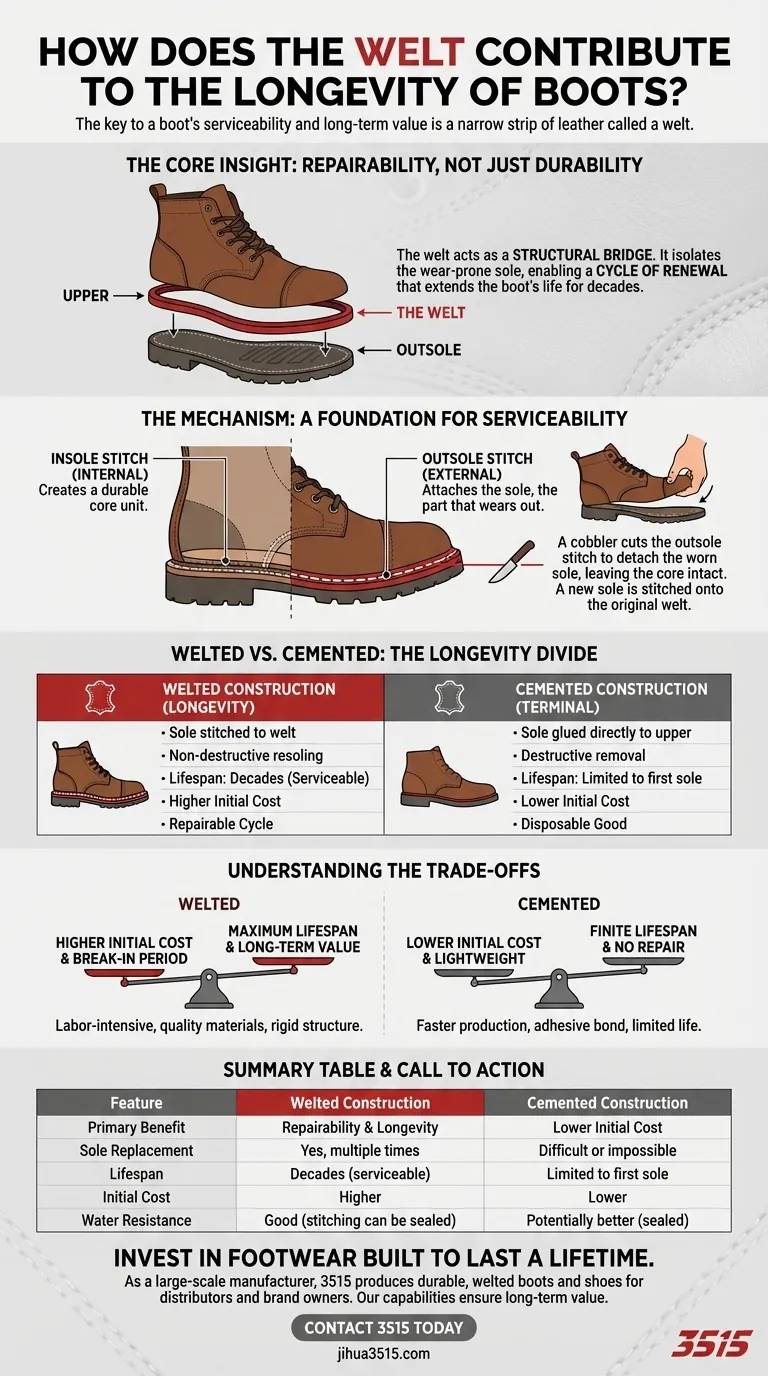
At the heart of a boot's longevity is a narrow strip of leather called a welt. Its function is not to add toughness for daily wear, but to serve as a structural bridge between the boot's upper and its outsole. This design allows the sole to be removed and replaced multiple times by a cobbler without compromising the boot's core integrity, transforming the footwear from a disposable good into a serviceable, long-term asset.
The critical insight is that a welt doesn't make a boot last longer by being more durable itself; it makes a boot last longer by making it repairable. It isolates the most wear-prone component—the sole—from the rest of the boot, enabling a cycle of renewal that can extend the boot's life for decades.
The Welt: A Foundation for Serviceability
To grasp why a welt is so crucial for longevity, we must look at it as a foundational piece of engineering. It fundamentally changes how a boot is constructed and, more importantly, how it can be deconstructed for repair.
The Stitching Mechanism
A welted boot is held together by two independent sets of stitches.
The first stitch, the insole stitch, runs on the inside of the boot. It masterfully connects the leather upper, the lining, and the insole to the welt itself. This creates a single, durable core unit.
The second stitch, the outsole stitch, is visible on the outside, running along the bottom edge of the welt and through the outsole. This is the stitch that attaches the part of the boot that contacts the ground.
Why This Design Is Revolutionary
When the sole of your boot inevitably wears thin, a cobbler simply cuts the outsole stitch.
This single action detaches the worn-out sole while leaving the critical insole stitch—and the entire upper structure of the boot—completely intact and undamaged. A new sole is then simply stitched onto the original welt, restoring the boot to full function.
Welted vs. Cemented: The Longevity Divide
The value of the welt is best understood when contrasted with the most common alternative: cemented construction. This comparison highlights a fundamental difference in design philosophy.
Cemented Construction (The Alternative)
In this method, the boot's outsole is attached directly to the upper using a strong, permanent adhesive. There is no welt and no structural stitching holding the sole in place.
The Problem with Glued Soles
This method is faster and cheaper, but it creates a terminal lifespan. When a glued sole wears out, removing it is a destructive process that often tears and damages the leather or fabric upper it was bonded to.
Resoling a cemented boot is often impossible, and even when it is, the repair is rarely as secure as the original bond. This effectively means the boot's life is limited to the life of its first and only sole.
Understanding the Trade-offs
While welted construction is superior for longevity, it is not without its considerations. An objective assessment requires acknowledging the trade-offs involved.
The Initial Cost
A welted boot is more complex and labor-intensive to produce. This manufacturing process, coupled with the use of more high-quality materials, results in a significantly higher initial purchase price.
Water Resistance
The stitching holes created by the outsole stitch can be a potential point for water to enter the boot. While quality construction, tight stitching, and proper care can mitigate this, a sealed, cemented boot may offer better out-of-the-box water resistance.
Break-In Period
The layered and stitched construction of a welted boot creates a more rigid and substantial structure. This often translates to a longer and more pronounced break-in period compared to more flexible, cemented footwear.
Making the Right Choice for Your Goal
The decision between a welted or non-welted boot depends entirely on your priorities. The welt is a feature that provides a specific, powerful benefit, but only if that benefit aligns with your intended use and ownership goals.
- If your primary focus is maximum lifespan and long-term value: Choose a welted boot, as it is the only construction method fundamentally designed to be repaired and rebuilt over many years.
- If your primary focus is lightweight performance and lower initial cost: A cemented boot is a practical choice, but you must accept its lifespan is finite and tied to its original sole.
- If your primary focus is a balance of durability and serviceability: Ensure your welted boot is made with high-quality components, like full-grain leather uppers and a durable sole, to maximize the time between repairs.
By understanding the welt, you can invest not just in a pair of boots, but in a piece of footwear engineered to last a lifetime.
Summary Table:
| Feature | Welted Construction | Cemented Construction |
|---|---|---|
| Primary Benefit | Repairability & Longevity | Lower Initial Cost |
| Sole Replacement | Yes, multiple times | Difficult or impossible |
| Lifespan | Decades (serviceable) | Limited to first sole |
| Initial Cost | Higher | Lower |
| Water Resistance | Good (stitching can be sealed) | Potentially better (sealed) |
Invest in footwear built to last a lifetime.
As a large-scale manufacturer, 3515 produces a comprehensive range of durable, welted boots and shoes for distributors, brand owners, and bulk clients. Our production capabilities ensure your customers receive footwear engineered for long-term value and serviceability.
Contact 3515 today to discuss how our manufacturing expertise can build longevity into your product line.
Visual Guide
Related Products
- Durable Goodyear Welt Leather Work Boots for Wholesale & Private Label
- Wholesale Durable Leather Work Boots | 8-Inch Goodyear Welt Manufacturer
- Wholesale Lightweight Tactical Boots Custom Manufacturer for Desert & Combat Use
- Durable Military Combat Boots with Water Drainage for Wholesale & OEM
- High-Traction Suede Tactical Boots Wholesale & Custom Manufacturing
People Also Ask
- What is the difference between full-grain and top-grain leather? Premium Material Guide for Boot Manufacturers
- What are the advantages of leather as an upper material for work boots? Unmatched Durability & Custom Comfort
- Why is it important to waterproof leather work boots? Protect Your Investment and Performance
- How should new leather work boots be broken in? A Guide to Comfort and Durability
- What are the advantages of leather uppers in work boots? Unmatched Durability & Protection



















