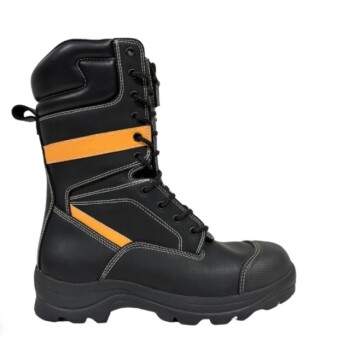
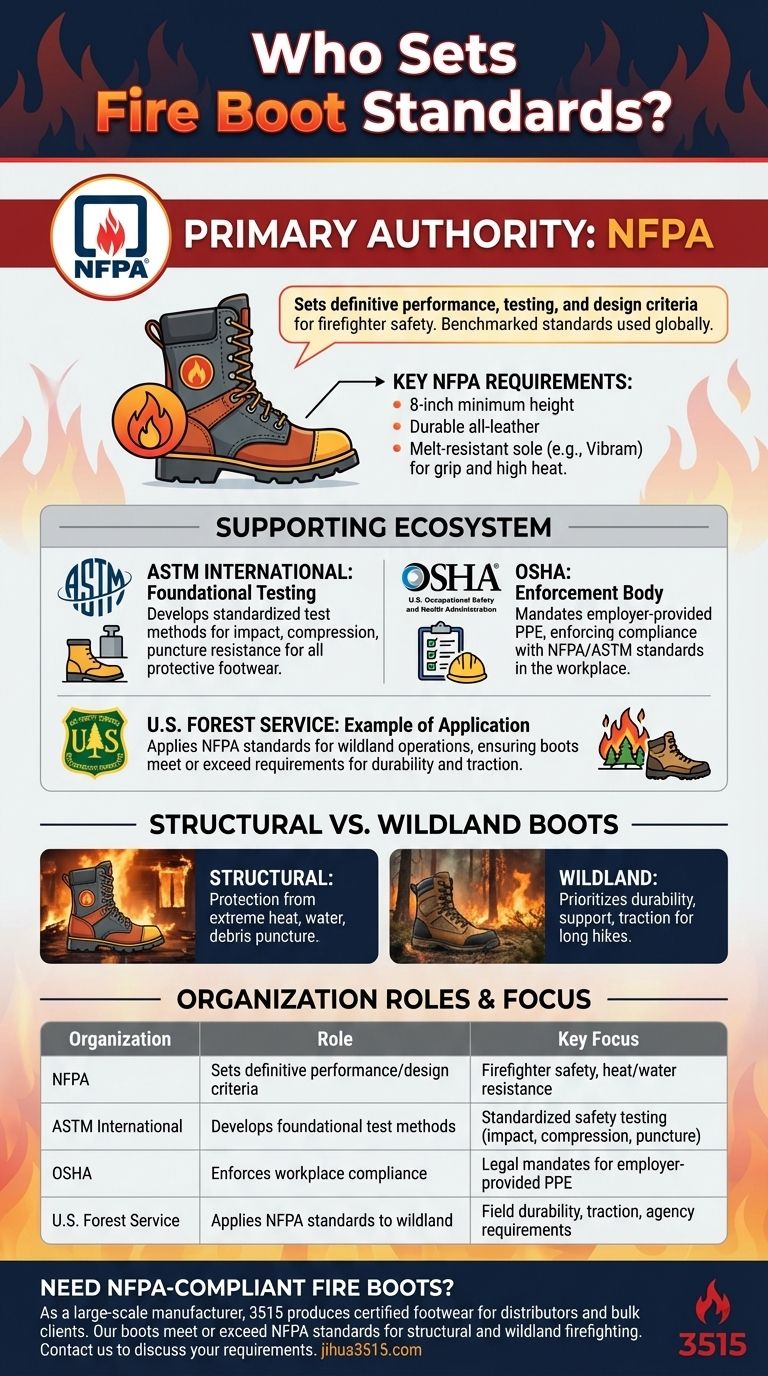
The primary organization that sets the definitive standards for fire boots in the United States is the National Fire Protection Association (NFPA). This independent body establishes the specific performance, testing, and design criteria that all compliant firefighting footwear must meet to ensure the safety and reliability of this critical personal protective equipment.
While the NFPA creates the specific standards for firefighting, it operates within a larger ecosystem. Foundational safety and testing methods are often developed by ASTM International, and compliance is legally mandated in the workplace by government bodies like OSHA.
The Role of the NFPA: The Definitive Authority
The NFPA is the central figure in fire boot safety. Its standards are comprehensive, research-based, and widely adopted as the benchmark for the industry.
What is the NFPA?
The National Fire Protection Association is a global nonprofit organization devoted to eliminating death, injury, and property loss due to fire and related hazards. It develops and publishes codes and standards that are used by fire departments and governments worldwide.
Key NFPA Requirements for Fire Boots
NFPA standards are highly detailed. For wildland and some other fire boots, they mandate specific features to handle harsh conditions.
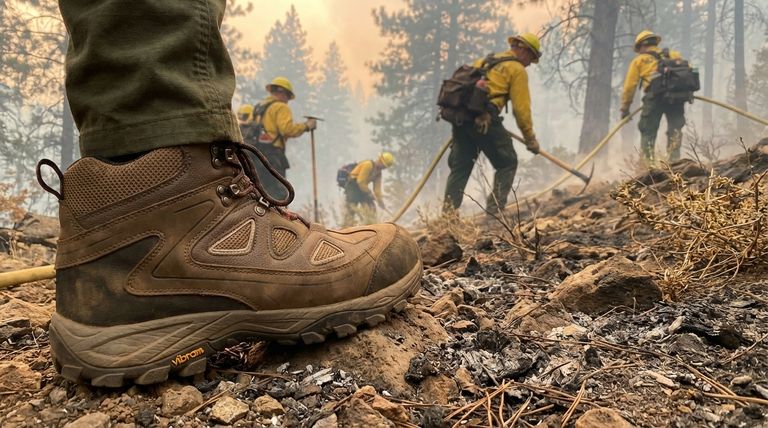
These often include a minimum height of 8 inches, durable all-leather construction, and a melt-resistant sole made from materials like Vibram to provide grip and prevent failure under high heat.
How Other Organizations Fit into the Picture
While the NFPA writes the specific rules for fire boots, other organizations play crucial roles in the broader landscape of safety footwear. Understanding them provides a complete picture of safety compliance.
ASTM International: The Foundation for Testing
The American Society for Testing and Materials (ASTM) develops and publishes a vast range of consensus standards. For footwear, it establishes the standardized test methods for things like impact, compression, and puncture resistance that protect workers from common workplace dangers.
OSHA: The Enforcement Body
The U.S. Occupational Safety and Health Administration (OSHA) is a government agency that sets and enforces workplace safety regulations. OSHA mandates that employers provide appropriate Personal Protective Equipment (PPE), and its guidelines often reference and require compliance with standards developed by the NFPA and ASTM.
The U.S. Forest Service: An Example of Application
Government agencies like the Forest Service act as the end-user. They don't set the national standard but create internal policies that require their firefighters to wear boots that meet or exceed the established NFPA standards for wildland firefighting.
Understanding the Key Distinction
Not all fire boots are the same, because not all firefighting is the same. The standards reflect the specific hazards of the job.
Structural vs. Wildland Boots
The demands on a boot for a building fire (structural) are very different from those for a forest fire (wildland). NFPA has separate, specific standards for each.
Structural boots require more protection from extreme heat, water, and puncture from debris. Wildland boots prioritize durability, support, and traction for hiking long distances over rugged terrain.
"Meets or Exceeds NFPA Standards"
This phrase is a critical indicator of quality and safety. It signifies that the footwear has been rigorously tested and certified to perform reliably under the extreme conditions outlined in the relevant NFPA standard.
How to Ensure Your Boots Are Compliant
Selecting the right boot comes down to matching its certification to your specific role and environment.
- If your primary focus is structural firefighting: You must select boots that are explicitly certified to the current NFPA standard for structural fire gear.
- If your primary focus is wildland firefighting: Look for boots that meet the specific NFPA standard for wildland operations and any additional requirements from your agency.
- If you are managing general workplace safety: Your focus will be on ensuring boots meet the broader ASTM standards for impact and compression, as required by OSHA.
By understanding the roles of these key organizations, you can confidently select footwear that guarantees both compliance and safety for the task at hand.
Summary Table:
| Organization | Role in Fire Boot Standards | Key Focus |
|---|---|---|
| NFPA | Sets definitive performance and design criteria | Firefighter safety, heat/water resistance, specific boot construction |
| ASTM International | Develops foundational test methods (impact, compression, puncture) | Standardized safety testing for all protective footwear |
| OSHA | Enforces workplace compliance with NFPA/ASTM standards | Legal mandates for employer-provided PPE |
| U.S. Forest Service | Applies NFPA standards to wildland firefighting operations | Field durability, traction, and agency-specific requirements |
Need NFPA-compliant fire boots for your team? As a large-scale manufacturer, 3515 produces a comprehensive range of certified footwear for distributors, brand owners, and bulk clients. Our production capabilities encompass all types of structural and wildland boots that meet or exceed NFPA standards, ensuring your personnel are equipped with reliable, safety-tested gear. Contact us today to discuss your specific requirements and leverage our expertise in protective footwear manufacturing.
Visual Guide
Related Products
- High Performance Fire-Retardant Waterproof Safety Boots
- Premium Flame-Retardant Waterproof Safety Boots and Shoes
- Wholesale Lightweight Tactical Boots Custom Manufacturer for Desert & Combat Use
- High-Traction Suede Tactical Boots Wholesale & Custom Manufacturing
- Wholesale Waterproof Tactical Boots Custom Suede & High-Traction Soles
People Also Ask
- Why are waterproof safety boots recommended for certain work environments? Essential Protection for Wet & Hazardous Jobs
- What roles do 3D vision systems and industrial robots play in the manufacturing of fire safety boots? Smart Automation
- What should you look for to ensure boots are fully waterproof? The Essential 2-Part System
- What are the drawbacks of waterproof boots? The Breathability vs. Protection Trade-Off
- What materials make waterproof boots durable? The Ultimate Guide to Long-Lasting Footwear