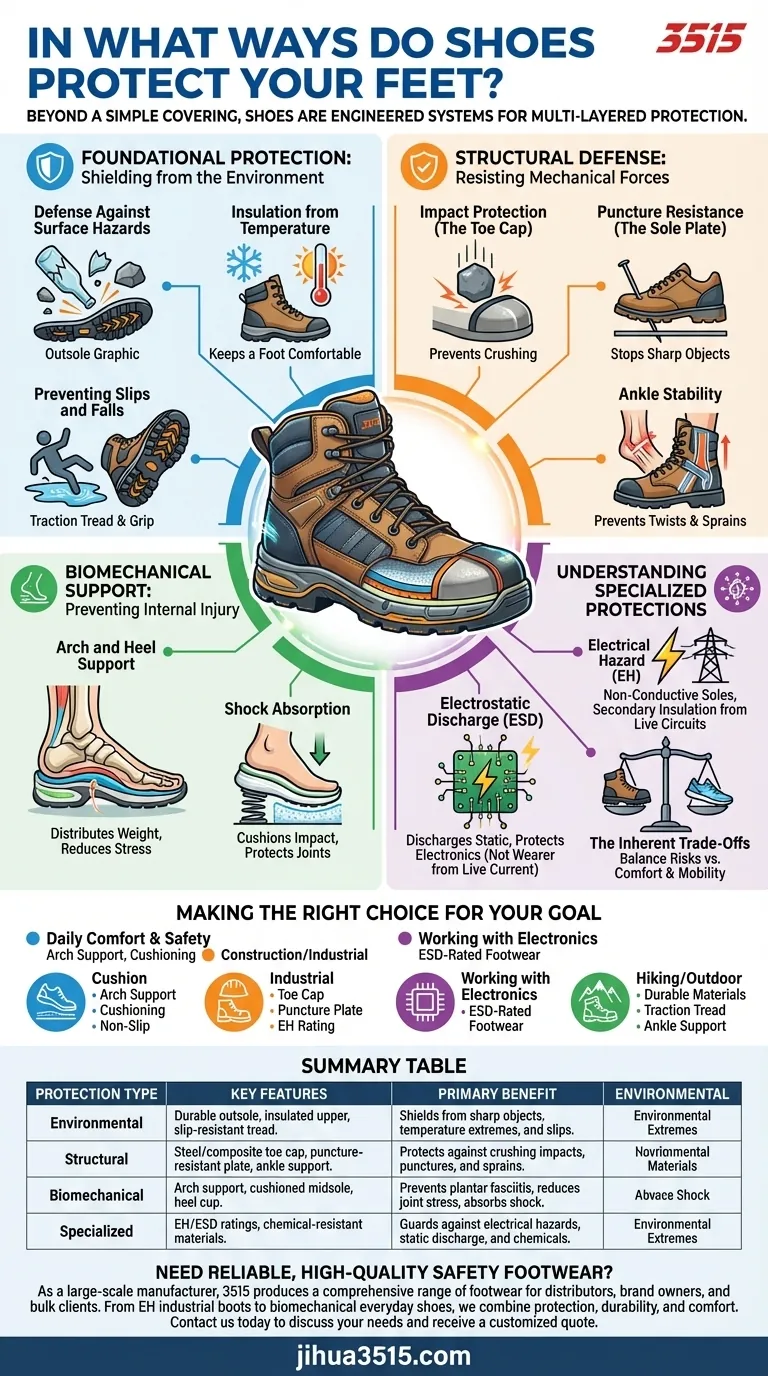
Beyond a simple covering, shoes are engineered systems designed to provide multi-layered protection for your feet. They serve as a critical barrier against environmental elements like heat and sharp objects, offer biomechanical support to prevent sprains and fractures, and can be specialized to guard against unique workplace hazards such as electrical shock or punctures.
The protective value of a shoe is not a single feature, but a combination of specific components. Understanding how the outsole, midsole, toe cap, and upper materials work together is the key to selecting footwear that truly mitigates risk.
Foundational Protection: Shielding from the Environment
The most basic function of any shoe is to create a barrier between your foot and the world. This protection is fundamental to preventing everyday injuries and discomfort.
Defense Against Surface Hazards
The outsole and upper work in tandem to shield you from common dangers. They provide a durable barrier against sharp objects like broken glass, rocks, or loose nails you might encounter on the ground.
Insulation from Temperature
Shoes protect your feet from the elements, whether it's the cold of snow or the heat radiating from hot pavement. This insulation is crucial for preventing frostbite in winter and burns or heat exhaustion in summer.
Preventing Slips and Falls
A shoe's outsole is engineered for traction. Specific tread patterns and rubber compounds are designed to grip surfaces and resist slipping, which is one of the most common causes of workplace and daily life injuries.
Structural Defense: Resisting Mechanical Forces
For more demanding environments, shoes incorporate specific structural components designed to absorb impacts and prevent penetration from severe physical threats.
Impact Protection (The Toe Cap)
Many work and safety boots feature a reinforced toe cap, often made of steel or lighter composite materials. This component is designed to protect the toes from being crushed by heavy falling or rolling objects.
Puncture Resistance (The Sole Plate)
To safeguard the bottom of the foot, puncture-resistant plates are embedded between the insole and outsole. These plates, often made of steel or flexible composites, are vital for stopping sharp objects like nails from piercing the sole.
Ankle Stability
Higher-shaft boots provide crucial support for the ankles. This structural stability helps prevent twists, sprains, and strains, especially when walking on uneven terrain or carrying heavy loads.
Biomechanical Support: Preventing Internal Injury
Properly designed footwear does more than just block external threats; it supports the complex structure of your foot to prevent strain and long-term injury.
Arch and Heel Support
A well-constructed shoe provides foundational support for your arches and cups the heel. This alignment helps distribute your body weight evenly, reducing stress on the plantar fascia and preventing common conditions like plantar fasciitis.
Shock Absorption
Midsoles, often made from foam or gel-like materials, are designed to absorb and dissipate the shock generated by walking and running. This cushioning reduces the impact stress that travels up through your ankles, knees, and back.
Understanding Specialized Protections
Beyond general safety, many shoes are engineered to counter specific, often unseen, workplace risks. It's crucial to understand these distinctions as they are not interchangeable.
Electrostatic Discharge (ESD)
ESD-rated shoes are designed to safely discharge static electricity from your body to the ground. Their primary purpose is to protect sensitive electronic components from being damaged by a static shock, not to protect the wearer from live currents.
Electrical Hazard (EH)
In contrast, Electrical Hazard (EH) rated footwear is built with non-conductive soles and heels. These shoes are designed to protect the wearer by providing a secondary source of insulation from accidental contact with live electrical circuits.
The Inherent Trade-Offs
No single shoe can offer maximum protection in all categories. A heavily armored steel-toe boot provides incredible impact resistance but is heavy and inflexible. A lightweight running shoe offers excellent shock absorption and flexibility but zero puncture or impact protection. Choosing the right shoe always involves balancing the most likely risks of your environment against your need for comfort and mobility.
Making the Right Choice for Your Goal
Selecting the correct footwear requires matching its protective features to your specific activities and environment.
- If your primary focus is daily comfort and general safety: Prioritize footwear with excellent arch support, a cushioned midsole, and a reliable non-slip outsole.
- If your primary focus is construction or industrial work: A safety-rated boot with a reinforced toe cap, puncture-resistant plate, and EH rating is essential.
- If your primary focus is working with sensitive electronics: ESD-rated footwear is non-negotiable to prevent component damage from static discharge.
- If your primary focus is hiking or outdoor activities: Look for durable, weather-resistant materials, aggressive tread for traction, and strong ankle support.
Understanding these layers of protection empowers you to choose footwear not just for style, but as a critical tool for your long-term safety and well-being.
Summary Table:
| Protection Type | Key Features | Primary Benefit |
|---|---|---|
| Environmental | Durable outsole, insulated upper, slip-resistant tread | Shields from sharp objects, temperature extremes, and slips |
| Structural | Steel/composite toe cap, puncture-resistant plate, ankle support | Protects against crushing impacts, punctures, and sprains |
| Biomechanical | Arch support, cushioned midsole, heel cup | Prevents plantar fasciitis, reduces joint stress, absorbs shock |
| Specialized | EH/ESD ratings, chemical-resistant materials | Guards against electrical hazards, static discharge, and chemicals |
Need Reliable, High-Quality Safety Footwear?
As a large-scale manufacturer, 3515 produces a comprehensive range of footwear for distributors, brand owners, and bulk clients. Our production capabilities encompass all types of shoes and boots—from durable industrial safety boots with EH ratings and puncture-resistant soles to comfortable everyday footwear with superior biomechanical support.
We help you mitigate risk and enhance workforce safety with footwear that combines proven protection, durability, and comfort. Whether you need specialized ESD shoes for electronics manufacturing or heavy-duty boots for construction sites, we deliver solutions tailored to your specific hazards and environment.
Contact us today to discuss your footwear needs and receive a customized quote.
Visual Guide
Related Products
- Premium Suede Sport Safety Shoes for Wholesale & Bulk Orders
- Premium Lightweight Safety Shoes for Wholesale & Bulk Orders
- Wholesale Anti-Smash & Puncture-Proof Safety Shoes Custom Manufacturing for Brands
- Premium KPU Injection Athletic Style Safety Shoes
- Premium Safety Shoes with Rotating Buckle Safety Sneakers
People Also Ask
- What industries have specific OSHA footwear requirements? Ensure Compliance & Protect Your Workforce
- What are the primary functions of professional safety shoes? Maximize Safety in Water Supply Confined Spaces
- What role do specialized safety shoes play in preventing falls? Engineering Stability in Industrial Environments
- Why should ergonomics and comfort be prioritized when selecting safety shoes? Boost Compliance & Worker Health
- How do gait analysis algorithms ensure accuracy in footwear? Master Step Length Precision for Boots & Sneakers