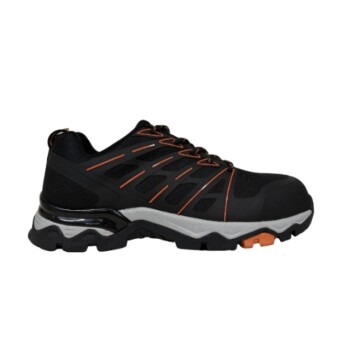
The cylindrical load platform acts as the foundational interface for applying vertical force in slip resistance testing. It serves as the primary support base for the shoe outsole material, ensuring that any weight applied is distributed uniformly across the test sample. Its critical function is to maintain horizontal stability while effectively transferring specific weights to the footwear material.
Core Takeaway The platform allows a static test setup to mimic dynamic human movement. By ensuring uniform pressure distribution and stability, it simulates the actual mechanical logic of walking, transforming raw weight into valid data regarding how a safety shoe interacts with the ground.
The Mechanics of the Setup
Uniform Load Distribution
The accuracy of a friction test depends entirely on how force is applied. The cylindrical load platform serves as a support base that prevents pressure from concentrating in a single area.
By flattening the distribution of force, it ensures the outsole material is tested evenly. This prevents localized pressure points that could artificially inflate or deflate friction readings.
Simulating Human Body Pressure
Safety shoes are designed to prevent falls, but testing them requires replicating the user's weight. The platform is designed to hold specific weights that mimic the mass of a human body.
This setup aligns the test with the "mechanical logic" of walking. It ensures the downward pressure on the shoe sample matches what a worker would actually exert on a floor surface.
Maintaining Horizontal Stability
During a slip test, the shoe material is subjected to lateral (side-to-side) movement or force. The platform anchors the sample, ensuring it remains horizontally stable throughout the process.
Without this stability, the sample might tilt or shift. This would result in data measuring the equipment's instability rather than the shoe's slip resistance.
Understanding the Trade-offs
The Necessity of Precision
While the platform simulates human weight, it is a simplified mechanical proxy. The simulation is only as accurate as the load applied. If the weights placed on the platform do not accurately reflect the intended user demographic, the resulting friction data may not translate to real-world safety.
Component Alignment
The "cylindrical" nature of the platform implies a need for perfect geometric alignment. Any deviation in the platform's surface can disrupt the uniform distribution of loads. This introduces variables that compromise the integrity of the test, making the "mechanical logic" flawed.
Ensuring Experimental Validity
To maximize the reliability of your slip resistance data, ensure the cylindrical load platform is utilized correctly regarding your specific testing goals.
- If your primary focus is Data Accuracy: Ensure the platform surface is perfectly level to guarantee that vertical loads remain uniformly distributed across the entire outsole sample.
- If your primary focus is Realism: Verify that the specific weights placed on the platform accurately calculate the pressure exerted by the standard body weight of the target workforce.
The cylindrical load platform is the essential bridge between a static material sample and the dynamic reality of workplace safety.
Summary Table:
| Feature | Function in Slip Testing | Importance for Experimental Validity |
|---|---|---|
| Force Distribution | Ensures uniform pressure across the outsole | Prevents localized pressure points from skewing data |
| Load Simulation | Holds specific weights to mimic human body mass | Aligns test results with real-world walking mechanics |
| Lateral Anchoring | Maintains horizontal stability of the sample | Eliminates data noise caused by tilting or shifting |
| Geometric Design | Provides a standardized mechanical interface | Guarantees consistent alignment for repeatable results |
Partner with 3515 for High-Performance Safety Footwear
As a large-scale manufacturer serving global distributors and brand owners, 3515 leverages advanced mechanical testing logic to deliver footwear that meets the highest safety standards. Our comprehensive production capabilities allow us to anchor our flagship Safety Shoes series with unmatched slip resistance and durability.
Beyond safety footwear, our extensive portfolio includes:
- Work and Tactical Boots for extreme environments
- Outdoor and Training Shoes for performance and comfort
- Sneakers, Dress & Formal Shoes for diverse bulk requirements
Ready to elevate your product line with precision-engineered footwear? Contact us today to discuss your bulk manufacturing needs and discover the value of partnering with an industry leader.
References
- Murat DİKER, Engin Ergül. Determination of The Static Friction Coefficient of Some Materials Used for Anti-slip Safety with ANOVA. DOI: 10.29137/umagd.1182843
This article is also based on technical information from 3515 Knowledge Base .
Related Products
- Premium Suede Sport Safety Shoes for Wholesale & Bulk Orders
- Premium Lightweight Safety Shoes for Wholesale & Bulk Orders
- Wholesale Anti-Smash & Puncture-Proof Safety Shoes Custom Manufacturing for Brands
- Premium KPU Injection Athletic Style Safety Shoes
- Premium Safety Shoes with Rotating Buckle Safety Sneakers
People Also Ask
- What are the primary functions of professional safety shoes? Maximize Safety in Water Supply Confined Spaces
- What industries have specific OSHA footwear requirements? Ensure Compliance & Protect Your Workforce
- What role do specialized safety shoes play in preventing falls? Engineering Stability in Industrial Environments
- Why must safety training be synchronized with the provision of physical safety shoes? Achieve Optimal Workplace Protection
- What are the technical advantages of integrating sensors into safety shoes? Achieve Superior Motion Capture Precision