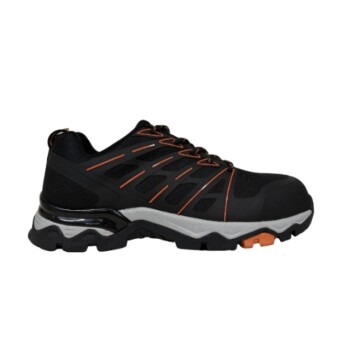
The specific protective mechanism of safety shoes is a rigid, reinforced toe cap designed to withstand significant impact and compression forces. unlike safety helmets, which rely on a suspension buffer system to absorb shock from falling objects, or industrial goggles that shield against liquid splashes and infrared radiation, safety shoes provide a hardened physical barrier. This ensures the feet remain secure against crushing injuries during the manual or mechanical handling of heavy metal blocks.
The core distinction lies in the engineering approach: while headgear focuses on energy absorption and eyewear on deflection, safety shoes function as a non-deformable shield. They isolate the foot’s structure from crushing weights and, in smelting contexts, serve as a critical thermal barrier against conductive heat.
Distinct Mechanical Principles
The Rigid Shield vs. The Buffer System
The primary protective element in safety shoes is the reinforced toe cap. This component acts as a hard shell intended to maintain its shape under duress.
In contrast, safety helmets typically employ a buffer system. This internal suspension absorbs the kinetic energy of a falling object, dissipating the shock before it reaches the skull.
Addressing Compression Hazards
While helmets and goggles protect against transient threats (like a falling stone or a splash), safety shoes must address sustained compression.
In a smelting workshop, the risk involves heavy metal blocks or machinery resting on the foot. The toe cap provides a dedicated structural void that prevents the toes from being crushed, a function no other PPE is designed to perform.
The Smelting Environment Context
Thermal Insulation Mechanisms
Beyond impact, the smelting environment introduces extreme heat. Industrial safety shoes utilize high-temperature resistant outsoles.
These outsoles act as a thermal barrier, preventing conductive heat from the floor or hot materials from traveling up into the foot. This differs from goggles, which primarily filter infrared radiation rather than blocking conductive heat transfer.
Molten Metal Defense
Safety shoes in this sector are engineered to resist the penetration of high-temperature liquids, such as molten aluminum.
While goggles protect the eyes from the trajectory of a splash, safety shoes must maintain structural integrity even when submerged or covered in molten material to prevent severe thermal burns.
Understanding the Trade-offs
Limits of Protection
It is critical to understand that the protective toe cap is not infinitely resistant. Standard safety shoes (EN ISO 345) typically feature a 200-joule impact resistance.
Forces exceeding this limit can compromise the cap, leading to failure. The mechanism is designed for accidental drops and compression, not for stopping massive industrial presses.
Specificity of Design
Not all "work shoes" offer this mechanism. Shoes categorized merely as "work shoes" (EN ISO 347) lack the toe cap entirely.
Furthermore, a shoe designed for impact may not possess the anti-static or high-heat resistant properties required for specific smelting zones. Using a general-purpose safety shoe in a high-heat casting zone compromises the thermal barrier functionality.
Making the Right Choice for Your Workshop
Selecting the correct footwear requires analyzing the primary hazards of your specific station within the smelting plant.
- If your primary focus is heavy material handling: Prioritize footwear with EN ISO 345 compliant reinforced toe caps to ensure maximum protection against crushing injuries.
- If your primary focus is furnace operations: Ensure the footwear specifies high-temperature resistant outsoles and molten metal penetration resistance to prevent thermal injury.
- If your primary focus is general maintenance: Verify the presence of anti-puncture midsoles along with the standard toe cap to protect against sharp debris on the floor.
True safety is achieved only when the mechanical attributes of the gear align precisely with the physical realities of your environment.
Summary Table:
| PPE Type | Primary Protective Mechanism | Key Hazard Addressed |
|---|---|---|
| Safety Shoes | Rigid Toe Cap & Thermal Outsole | Crushing, Compression & Conductive Heat |
| Safety Helmets | Suspension Buffer System | Impact & Kinetic Energy Absorption |
| Goggles | Deflection Shield/Infrared Filter | Liquid Splashes & Radiation |
| Safety Boots (Smelting) | Molten Metal Resistance | Thermal Burns from High-Temp Liquids |
Secure Your Workforce with Premium Industrial Footwear
As a large-scale manufacturer serving global distributors and brand owners, 3515 offers comprehensive production capabilities for all footwear types. Our flagship Safety Shoes series is engineered to meet the rigorous demands of smelting and industrial environments, ensuring maximum protection through reinforced toe caps and heat-resistant technology.
Our extensive portfolio covers:
- Heavy-Duty Safety Shoes (EN ISO 345 compliant)
- Tactical & Work Boots
- Outdoor & Training Shoes
- Dress & Formal Shoes for bulk requirements
Ready to elevate your product standards? Contact us today to discuss how our manufacturing expertise can provide the durability and safety your customers demand.
References
- Syahrul Faiz, Ferida Yuamita. Identifikasi Potensi Bahaya pada Area Peleburan Logam Menggunakan Metode Hazard Identification Risk Assesment And Risk Control (HIRARC) dan Fault Tree Analysis (FTA) di CV. Barokah Logam Sejahtera. DOI: 10.56799/jim.v2i8.2007
This article is also based on technical information from 3515 Knowledge Base .
Related Products
- Premium Suede Sport Safety Shoes for Wholesale & Bulk Orders
- Premium Lightweight Safety Shoes for Wholesale & Bulk Orders
- Wholesale Anti-Smash & Puncture-Proof Safety Shoes Custom Manufacturing for Brands
- Premium KPU Injection Athletic Style Safety Shoes
- Premium Safety Shoes with Rotating Buckle Safety Sneakers
People Also Ask
- What are the primary functions of professional safety shoes? Maximize Safety in Water Supply Confined Spaces
- What industries have specific OSHA footwear requirements? Ensure Compliance & Protect Your Workforce
- What role do specialized safety shoes play in preventing falls? Engineering Stability in Industrial Environments
- Why is barefoot walking used as a baseline in gait safety research? Unlocking Natural Biomechanics for Shoe Design
- How do the 3R principles influence green footwear design? Master Sustainable Safety Shoe Manufacturing