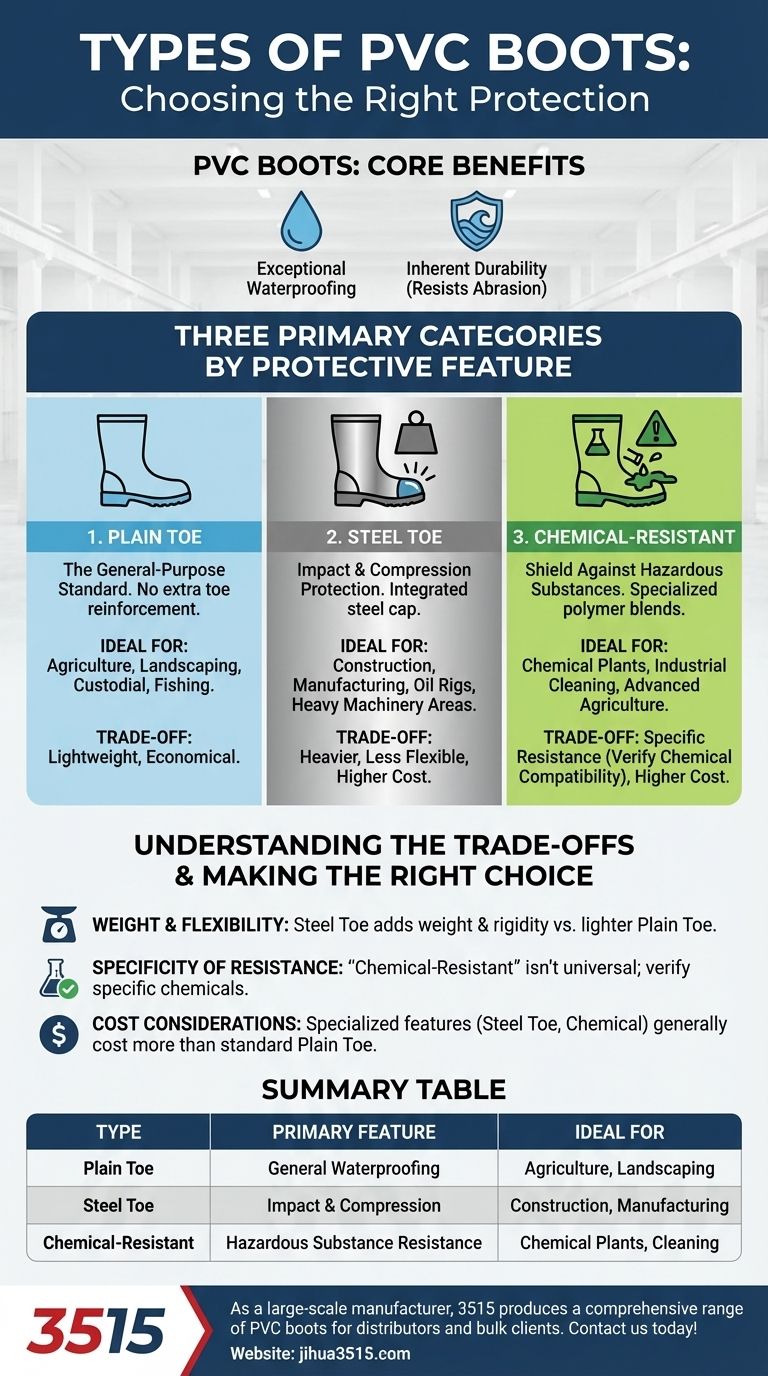
At their core, PVC boots are categorized by their specific protective features. The primary types are plain toe for general use, steel toe for impact protection, and chemical-resistant for handling hazardous substances, each designed to meet distinct workplace safety standards.
The most critical factor in choosing a PVC boot is not the boot itself, but the environment you work in. Matching the boot’s specific features—impact resistance, chemical barriers, or general waterproofing—to your daily tasks is essential for both safety and efficiency.
The Foundation: What All PVC Boots Offer
Before examining the differences, it's important to understand the universal benefits of polyvinyl chloride (PVC) construction. This material provides a baseline of reliable protection for a wide range of industries.
Exceptional Waterproofing
The primary advantage of PVC is its seamless, non-porous nature. This creates a completely waterproof barrier, ensuring your feet remain dry and comfortable in even the most wet and muddy conditions.
Inherent Durability
PVC is a robust material designed for heavy-duty use. It resists abrasion and wear, making it a long-lasting option for demanding indoor and outdoor work environments, from farms to food processing plants.
Key Types of PVC Boots by Protective Feature
The fundamental differences between PVC boots emerge from the specific hazards they are engineered to mitigate. Your choice depends entirely on the risks present in your workplace.
Plain Toe: The General-Purpose Standard
This is the most common type of PVC boot. It offers all the standard benefits of PVC—waterproofing and durability—without additional reinforcement in the toe.
These boots are ideal for jobs where the main hazards are water, mud, and dirt, but not falling objects. They are frequently used in general agriculture, fishing, custodial work, and landscaping.
Steel Toe: Protection Against Impact and Compression
For environments where heavy objects, rolling equipment, or compression risks are present, steel-toe boots are the required standard. A steel cap is integrated into the toe of the boot to protect the foot from serious injury.
This type is non-negotiable on construction sites, oil rigs, and in certain manufacturing or food processing facilities where machinery and heavy materials are constantly in motion.
Chemical-Resistant: A Shield Against Hazardous Substances
While all PVC offers some resistance, specialized chemical-resistant boots are formulated with specific polymer blends to withstand degradation from chemicals, fertilizers, and other caustic materials.
These are critical for workers in chemical processing plants, advanced agricultural operations, and industrial cleaning roles where direct contact with hazardous substances is a daily reality.
Understanding the Trade-offs
Selecting the right boot involves balancing protection with practicality. Each specialized feature comes with its own set of considerations.
Weight and Flexibility
A steel toe adds significant weight and rigidity to a boot. While essential for safety, this can lead to greater fatigue over a long workday compared to a lighter, more flexible plain-toe model.
Specificity of Resistance
The term "chemical-resistant" is not a universal guarantee. Different PVC formulations protect against different chemicals. Always verify that a boot is rated to handle the specific substances you will be exposed to.
Cost Considerations
As protective features become more specialized, the cost of the boot generally increases. A standard plain-toe boot is the most economical option, while certified steel-toe and specialized chemical-resistant boots represent a greater investment in safety.
Making the Right Choice for Your Task
Your final decision should be guided by a clear assessment of your primary work environment and its associated risks.
- If your primary focus is general protection from water and mud: A plain-toe PVC boot offers the most practical and cost-effective solution for keeping your feet dry.
- If your primary focus is safety in environments with heavy objects: A steel-toe PVC boot is the only acceptable choice to protect against serious impact and compression injuries.
- If your primary focus is handling potentially hazardous materials: A chemical-resistant PVC boot is essential, and you must confirm its specific resistance rating matches your workplace chemicals.
Ultimately, choosing the correct PVC boot is a fundamental decision that directly impacts your safety and comfort on the job.
Summary Table:
| Type of PVC Boot | Primary Protective Feature | Ideal For |
|---|---|---|
| Plain Toe | General waterproofing & durability | Agriculture, landscaping, custodial work |
| Steel Toe | Impact & compression protection | Construction, manufacturing, oil rigs |
| Chemical-Resistant | Resistance to hazardous substances | Chemical plants, industrial cleaning, farming |
As a large-scale manufacturer, 3515 produces a comprehensive range of PVC boots for distributors, brand owners, and bulk clients. We offer plain toe, certified steel toe, and specialized chemical-resistant models to meet your exact safety and durability needs. Ensure your workforce has the right protection for any environment—contact us today to discuss your requirements and get a quote!
Visual Guide
Related Products
- Premium Wholesale Waterproof Safety Boots High Performance Protection for Industrial Markets
- High-Traction Suede Tactical Boots Wholesale & Custom Manufacturing
- High Performance Fire-Retardant Waterproof Safety Boots
- Wholesale Waterproof Tactical Boots Custom Suede & High-Traction Soles
- Premium Waterproof High-Cut Industrial Safety Boots for Wholesale and Bulk Orders
People Also Ask
- What weather and chemical protections do premium boots offer? Your Complete Guide to Safety & Performance
- Why are waterproof safety boots recommended for certain work environments? Essential Protection for Wet & Hazardous Jobs
- What are the primary protective functions of industrial safety boots in oil palm plantations? Master Rough Terrain Safety
- Why are oil-resistant and anti-slip properties critical for industrial safety boots? Expert Outsole Engineering Guide
- What are the best types of shoes for different gardening conditions? Find Your Perfect Match.