
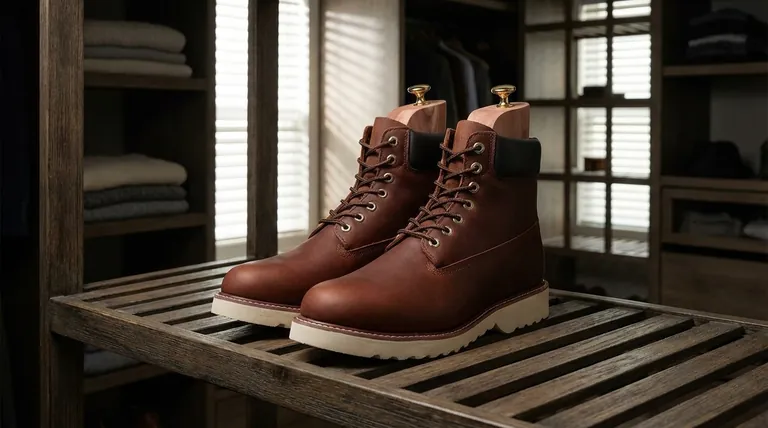
The single best practice for storing leather work boots is to place them on cedar boot trees in a cool, dry, and dark environment with good air circulation. This combination actively maintains the boot's shape, manages moisture, and protects the leather from environmental damage.
Your work boots are an investment in your safety and comfort. Proper storage isn't a passive activity—it is the essential, final step in boot maintenance that directly determines their lifespan and performance.
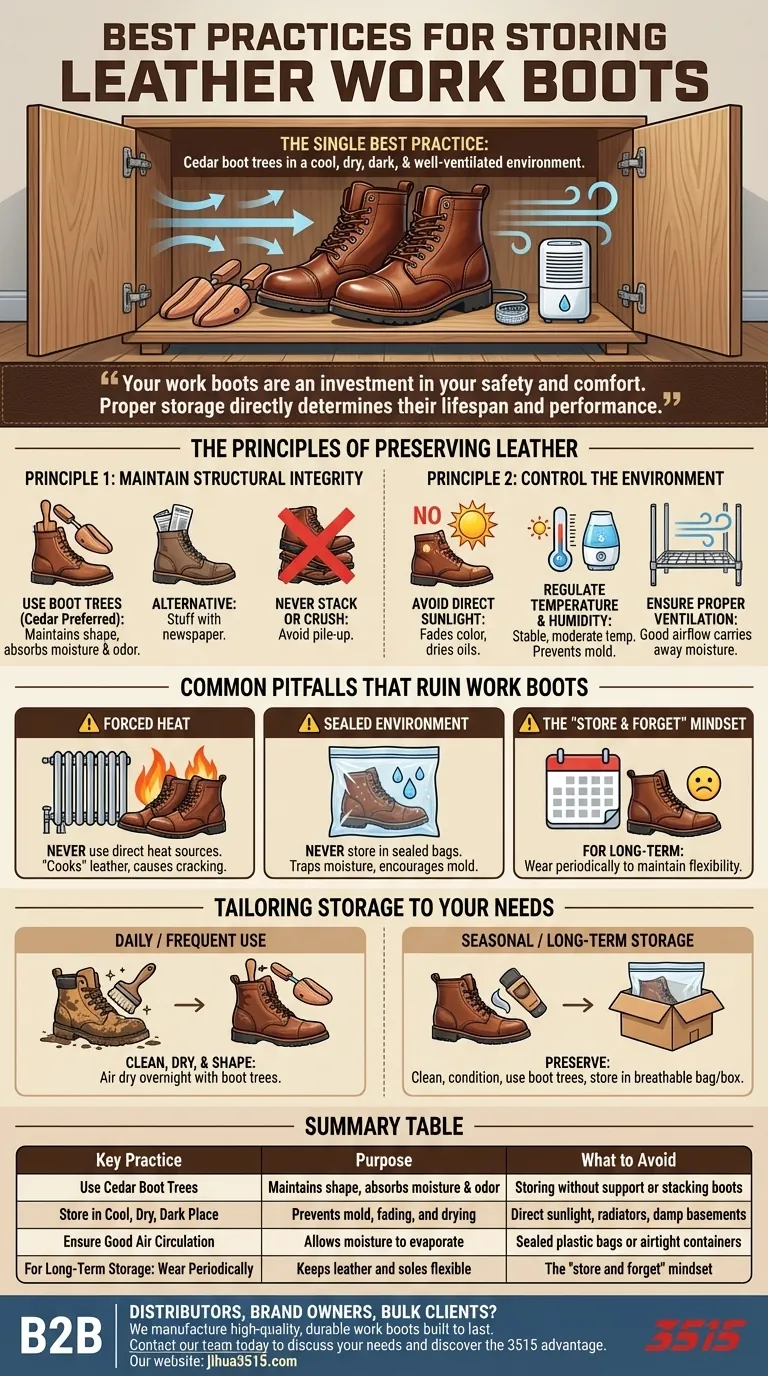
The Principles of Preserving Leather
Leather is a natural material that reacts to its environment. To protect it, you must control three key factors: its physical shape, the ambient conditions, and its internal moisture level.
Principle 1: Maintain Structural Integrity
A boot's structure is critical for support and comfort. Storing it improperly will cause the leather to crease, sag, and permanently lose its intended shape.
Use Boot Trees. This is the most crucial step. A boot tree, preferably made of unfinished cedar, maintains the boot's form, smooths out creases where sweat and dirt accumulate, and absorbs residual moisture and odor.
Consider Alternatives. If you don't have boot trees, stuffing the boots tightly with newspaper is a viable alternative. It helps hold the shape and absorbs some moisture, though less effectively than cedar.
Never Stack or Crush. Avoid storing boots in a pile or placing heavy objects on top of them. This pressure will deform the leather and can permanently damage the boot's supportive structure.
Principle 2: Control the Environment
The storage location has a direct and significant impact on the health of the leather. The wrong environment can cause irreversible damage in a matter of weeks.
Avoid Direct Sunlight. UV rays will fade the leather's color and, more importantly, dry out its natural oils. This leads to the material becoming brittle and prone to cracking.
Regulate Temperature and Humidity. Store your boots in a place with a stable, moderate temperature. Extreme heat can dry and shrink leather, while damp, humid areas (like a basement or unventilated closet) are breeding grounds for mold and mildew.
Ensure Proper Ventilation. Good airflow is essential to carry away any lingering moisture from a day's work. A wire shelf is superior to a solid one, and an open closet is better than a sealed plastic container.
Common Pitfalls That Ruin Work Boots
Many well-intentioned owners destroy their boots by making one of these common storage mistakes. Understanding what not to do is as important as knowing what to do.
The Mistake of Forced Heat
Never try to speed up the drying process by placing wet boots near a direct heat source like a radiator, campfire, or heater vent.
Forced, intense heat "cooks" the leather. It rapidly draws out essential oils, causing the material to become stiff, shrink, and crack, fundamentally ruining the boot's integrity.
The Danger of a Sealed Environment
Storing boots for the long term in a sealed plastic bag or airtight container is a mistake. This traps any residual moisture against the leather, creating a perfect environment for mold to grow and for the boot's adhesives and sole materials to decompose.
The "Store and Forget" Mindset
Leather needs to flex to maintain its properties. If you are storing boots for an entire season or longer, it's not a one-time event.
For very long-term storage, take the boots out once every month or two and wear them for a short period. This small action keeps the materials from becoming brittle and helps maintain the sole's flexibility.
Tailoring Storage to Your Needs
Your storage strategy should adapt based on how frequently you use your boots.
- For daily or frequent use: Your primary focus should be on drying and shaping. After each wear, clean off loose dirt and immediately insert cedar boot trees to let them air dry overnight in a well-ventilated spot.
- For seasonal or long-term storage: Your focus is on preservation. Thoroughly clean and condition the leather, insert boot trees, and place them in a breathable dust bag or their original box in a climate-controlled part of your home.
Properly storing your boots is the final act of care that ensures your investment remains ready for work, season after season.
Summary Table:
| Key Practice | Purpose | What to Avoid |
|---|---|---|
| Use Cedar Boot Trees | Maintains shape, absorbs moisture & odor | Storing without support or stacking boots |
| Store in Cool, Dry, Dark Place | Prevents mold, fading, and drying | Direct sunlight, radiators, damp basements |
| Ensure Good Air Circulation | Allows moisture to evaporate | Sealed plastic bags or airtight containers |
| For Long-Term Storage: Wear Periodically | Keeps leather and soles flexible | The "store and forget" mindset |
Are you a distributor, brand owner, or bulk client in need of high-quality, durable work boots? As a large-scale manufacturer, 3515 produces a comprehensive range of footwear designed for performance and longevity. Our production capabilities encompass all types of safety and work boots built to last. Let us help you equip your customers with the best. Contact our team today to discuss your footwear needs and discover the 3515 advantage.
Visual Guide
Related Products
- Durable Leather Work Boots for Wholesale & Custom Manufacturing
- Wholesale Leather Work Boots with Customizable Wedge Sole for Brands
- Durable Leather Work Boots for Wholesale & Custom OEM Manufacturing
- Durable Leather Work Boots Wholesale Manufacturer & Custom Factory
- Durable Goodyear Welt Leather Work Boots for Wholesale & Private Label
People Also Ask
- What is the difference between full-grain and top-grain leather? Premium Material Guide for Boot Manufacturers
- What are the common workplace hazards that can be mitigated with the right work boots? Protect Your Workforce
- What are the common foot issues workers face due to uncomfortable work boots? Prevent Pain & Deformities
- What are the advantages of leather versus synthetic work boots? A Guide to Choosing the Right Material
- What are the key components of modern work boots? Engineered for Ultimate Durability and Comfort













