At their core, motorcycle boots enhance safety by providing a rigid, protective system for your feet and ankles. Unlike standard footwear, they are engineered to absorb impact, resist abrasion during a slide, and prevent the unnatural twisting that causes severe sprains and fractures in a crash. This specialized construction shields some of the most complex and vulnerable bone structures in your body.
The most critical mistake a rider can make is viewing motorcycle boots as simple footwear. They are a purpose-built piece of safety equipment designed to manage the three primary forces of an accident: direct impact, abrasive sliding, and torsional twisting.
The Three Pillars of Foot Protection
A motorcycle boot's effectiveness comes from its ability to defend against multiple types of injury simultaneously. Each design element addresses a specific threat you face on the road.
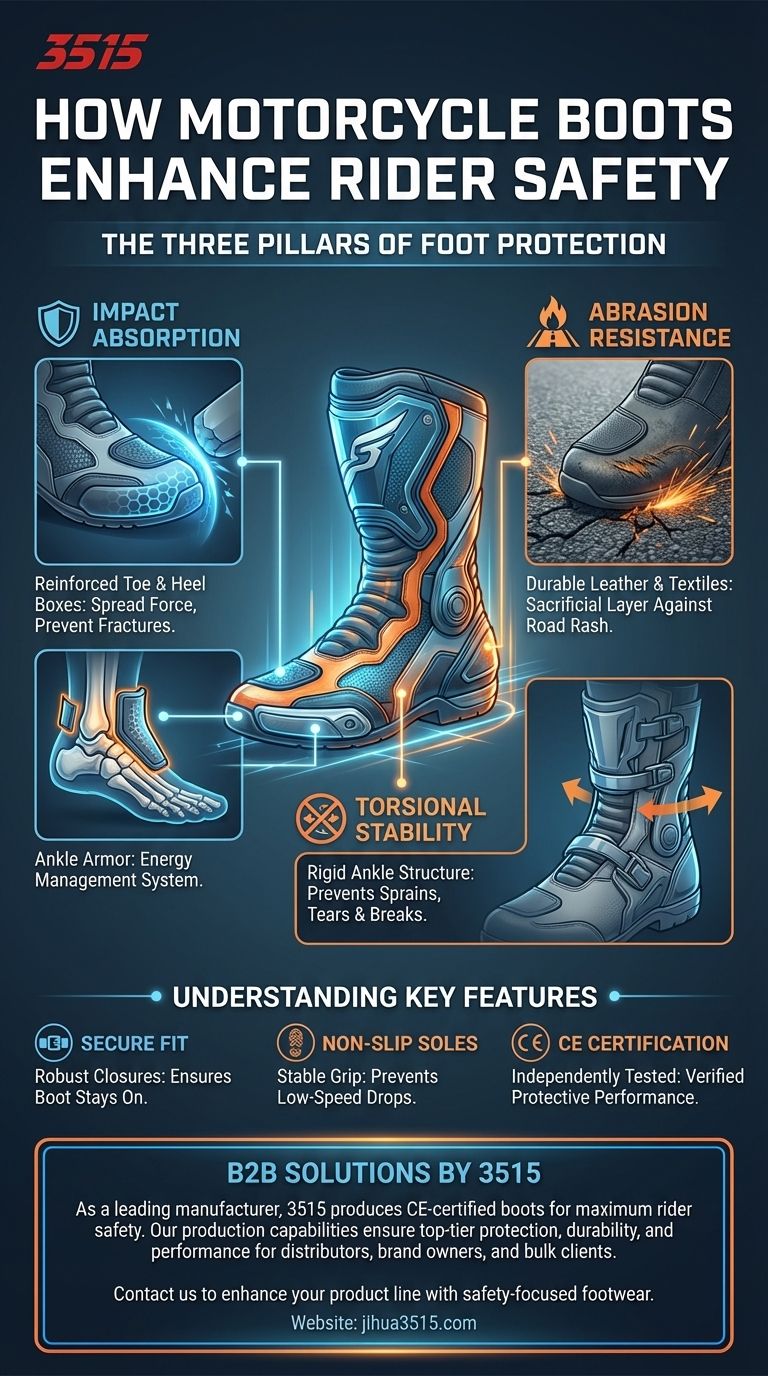
Impact Absorption: Shielding Against Direct Force
In a crash, your feet can be struck by the motorcycle itself or other objects. Motorcycle boots feature reinforced toe and heel boxes and often include armor over the ankle bones.
This reinforcement is not just hard plastic; it's an energy-management system. It spreads the force of a direct blow across a wider area, preventing the concentrated energy that would otherwise shatter small bones.
Abrasion Resistance: Surviving the Slide
When you slide on asphalt, the friction generates intense heat and acts like a belt sander on your gear. Regular shoes disintegrate in seconds, exposing skin and bone.
Motorcycle boots are constructed from thick leather or advanced, abrasion-resistant textiles. They act as a durable second layer of skin, sacrificing their own material to protect yours from severe road rash and deep tissue damage.
Torsional Stability: Preventing Twists and Breaks
One of the most common and debilitating riding injuries is a twisted ankle. During a tumble, your foot can be caught and forced to rotate while the rest of your leg cannot.
A proper boot provides a rigid structure around the ankle, severely limiting its ability to bend in unnatural directions. This bracing is crucial for preventing the ligament tears, sprains, and complex fractures that can result from these twisting forces.
Understanding the Key Features
Beyond the core principles, specific features determine a boot's overall level of safety and usability. Understanding them helps you evaluate the quality of the gear.
Secure Fit and Closures
A boot that flies off your foot in an accident provides zero protection. Secure closure systems, such as robust buckles, zippers, or quick-lacing mechanisms, are essential to ensure the boot stays in place when you need it most.
Non-Slip Soles for Control
Safety isn't just about crashing; it's also about prevention. The non-slip, oil-resistant soles on motorcycle boots provide a stable grip on the pavement when you stop and on the footpegs while riding. This enhanced control can help prevent a low-speed drop.
The Value of CE Certification
Riders should always look for CE-certified boots. This marking indicates the boot has been independently tested and meets a specific European safety standard for protective performance, verifying its ability to resist impact and abrasion.
Making the Right Choice for Your Goal
The right boot depends entirely on your primary type of riding. You must balance the level of protection with practical needs like comfort and weather resistance.
- If your primary focus is daily commuting: Prioritize a CE-certified boot that offers a balance of protection, walkability, and weather resistance.
- If your primary focus is long-distance touring: Look for maximum comfort and support combined with robust protection, especially in the ankle and shin areas.
- If your primary focus is track or aggressive sport riding: Choose boots with the highest level of torsional rigidity, impact armor, and abrasion resistance, where off-bike comfort is a low priority.
Ultimately, investing in true motorcycle boots is a direct investment in your ability to walk away from an accident.
Summary Table:
| Safety Feature | Core Function | Key Benefit |
|---|---|---|
| Impact Absorption | Reinforced toe/heel boxes spread force | Prevents bone fractures from direct blows |
| Abrasion Resistance | Durable leather/textiles sacrifice material | Protects against severe road rash in a slide |
| Torsional Stability | Rigid ankle structure limits movement | Prevents sprains, ligament tears, and breaks |
| CE Certification | Independent verification of safety standards | Confirms tested performance for impact and abrasion |
As a leading manufacturer, 3515 produces a comprehensive range of CE-certified motorcycle boots designed for maximum rider safety. Whether you are a distributor, brand owner, or bulk client, our production capabilities ensure top-tier protection, durability, and performance across all styles. Contact us today to discuss how our safety-focused footwear solutions can enhance your product line and protect your customers.
Visual Guide
Related Products
- High Performance Fire-Retardant Waterproof Safety Boots
- Wholesale Tactical Boots High-Traction & Reflective for Bulk & Brand Orders
- Premium High-Cut Waterproof Safety Boots Manufacturing & Wholesale Solutions
- Durable Goodyear Welt Leather Work Boots for Wholesale & Private Label
- Wholesale High-Traction Camo Boots - Custom Manufacturer for Brands
People Also Ask
- Why are waterproof safety boots recommended for certain work environments? Essential Protection for Wet & Hazardous Jobs
- What roles do 3D vision systems and industrial robots play in the manufacturing of fire safety boots? Smart Automation
- How does boot construction affect waterproofing? The Science Behind Truly Dry Feet
- What is the advantage of one-piece construction in waterproof boots? Unbeatable Seamless Protection
- What is the difference between waterproof and water-resistant boots? Choose the Right Footwear for Any Condition