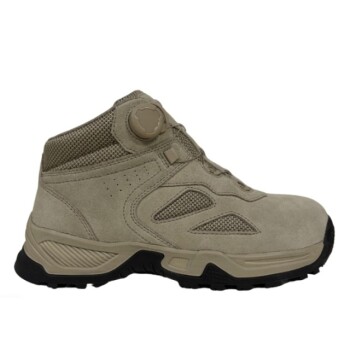
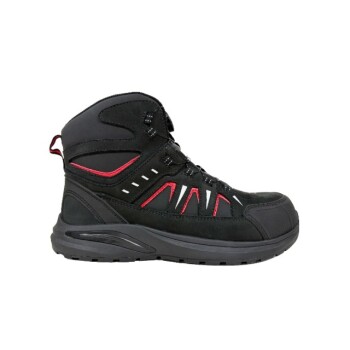
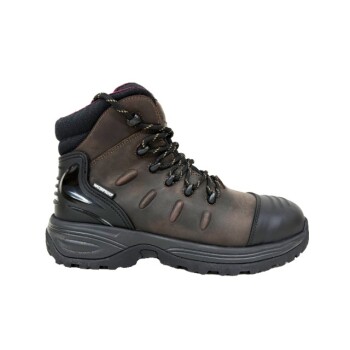
Industrial safety boots act as the foundational anchor for maintenance personnel working at dangerous heights. They primarily assist technicians by ensuring stability on the specific hazards of palm oil factories—such as greasy metal gratings on high-level conveyor belts and tank tops—allowing workers to maintain secure footing while performing complex mechanical or electrical tasks.
By providing rugged, slip-resistant traction, industrial safety boots function as a preventative measure against falls, complementing the fall-arrest capabilities of safety belts.
Engineering Stability at Heights
Combating Slick Surfaces
Palm oil processing environments are inherently hazardous due to the presence of oil and grease. Industrial safety boots are engineered with rugged, slip-resistant soles designed specifically to bite into slippery surfaces. This traction is essential for traversing metal gratings often found on high-level structures.
Enabling Precise Work
Maintenance personnel at these heights are not merely walking; they are performing intricate repairs. Secure footing allows technicians to focus entirely on complex mechanical repairs or electrical inspections. Without this stability, the cognitive load of balancing would compromise the quality and safety of the maintenance work.
Comprehensive Physical Protection
The Final Physical Barrier
Beyond stability, these boots serve as the last line of defense against physical trauma. As noted in safety protocols, high-performance boots provide critical impact resistance to protect feet from falling objects. They also offer puncture protection, guarding against sharp debris common in maintenance zones.
Synergizing with Fall Protection
Safety boots do not operate in isolation; they are a vital component of a broader Personal Protective Equipment (PPE) system. When used in conjunction with safety belts, they create a two-tier safety system. The boots prevent the slip that causes the fall, while the safety belt acts as the fail-safe if stability is lost.
Understanding the Trade-offs
The "False Security" of Worn Gear
A common pitfall is assuming that simply wearing the boots guarantees safety. The effectiveness of the slip-resistant sole degrades over time. As indicated by safety management observations, the wear rate of boots must be monitored; a worn sole on a greasy grating offers significantly reduced protection.
Compliance as a Safety Indicator
The presence of boots is also a metric for organizational behavior. The wear rate and usage of safety boots serve as a direct indicator of employee compliance. High-quality boots are ineffective if the safety culture does not enforce their consistent use during every maintenance task.
Making the Right Choice for Your Team
To maximize safety on high-level structures, you must align your equipment choices with your specific operational goals:
- If your primary focus is accident prevention: Prioritize boots with aggressive, oil-resistant tread patterns to mitigate the specific slip hazards of palm oil grease on metal.
- If your primary focus is safety management: Establish a routine inspection schedule to check boot wear rates, using this data to gauge overall PPE compliance.
True safety at height begins at the ground level with the correct footwear.
Summary Table:
| Feature | Benefit for High-Level Maintenance | Impact on Safety |
|---|---|---|
| Slip-Resistant Soles | Ensures grip on greasy metal gratings and tank tops | Prevents primary falls at height |
| Impact Resistance | Protects against dropped tools or falling mechanical parts | Reduces foot trauma injuries |
| Puncture Protection | Shields feet from sharp debris in maintenance zones | Prevents secondary injuries |
| Rugged Stability | Reduces cognitive load by providing secure footing | Improves quality of complex repairs |
| PPE Synergy | Complements fall-arrest systems (safety belts) | Creates a two-tier safety system |
Elevate Your Site Safety Standards with 3515 Footwear Solutions
Protect your workforce and streamline your operations with high-performance footwear from 3515, a leading large-scale manufacturer serving global distributors and brand owners. We understand that in the demanding palm oil industry, safety starts from the ground up.
By partnering with 3515, you gain access to our comprehensive production capabilities and specialized engineering. Our flagship Safety Shoes series is specifically designed to combat slippery, high-risk environments, while our extensive portfolio—including tactical boots, outdoor shoes, training shoes, sneakers, and formal footwear—ensures we can meet all your bulk procurement needs with consistent quality.
Ready to upgrade your team's protection? Contact us today to discuss your bulk requirements and discover how our manufacturing expertise can support your safety goals.
References
- Rapima Sartika Tinambunan, Feby Aulia Safrin. IMPLEMENTASI METODE JOB SAFETY ANALYSIS SEBAGAI UPAYA PENCEGAHAN KECELAKAAN KERJA PADA KARYAWAN. DOI: 10.55047/transekonomika.v3i3.414
This article is also based on technical information from 3515 Knowledge Base .
Related Products
- Premium Waterproof High-Cut Industrial Safety Boots for Wholesale and Bulk Orders
- Puncture-Resistant Velcro Safety Boots for Wholesale & Custom Manufacturing
- Premium Wholesale Waterproof Safety Boots High Performance Protection for Industrial Markets
- Customizable Anti-Smash Safety Boots for Wholesale & Private Label Manufacturing
- Premium Wholesale Wheat Nubuck Safety Boot with Rapid Lacing System
People Also Ask
- Why are oil-resistant and anti-slip properties critical for industrial safety boots? Expert Outsole Engineering Guide
- What are the primary protective functions of industrial safety boots in oil palm plantations? Master Rough Terrain Safety
- What protective functions do industrial-grade safety boots provide in construction and mining? Maximize Worker Safety
- Why is professional industrial-grade safety footwear a suitable carrier for diabetic rehabilitation insoles?
- What are the protective functions of industrial safety boots in sugar factory clarification stations? Thermal & Slip Experts