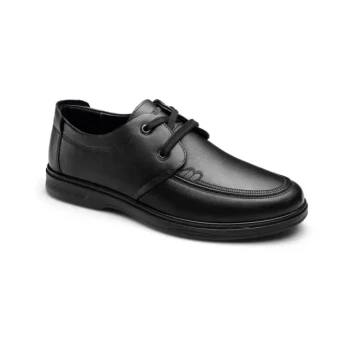
The skiving process is a critical preparatory step in leather footwear construction. It involves the precise thinning of leather edges to ensure that overlapping seams remain flush and structurally sound. By reducing bulk at the point of assembly, skiving directly impacts the safety shoe's ergonomic fit, aesthetic finish, and long-term durability.
Skiving transforms bulky leather junctions into streamlined, high-strength seams. This process is essential for preventing internal friction against the foot while ensuring that stitching maintains uniform tension across the shoe's upper.
The Mechanics of the Skiving Process
Precision Edge Reduction
The skiving process utilizes specialized machinery to shave away a specific depth of material from the edge of a leather component. By thinning only the perimeter where two pieces will overlap, the manufacturer ensures the final seam is no thicker than the original leather itself.
Ensuring Geometric Alignment
Safety shoe leather is typically thicker and more robust than standard footwear material to provide necessary protection. Skiving creates a "tapered" edge that allows these heavy-duty components to nest perfectly during the stitching phase, maintaining the shoe's intended shape.
Enhancing Wearer Comfort and Safety
Preventing Pressure Points and Abrasion
An un-skived, bulky seam inside a safety shoe can create significant friction and "hot spots" against the foot. By ensuring a flat joint, skiving eliminates these protrusions, which is vital for professionals who spend long shifts in demanding environments.
Facilitating Proper Internal Volume
By removing excess bulk at the seams, the shoe maintains its intended internal dimensions. This prevents the "crowding" of the foot, ensuring that the foot interacts correctly with protective elements like steel or composite toe caps.
Structural Integrity and Durability
Optimizing Stitching Tension
When leather layers are excessively thick, sewing needles encounter high resistance, often leading to uneven thread tension or skipped stitches. Skiving provides a consistent thickness that allows the industrial sewing machine to apply uniform tension, resulting in a much stronger bond.
Improving Load Distribution
A flat, skived seam allows mechanical stresses to be distributed evenly across the leather fibers. This prevents localized stress concentrations that could otherwise lead to the leather tearing at the stitch line under heavy use.
Understanding the Trade-offs
The Risk of Over-Thinning
If the skiving blade removes too much material, the leather edge becomes structurally compromised. This "starved" edge may lack the fiber density required to hold a stitch, leading to seam failure or "grinning" where the layers pull apart.
Material Consistency Challenges
Natural leather varies in density and oil content, which can cause the skiving blade to behave inconsistently. Technicians must frequently calibrate equipment to avoid "gouging" the material, which would create a permanent weak point in the safety shoe upper.
Applying Skiving Standards to Production
Implementing a rigorous skiving protocol is essential for producing high-performance safety footwear that meets both protective and comfort standards.
- If your primary focus is wearer ergonomics: Prioritize a gradual, tapered skive on all internal lining seams to completely eliminate friction points.
- If your primary focus is maximum durability: Utilize a conservative skiving width to ensure maximum leather fiber remains to anchor high-tension industrial stitching.
- If your primary focus is aesthetic precision: Ensure skiving machines are calibrated for the specific weight of the leather to achieve perfectly flush external seams.
Mastering the skiving process is the technical foundation for a safety shoe that provides both uncompromised protection and lasting professional performance.
Summary Table:
| Benefit Category | Primary Impact | Technical Purpose |
|---|---|---|
| Wearer Comfort | Prevents internal friction | Eliminates bulky seams and pressure points. |
| Structural Strength | Optimizes stitch tension | Provides uniform thickness for secure industrial bonding. |
| Aesthetic Quality | Streamlined finish | Ensures overlapping leather components remain flush. |
| Durability | Load distribution | Prevents leather tearing by spreading stress across fibers. |
Partner with 3515 for High-Performance Footwear Manufacturing
As a large-scale manufacturer serving global distributors and brand owners, 3515 leverages precision engineering like the skiving process to deliver superior footwear solutions. Our comprehensive production capabilities allow us to anchor our flagship Safety Shoes series with unmatched ergonomic fit and durability.
Whether you require work and tactical boots, outdoor shoes, training sneakers, or high-end Dress & Formal shoes, our factory is equipped to meet your diverse bulk requirements with technical excellence.
Ready to elevate your product line? Contact us today to discuss your manufacturing needs and discover how our expertise brings value to your brand.
References
- Eko Fandra Winata, Sugiyono Sugiyono. Analysis of Safety Shoes Product Quality Control at PT. BINA USAHA SEJAHTERA With Statistical Quality Control (SQC) Method Case Study of PT Bina Usaha Sejahtera (BINUSA). DOI: 10.55927/ijba.v4i1.8323
This article is also based on technical information from 3515 Knowledge Base .
Related Products
- Durable Goodyear Welt Leather Work Boots for Wholesale & Private Label
- Durable Leather Work Boots for Wholesale & Custom Manufacturing
- Premium Suede Sport Safety Shoes for Wholesale & Bulk Orders
- Durable Leather Work Boots for Wholesale & Custom OEM Manufacturing
- Durable Leather Work Boots Wholesale Manufacturer & Custom Factory
People Also Ask
- What is the difference between full-grain and top-grain leather? Premium Material Guide for Boot Manufacturers
- What are the advantages of leather as an upper material for work boots? Unmatched Durability & Custom Comfort
- Why is it important to waterproof leather work boots? Protect Your Investment and Performance
- How should new leather work boots be broken in? A Guide to Comfort and Durability
- What are the advantages of leather uppers in work boots? Unmatched Durability & Protection