In short, arch support is critical in work shoes because it maintains proper foot alignment, which is the foundation for your entire body's posture. This simple feature is the first line of defense against the fatigue, discomfort, and even long-term injury that comes from spending hours on your feet.
The core issue isn't just foot pain; it's a chain reaction. Without proper arch support, poor foot alignment creates stress that travels up through your ankles, knees, hips, and lower back, leading to chronic pain and fatigue throughout your body.
The Foundation of Your Body: How the Arch Works
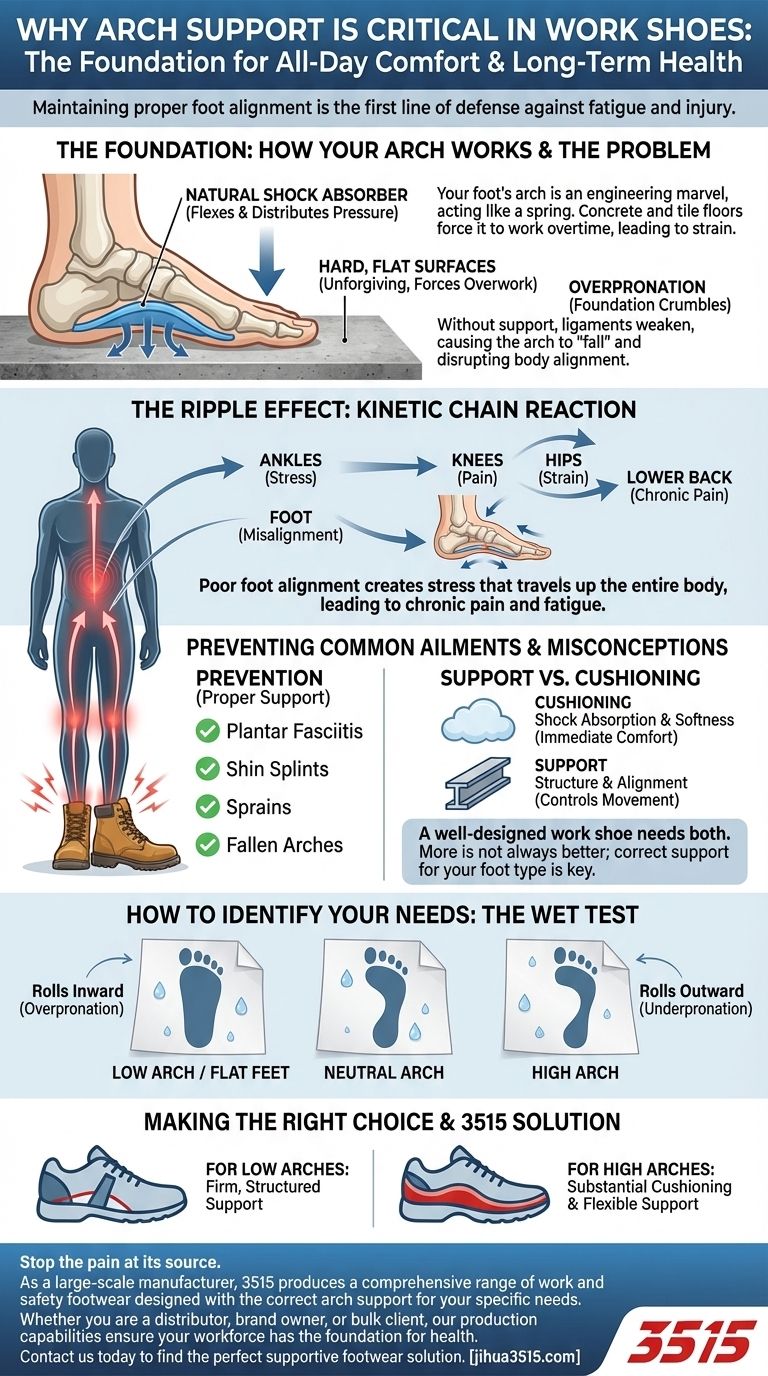
Your foot's arch is an engineering marvel designed to absorb shock and distribute pressure across your feet as you stand and move. Understanding its function is key to realizing why supporting it is non-negotiable for anyone with a demanding job.
Your Foot's Natural Shock Absorber
The arch of your foot acts like a natural spring. It flexes to absorb the impact of each step and provides the rigidity needed to push off for the next one. This mechanism is essential for efficient and painless movement.
The Problem with Hard, Flat Surfaces
Most modern work environments—concrete floors, tile, and linoleum—are unforgiving. These hard, flat surfaces force your foot's arch to work overtime to absorb shock, leading to strain and fatigue that it wasn't designed to handle for 8-12 hours a day.
When the Foundation Crumbles
Without external support from your shoes, the ligaments and muscles in your arch can become overstretched and weakened. This can cause the arch to "fall" or collapse, a condition known as overpronation, which disrupts your body's entire alignment.
The Ripple Effect: Beyond Just Foot Pain
A poorly supported foot doesn't just cause localized pain. It triggers a cascade of biomechanical problems that can affect your entire musculoskeletal system.
The Kinetic Chain Reaction
Think of your body as a chain of interconnected links (the kinetic chain). When the first link—your foot—is out of alignment, it forces the next links—your ankles, knees, and hips—into unnatural positions to compensate. This misalignment is a primary cause of chronic knee and lower back pain for standing workers.
Preventing Common Ailments
Proper arch support is a powerful preventative tool. It stabilizes the foot and helps prevent common workplace ailments like plantar fasciitis, shin splints, sprains, and the development of fallen arches.
Understanding the Trade-offs and Misconceptions
Choosing the right support isn't always straightforward. It's crucial to distinguish between support, cushioning, and the myth that more is always better.
More Support Isn't Always Better
The goal is not maximum support; it's the correct support for your foot type. A person with a high, rigid arch needs a different kind of support than someone with a low, flexible arch. The wrong type of support can be just as damaging as no support at all.
Support vs. Cushioning
Many people confuse these two features. Cushioning is about shock absorption and immediate comfort—it makes the shoe feel soft. Support is about structure and alignment—it controls how your foot moves and is positioned inside the shoe. A well-designed work shoe needs both.
How to Identify Your Specific Needs
To get the benefits, you must match the shoe's support to your foot's unique anatomy. A simple test can give you the insight you need.
Finding Your Arch Type: The Wet Test
You can easily determine your arch type at home. Simply wet the bottom of your foot and step onto a flat surface like a piece of paper or cardboard where your footprint will be visible.
- A full, wide footprint with little to no curve inward indicates a low arch or flat feet.
- A footprint with a very narrow curve or a gap in the middle indicates a high arch.
- A footprint with a moderate, noticeable curve indicates a neutral arch.
Aligning Support with Your Pronation
Your arch type directly relates to how your foot rolls when you walk (pronation).
- Low arches tend to roll inward too much, which is known as overpronation. These feet need shoes with structured support, often called "stability" or "motion control" features.
- High arches tend to roll outward, known as underpronation or supination. These feet need shoes with excellent cushioning and flexible support to help absorb shock.
Making the Right Choice for Your Workday
Once you understand your foot, you can select a shoe that provides a foundation for health, not a source of pain.
- If you have low arches or flat feet: Your priority is a shoe with firm, structured support on the medial (inner) side to prevent your arch from collapsing inward.
- If you have high arches: Your priority is a shoe with substantial cushioning and a supportive, contoured footbed to absorb impact and distribute pressure evenly.
- If you spend all day on hard surfaces: You must seek a shoe that offers a balanced combination of structured alignment from arch support and shock-absorbing cushioning.
Investing in a work shoe with the right support is a direct investment in your long-term health and daily well-being.
Summary Table:
| Key Aspect | Why It Matters |
|---|---|
| Proper Alignment | Prevents a kinetic chain reaction of stress on ankles, knees, hips, and back. |
| Shock Absorption | Your arch acts as a natural spring; support prevents strain on hard surfaces. |
| Injury Prevention | Crucial for preventing plantar fasciitis, shin splints, and sprains. |
| Correct Support Type | Depends on your arch type (low, high, neutral) for maximum benefit. |
Stop the pain at its source. As a large-scale manufacturer, 3515 produces a comprehensive range of work and safety footwear designed with the correct arch support for your specific needs. Whether you are a distributor, brand owner, or bulk client, our production capabilities ensure your workforce has the foundation for all-day comfort and long-term health. Contact us today to find the perfect supportive footwear solution for your business.
Visual Guide
Related Products
- Durable Canvas Work Shoes with Rubber Lug Sole | Wholesale Manufacturer
- Wholesale Leather Work Boots with Customizable Wedge Sole for Brands
- Wholesale Durable Camo Canvas Shoes with High-Traction Rubber Soles
- Wholesale Leather Ankle Boots with Lug Soles for Custom Brand Manufacturing
- Durable Leather Moc Toe Work Boots for Wholesale & Custom Manufacturing
People Also Ask
- What are the properties of canvas as a shoe material? A Guide to Lightweight Comfort & Style
- Why is the selection of high-strength fabric materials necessary in the production of canvas shoes and training shoes?
- What types of jobs are canvas work boots suitable for? Ideal for Light-Duty, High-Mobility Roles
- Can canvas shoes be worn in rainy conditions? The Truth About Water Resistance
- What are the functional advantages of choosing rubber soles over leather soles for work boots? Superior Safety & Durability