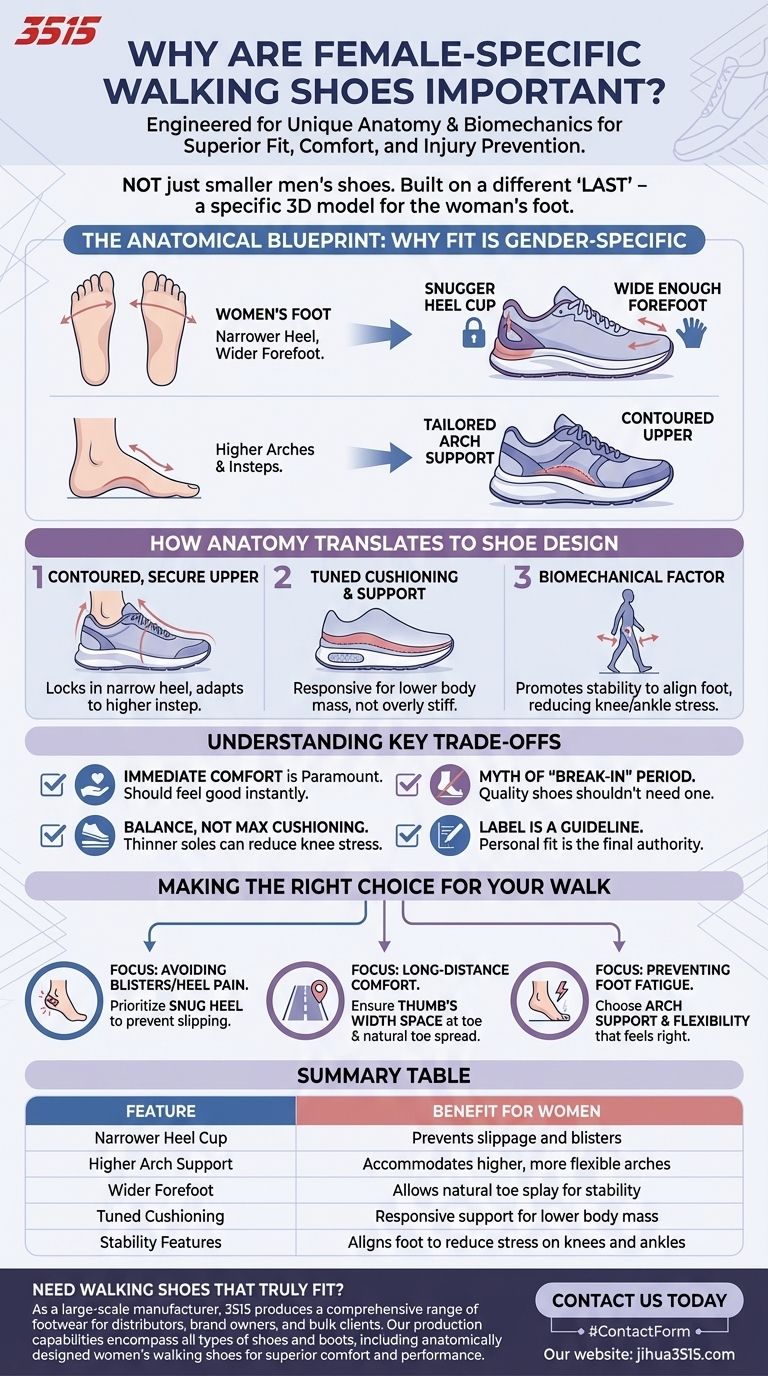
To put it simply, female-specific walking shoes are important because they are engineered to accommodate the anatomical and biomechanical differences of the average woman's foot. These shoes are not just smaller or differently colored versions of men's shoes; they are built on a different last—the 3D model a shoe is constructed around—to provide a better fit, which is the single most critical factor for comfort and injury prevention.
The core issue is not about gender, but about anatomy. Women's feet are generally narrower, with higher arches and insteps, and a proper shoe accounts for this unique geometry to deliver superior support and prevent pain.
The Anatomical Blueprint: Why Fit is Gender-Specific
Understanding why a shoe fits differently is the key to choosing the right one. The design of a female-specific shoe is a direct response to common differences in foot structure.
The Heel and Forefoot Shape
A woman's foot is typically narrower than a man's, especially in the heel, relative to the width of the forefoot.
A shoe designed for women will have a snugger heel cup to prevent slippage and blisters, while still offering a wide enough forefoot to allow toes to splay naturally for stability.
Higher Arches and Insteps
Many women have higher, more flexible arches and higher insteps than men.
Female-specific shoes often incorporate more tailored arch support and a contoured upper to accommodate this shape, preventing uncomfortable pressure on the top of the foot.
How Anatomy Translates to Shoe Design
Shoe manufacturers use these anatomical data points to create a walking shoe that provides a secure, comfortable, and supportive experience from the first step.
A Contoured, Secure Upper
The upper part of the shoe is designed to securely hold the foot in place. For women, this means a shape that locks in the narrower heel while adapting to a higher instep.
Cushioning and Support Systems
The midsole cushioning and support structures are often tuned differently. This accounts for women generally having less body mass than men, ensuring the cushioning feels responsive and not overly stiff.
The Biomechanical Factor
Women's wider hips can create a different angle of impact when walking. Features that promote stability are often integrated to help align the foot properly during each stride, reducing stress on the ankles and knees.
Understanding the Key Trade-offs
Choosing the right shoe involves more than just finding one labeled for your gender. You must prioritize what matters most for your comfort and health.
Comfort is Not Complicated
The single most important factor is immediate comfort. A shoe should feel good the moment you put it on.
The Myth of the "Break-In" Period
Quality walking shoes do not require a "break-in" period. If they feel tight, stiff, or uncomfortable in the store, that feeling will likely be amplified during a walk.
More Cushioning Isn't Always Better
While cushioning is important for shock absorption, some research suggests that thinner, more flexible soles can put less stress on the knees. The goal is balance, not maximum cushioning.
The Label is a Guideline, Not a Rule
Ultimately, your unique foot shape is what matters. If you have wider feet or lower arches, you might find a better fit in a men's or unisex shoe. The best shoe is the one that fits your foot perfectly.
Making the Right Choice for Your Walk
Focus on fit and feel above all else. Use the gender-specific design as a starting point, but let your personal comfort be the final authority.
- If your primary focus is avoiding blisters and heel pain: Prioritize a shoe with a snug heel that prevents any slipping or rubbing as you walk.
- If your primary focus is long-distance comfort: Ensure there is a thumb's width of space between your longest toe and the end of the shoe and that your toes can spread out naturally.
- If your primary focus is preventing foot fatigue and soreness: Choose a shoe that matches your arch type and provides a balance of support and flexibility that feels right to you.
Trust your own comfort to guide you to the shoe that will best support you on your walk.
Summary Table:
| Feature | Benefit for Women |
|---|---|
| Narrower Heel Cup | Prevents slippage and blisters |
| Higher Arch Support | Accommodates higher, more flexible arches |
| Wider Forefoot | Allows natural toe splay for stability |
| Tuned Cushioning | Responsive support for lower body mass |
| Stability Features | Aligns foot to reduce stress on knees and ankles |
Need walking shoes that truly fit? As a large-scale manufacturer, 3515 produces a comprehensive range of footwear for distributors, brand owners, and bulk clients. Our production capabilities encompass all types of shoes and boots, including anatomically designed women's walking shoes for superior comfort and performance. Contact us today to discuss your footwear needs!
Visual Guide
Related Products
- Wholesale Women's Leather Derby Shoes Custom Factory Production
- Wholesale Classic Leather Lace-Up Ankle Boots for Brand Manufacturing
- Wholesale Durable Camouflage Canvas Shoes with High-Traction Cleated Rubber Sole
- Durable Rubber Sole Outdoor Shoes Wholesale & Custom Manufacturing
- Premium Suede Sport Safety Shoes for Wholesale & Bulk Orders
People Also Ask
- How do Derby shoes fit into business casual attire? Master the Perfect Balance of Professional Style
- What are the features and appropriate occasions for wearing derby shoes? A Guide to Versatile Style
- What is the main difference between Derby Shoes and Oxford Shoes? It's All in the Lacing.
- What historical figure is associated with the Derby shoe? The Earl of Derby's Comfort Revolution
- How do Derby shoes differ from Oxford shoes? A Guide to Formality, Fit & Style