
The ideal fit for a riding boot is a precise balance of snug security and functional comfort. Your boot should feel like a firm handshake around your foot, ankle, and calf—secure enough to prevent movement or slippage, but not so tight that it restricts circulation or causes pressure points. The goal is to create a seamless extension of your leg that offers protection without hindering your ability to feel and communicate with the horse.
A properly fitted riding boot is your most critical piece of safety equipment. The correct fit ensures your foot remains secure in the stirrup, provides essential support to prevent injury, and allows for the precise leg control necessary for effective riding.

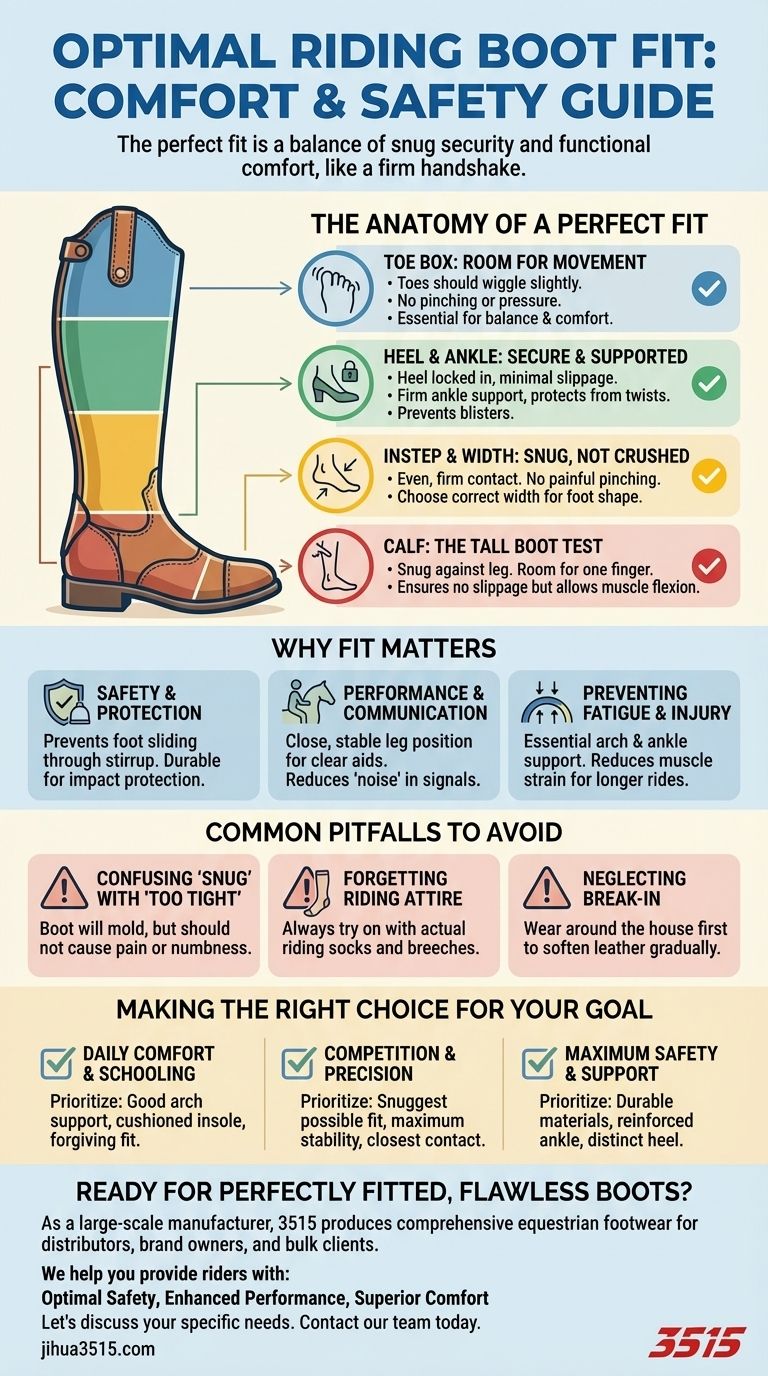
The Anatomy of a Perfect Fit: A Point-by-Point Guide
Achieving the right fit requires checking several key areas of the boot. Each plays a distinct role in your comfort, safety, and performance in the saddle.
The Toe Box: Room for Movement
Your toes should have enough room to wiggle slightly. They should never feel pinched or pressed against the end of the boot, either from the front or the sides.
This space is crucial for balance and all-day comfort, preventing numbness during long rides.
The Heel and Ankle: Secure and Supported
Your heel must be locked firmly into the back of the boot with minimal to no slippage as you walk. This prevents blisters and ensures your foot won't slide forward.
The boot should provide firm support around the ankle, protecting it from twists and strains without creating excessive pressure or rubbing.
The Instep and Width: Snug, Not Crushed
The boot should fit snugly across the widest part of your foot and over your instep. You are looking for even, firm contact without any painful pinching or crushing sensations.
Many boot manufacturers offer various width options (from medium to extra-wide) to accommodate different foot shapes.
The Calf: The Tall Boot Test
For tall boots, the calf fit is paramount. The boot should be snug against your leg, with just enough room to slide one finger between the boot and your calf.
This ensures the boot won't slip down while riding but still allows for muscle flexion and proper circulation.
Why Proper Fit is Non-Negotiable for Riders
An ill-fitting boot isn't just uncomfortable; it's a significant liability that compromises both safety and your effectiveness as a rider.
Safety and Protection
A boot that is too wide or loose can allow your foot to slide completely through the stirrup, creating a serious dragging risk in the event of a fall.
Furthermore, a well-constructed boot must be durable enough to protect your foot if it is accidentally stepped on by a horse.
Performance and Communication
Your lower leg is a primary tool for communicating with your horse. A boot that fits properly allows for a close, stable leg position, which translates to clearer aids and a better response.
Poorly fitting boots can cause your leg to shift, creating "noise" in your signals and reducing your effectiveness.
Preventing Fatigue and Injury
Proper fit provides essential support for your arches and ankles, reducing muscle strain and fatigue over long periods.
This support is critical for preventing common strains and maintaining good foot health, allowing you to ride longer and more comfortably.
Common Pitfalls and How to Avoid Them
Even with the best intentions, it's easy to make mistakes when selecting boots. Being aware of these common errors is the first step to avoiding them.
Confusing "Snug" with "Too Tight"
A new leather boot will have some give and mold to your shape over time. It should feel very snug at first, but it should never cause pain, tingling, or numbness.
If a boot causes immediate pressure points, it is too small. Don't assume an excessive amount of discomfort will resolve itself.
Forgetting Your Riding Attire
Always try on boots while wearing the same type of breeches and socks you ride in. The thickness of your socks and legwear can dramatically alter the fit in the foot and calf.
Trying on boots with thin dress socks will almost certainly result in a boot that is too tight once you put on your actual riding gear.
Neglecting the Break-In Period
No boot will feel perfect straight out of the box. It's essential to break in your new boots gradually by wearing them around the house for short periods before you ride in them.
This allows the leather to soften and conform to your specific foot and ankle shape, ensuring a truly customized and comfortable fit.
Making the Right Choice for Your Goal
Your ideal fit may have subtle differences based on your primary riding discipline and goals. Use these guidelines to zero in on what matters most for you.
- If your primary focus is daily comfort and schooling: Prioritize a boot with good arch support, a cushioned insole, and a slightly more forgiving fit that allows for all-day wear without fatigue.
- If your primary focus is competition and precision: Opt for the snuggest possible fit that is still comfortable, ensuring maximum stability and the closest possible contact between your leg and the horse.
- If your primary focus is maximum safety and support: Choose a boot made from durable, protective materials with reinforced ankle support and a distinct heel to prevent stirrup slippage.
Ultimately, a well-fitted boot empowers you to ride with confidence, safety, and control.
Summary Table:
| Area of the Boot | Ideal Fit | Why It Matters |
|---|---|---|
| Toe Box | Room to wiggle toes, no pinching | Prevents numbness, ensures balance and comfort |
| Heel & Ankle | Heel locked in, minimal slippage | Prevents blisters, protects from twists and strains |
| Instep & Width | Snug, even contact without pain | Accommodates foot shape, ensures stability |
| Calf (Tall Boots) | Snug, room for one finger | Prevents slippage, allows for muscle flexion |
Ready for Boots That Fit Perfectly and Perform Flawlessly?
As a large-scale manufacturer, 3515 produces a comprehensive range of equestrian footwear for distributors, brand owners, and bulk clients. Our production capabilities encompass all types of riding boots and shoes, ensuring you get the precise fit, superior safety features, and durable performance your customers demand.
We help you provide riders with:
- Optimal Safety: Secure fits that prevent stirrup accidents and offer foot protection.
- Enhanced Performance: Boots that enable clear communication and reduce rider fatigue.
- Superior Comfort: Expertly crafted fits for all-day riding comfort across disciplines.
Let's discuss your specific needs. Contact our team today to explore our catalog and manufacturing solutions.
Visual Guide
Related Products
- Premium Wholesale Tactical Style Safety Shoes Boots with Quick Lacing
- Wholesale High-Traction Camo Boots - Custom Manufacturer for Brands
- Durable Goodyear Welt Leather Work Boots for Wholesale & Private Label
- Wholesale Tactical Boots High-Traction & Reflective for Bulk & Brand Orders
- High-Traction Suede Tactical Boots Wholesale & Custom Manufacturing
People Also Ask
- How are gait analysis research findings applied to the functional design of safety shoes and tactical boots?
- How can specialized footwear mitigate safety risks? High-Volume OEM/ODM Solutions since 1951
- How do quality certification standards for safety shoes reduce perceived risk? Buy Online with Technical Certainty
- Why is the synchronization of craftsmanship and UX development emphasized for bulk customization of safety shoes?
- How does anthropomorphic design influence material selection? Enhance Footwear Performance through Biological Alignment



















