
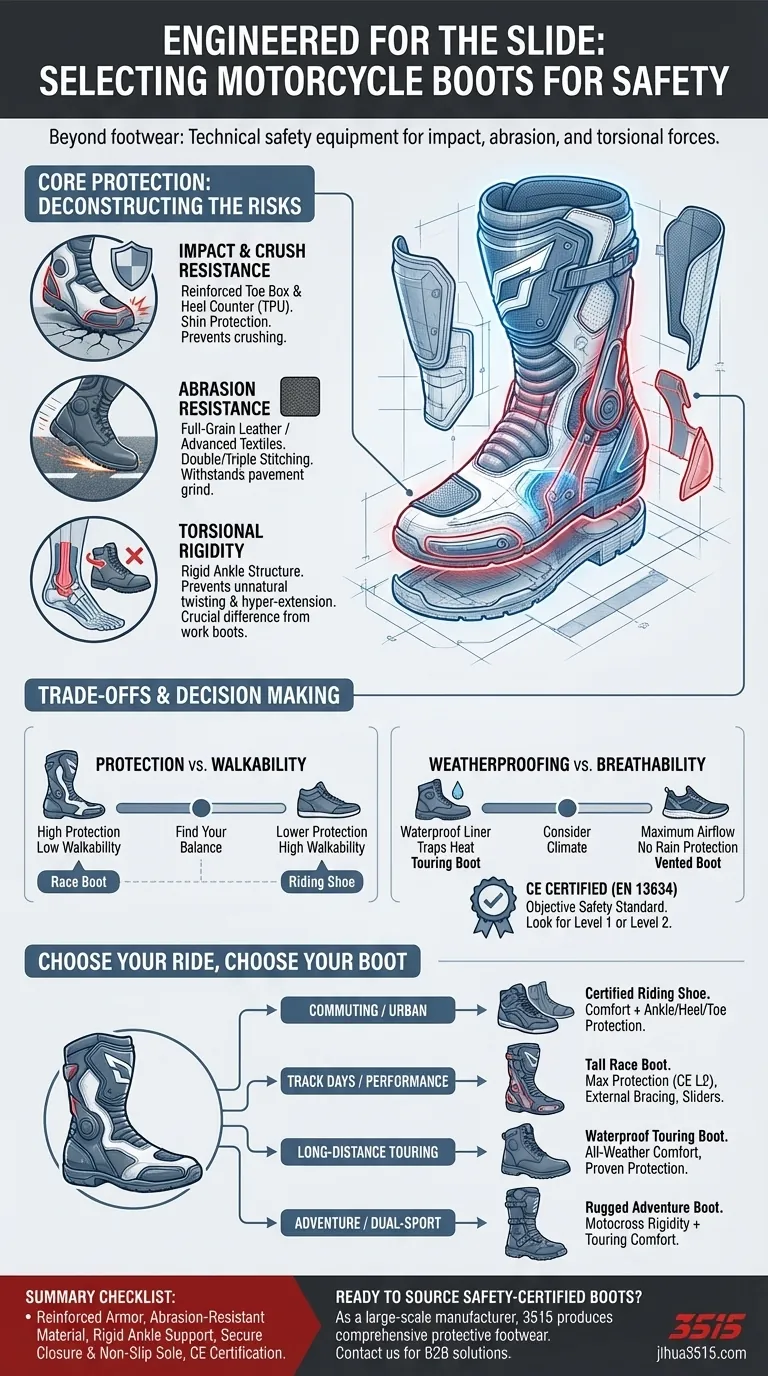
When selecting motorcycle boots for safety, your primary considerations must be protection against impact, abrasion, and torsional forces. Look for boots constructed from durable materials like full-grain leather, with reinforced armor in the ankle, heel, and toe areas. A rigid, non-slip sole and a secure closure system that ensures the boot stays on during a crash are non-negotiable.
The fundamental purpose of a motorcycle boot is not just to cover your foot, but to act as a piece of technical safety equipment. It is engineered to manage the violent and specific forces of a motorcycle accident, something no casual boot or sneaker can ever do.

Deconstructing Motorcycle Boot Protection
To choose the right boot, you must first understand the specific risks you are protecting against. A motorcycle crash involves a unique combination of impact, abrasion, and twisting forces that standard footwear is completely unprepared to handle.
Impact and Crush Resistance
The most obvious danger is the direct impact of your foot hitting the pavement or the crushing force of the motorcycle landing on it.
Dedicated motorcycle boots feature reinforced toe boxes and heel counters, often made from thermoplastic polyurethane (TPU) or other rigid materials. This armor is designed to prevent your bones from being crushed on impact.
Many taller boots also include shin protection, guarding against impacts from road debris or the bike's own footpegs during an accident.
Abrasion Resistance
When you fall at speed, you don't just hit the ground—you slide. Asphalt acts like a coarse belt sander that will tear through casual shoes and skin in seconds.
The boot's main chassis must be made from a highly abrasion-resistant material. Full-grain leather is the traditional gold standard, but modern textiles like Cordura and advanced microfibers also offer excellent protection.
Pay close attention to the construction. Features like double or triple stitching with heavy-duty thread are critical to ensure the boot doesn't burst at the seams during a slide.
Torsional Rigidity
This is the most overlooked and arguably one of the most important safety features. Torsional rigidity is the boot's ability to resist twisting.
During a crash, your foot can be caught and twisted in ways that cause severe, debilitating ankle and leg injuries. A good motorcycle boot has a built-in rigid structure around the ankle that prevents it from flexing unnaturally side-to-side or hyper-extending.
This is the single biggest difference between a real riding boot and a sturdy-looking work boot. While a work boot protects from falling objects, it offers almost no protection from these dangerous twisting forces.
Understanding the Trade-offs
Choosing a motorcycle boot is always an exercise in balancing competing needs. The safest boot in the world is useless if you find it so uncomfortable or impractical that you choose not to wear it.
Protection vs. Walkability
A full-height race boot with external bracing offers the pinnacle of protection. However, it is extremely stiff and awkward to walk in, making it impractical for commuting or running errands.
Shorter riding shoes offer more comfort and flexibility for walking but sacrifice shin protection and often have less torsional support. You must honestly assess how much time you will spend on and off the bike.
Weatherproofing vs. Breathability
Waterproof boots use a membrane liner to keep your feet dry, which is essential for touring or all-weather commuting. The trade-off is that this same membrane traps heat and reduces airflow, making them hot in warm, dry climates.
Conversely, highly ventilated boots with mesh panels are excellent for summer riding but offer zero protection from rain. Your local climate and typical riding season are key factors in this decision.
Safety Ratings as a Guide
Look for a CE certification label (typically EN 13634). This is an independent standard that tests boots for key safety metrics like abrasion resistance, impact cut resistance, and transverse rigidity.
A boot with a CE rating has been proven to meet a minimum level of protection. The ratings are often listed as Level 1 or the more protective Level 2, giving you an objective way to compare different models.
Making the Right Choice for Your Ride
Your ideal boot depends entirely on your primary type of riding. Be realistic about your needs to find the perfect balance of safety and usability.
- If your primary focus is commuting or urban riding: A certified riding shoe or a short boot that offers ankle, heel, and toe protection while remaining comfortable to walk in is your best choice.
- If your primary focus is track days or performance riding: Prioritize a tall boot with the highest CE rating, external ankle bracing, and replaceable sliders for maximum protection at speed.
- If your primary focus is long-distance touring: Look for a waterproof, comfortable boot with proven protection that is designed to be worn for long hours in variable weather conditions.
- If your primary focus is adventure or dual-sport riding: You need a rugged, taller boot that combines the rigidity of a motocross boot with the weatherproofing and comfort of a touring boot.
Ultimately, choosing the right motorcycle boot is a direct investment in your own well-being and riding confidence.
Summary Table:
| Safety Feature | Key Component | Purpose |
|---|---|---|
| Impact & Crush Resistance | Reinforced toe box, heel counter, shin guard | Protects bones from impact and crushing forces |
| Abrasion Resistance | Full-grain leather, double/triple stitching | Prevents tearing during slides on asphalt |
| Torsional Rigidity | Rigid ankle structure | Resists unnatural twisting to prevent ankle/leg injuries |
| Closure & Sole | Secure closure system, non-slip sole | Ensures boot stays on and provides grip |
| Safety Rating | CE certification (EN 13634) | Independent verification of minimum protection levels |
Ready to source high-quality, safety-certified motorcycle boots? As a large-scale manufacturer, 3515 produces a comprehensive range of protective footwear for distributors, brand owners, and bulk clients. Our production capabilities encompass all types of CE-certified motorcycle boots and shoes, designed to meet the highest standards of impact, abrasion, and torsional protection. Let us help you equip your customers with the confidence they need on the road. Contact us today to discuss your specific requirements and explore our extensive catalog!
Visual Guide
Related Products
- Wholesale Tactical Boots High-Traction & Reflective for Bulk & Brand Orders
- High Performance Fire-Retardant Waterproof Safety Boots
- Durable Goodyear Welt Leather Work Boots for Wholesale & Private Label
- Wholesale High-Traction Camo Boots - Custom Manufacturer for Brands
- Heavy-Duty Waterproof Nubuck Safety Boots Safety Shoes for Bulk Supply
People Also Ask
- How do tactical boots protect against injuries? Discover the Integrated Safety System
- What are the recommended work boot features for military and law enforcement? Enhance Operator Performance & Safety
- How should one choose the right tactical boots? Match Your Mission for Optimal Performance & Safety
- Are tactical boots suitable for urban environments? Discover Superior Comfort for City Life
- Why is the management of Initial Inventory (II) critical in the production and supply of tactical boots?



















