To identify UK brands committed to sustainable Wellington boot production, you must look for a specific, non-negotiable credential: the use of FSC-certified natural rubber. This certification is the primary indicator that a brand is serious about responsible sourcing, ensuring the raw material for their boots does not contribute to deforestation and is produced under fair conditions for workers.
The core challenge isn't finding a brand that claims to be "green," but one that can prove it. True sustainability in the Wellington boot industry hinges on third-party verification, with the Forest Stewardship Council (FSC) certification being the most critical benchmark for natural rubber.
What "Sustainable" Means for a Wellington Boot
The classic wellie is made from natural rubber, a material with a complex supply chain. A brand's commitment to sustainability is measured by how responsibly they manage this core component.
The Problem with Conventional Rubber
Much of the world's rubber is grown in plantations that can lead to significant deforestation, loss of biodiversity, and poor working conditions. Uncertified sourcing offers no guarantee against these negative impacts.
Natural Rubber as the Foundation
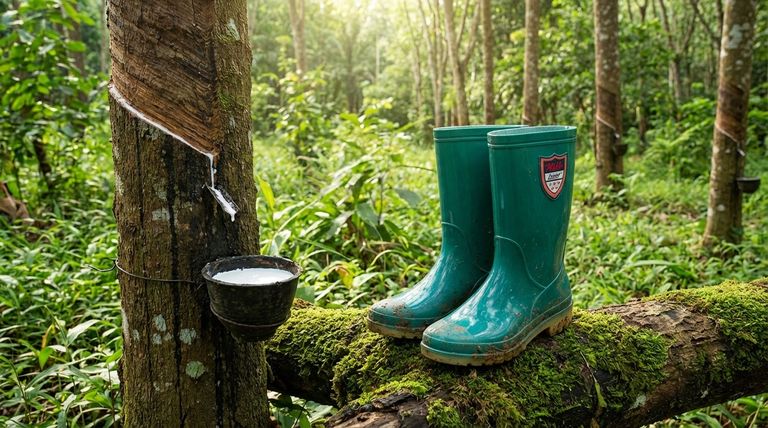
High-quality, durable Wellington boots are made from natural rubber tapped from trees, not synthetic, petroleum-based alternatives. This makes the method of farming and harvesting the rubber absolutely critical to the product's environmental footprint.
Why FSC Certification is the Gold Standard
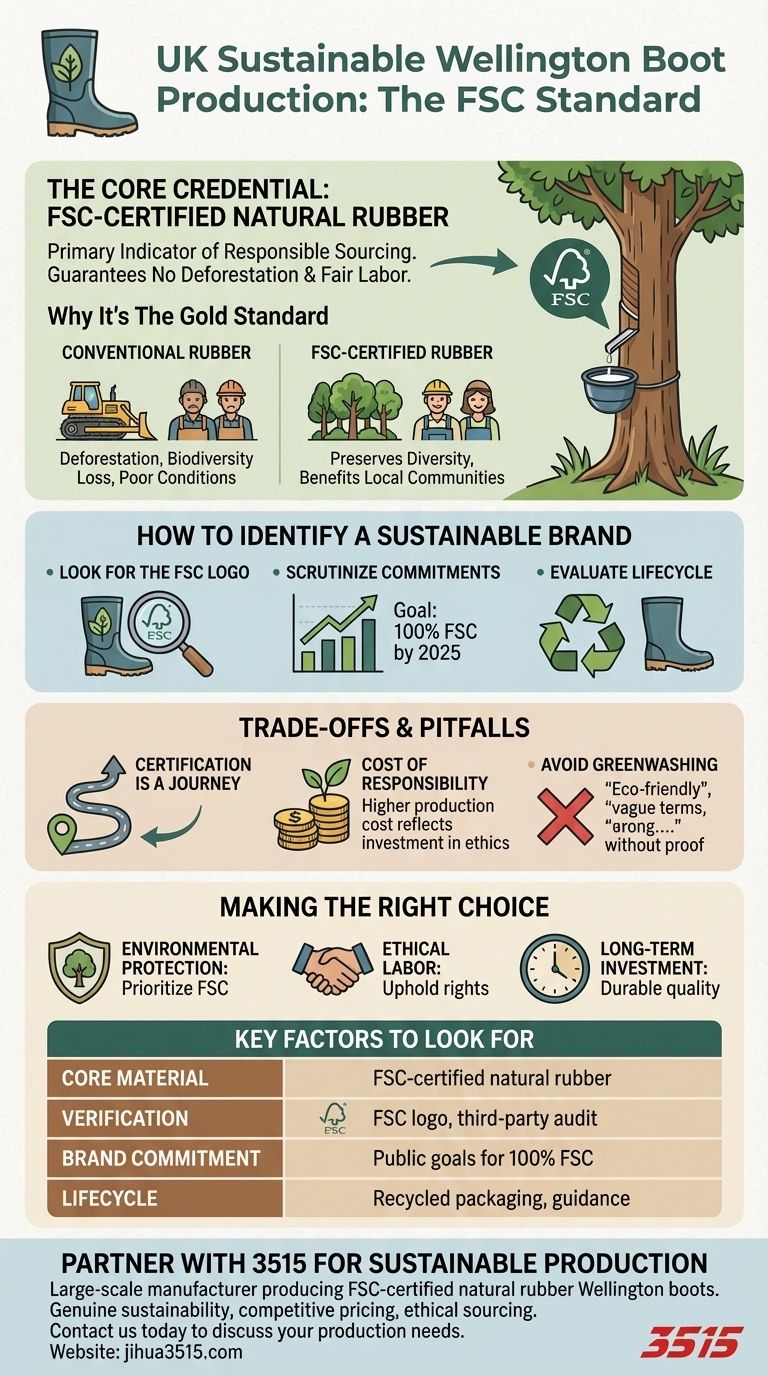
The Forest Stewardship Council (FSC) is an international organization that promotes responsible forest management. For rubber, an FSC certification guarantees that the plantation is managed in a way that preserves biological diversity and benefits the lives of local people and workers.
How to Identify a Genuinely Sustainable Brand
You can move beyond marketing claims by looking for clear, verifiable evidence of a brand's commitments.
Look for the FSC Logo
The most direct way to verify a brand's claim is to look for the FSC logo on the product, its packaging, or the company's website. This signifies that the natural rubber used is sourced from an FSC-certified and well-managed forest.
Scrutinize Brand Commitments
Truly committed brands are transparent about their goals. Many leading UK brands have publicly stated their intention to source 100% of their natural rubber from FSC-certified forests, with some setting clear deadlines, such as by 2025.
Evaluate the Entire Lifecycle
While certified rubber is the most important factor, a truly conscious brand also considers the boot's entire lifecycle. This includes using recycled materials in packaging, responsible manufacturing processes, and offering guidance on end-of-life recycling for the boots themselves.
Understanding the Trade-offs and Pitfalls
Navigating sustainability claims requires a clear-eyed view of the challenges involved for both consumers and producers.
Certification is a Journey
Achieving a fully certified supply chain is a complex process. A brand may be transitioning, with some but not all of its products being FSC-certified. This reflects progress, not necessarily a lack of commitment.
The Cost of Responsibility
FSC-certified rubber, which ensures environmental protection and fair wages, is more expensive to produce. This often translates to a higher retail price for the final product. The cost reflects a true investment in ethical production.
Avoiding "Greenwashing"
Be wary of vague terms like "eco-friendly," "green," or "responsibly sourced" without the backing of a specific certification. Without the proof of a standard like FSC, these claims are often meaningless marketing.
Making the Right Choice for Your Goal
Use these principles to guide your purchasing decision based on what matters most to you.
- If your primary focus is environmental protection: Prioritize boots made explicitly with FSC-certified natural rubber, as this is the best guarantee against deforestation.
- If your primary focus is ethical labor: Again, seek out the FSC certification, as its principles include upholding the rights of workers and local communities.
- If your primary focus is long-term investment: Choose a brand with clear, transparent sustainability goals, as this commitment to quality materials often results in a more durable and longer-lasting boot.
By focusing on certification over claims, you can confidently choose a Wellington boot that aligns with your values.
Summary Table:
| Key Factor | What to Look For | Why It Matters |
|---|---|---|
| Core Material | FSC-certified natural rubber | Guarantees no deforestation and fair labor practices |
| Verification | FSC logo on product or website | Proof of third-party audited, responsible sourcing |
| Brand Commitment | Public goals for 100% FSC rubber (e.g., by 2025) | Shows long-term dedication to sustainability |
| Lifecycle Consideration | Recycled packaging, recycling guidance | Reflects a holistic approach to reducing environmental impact |
Ready to produce sustainable Wellington boots with guaranteed quality and ethical sourcing?
As a large-scale manufacturer, 3515 produces a comprehensive range of footwear for distributors, brand owners, and bulk clients. Our production capabilities encompass all types of shoes and boots, including FSC-certified natural rubber Wellington boots that meet the highest standards of environmental and social responsibility.
Partner with us to ensure your products are genuinely sustainable and competitively priced. Contact us today to discuss your production needs and leverage our expertise in responsible manufacturing.
Visual Guide
Related Products
- Durable Waterproof Rain Boots | Custom Manufacturer for Wholesale & Brands
- Durable Goodyear Welt Leather Work Boots for Wholesale & Private Label
- Durable Moc-Toe Wedge Work Boots | Wholesale Manufacturing for Brands
- Durable Leather High-Ankle Tactical Boots for Wholesale & Custom Manufacturing
- Durable Leather Tactical Boots Wholesale & Custom Manufacturing for Brands
People Also Ask
- What are the main materials for waterproof rain boots? Choose the Right Material for Durability & Comfort
- What is the overall recommendation for choosing rain boot materials? A Guide to Rubber vs. PVC
- How does boot height affect waterproofing? Choose the Right Height for Ultimate Protection
- Why are rain boots more flexible and comfortable than snow boots? The Key Differences Explained
- What are the best types of shoes for different gardening conditions? Find Your Perfect Match.