
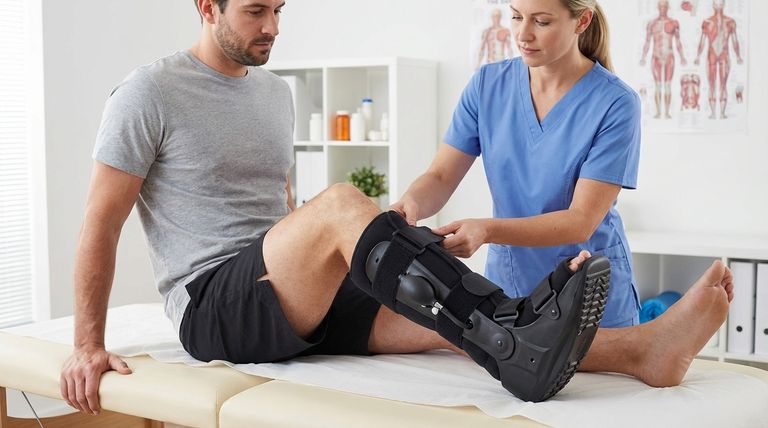
At its core, a walking brace, or walking boot, is a medical device designed to immobilize and support your foot, ankle, or lower leg after an injury. The primary types are distinguished by their height—ranging from ankle-high "low-tops" to knee-high "high-tops"—to accommodate the specific location and severity of the injury.
The most critical factor in choosing a walking brace is not personal preference, but the medical need for immobilization. The height and features of the brace must match the specific requirements for healing your injury, making professional medical guidance essential.
The Two Primary Categories of Walking Braces
Walking braces are fundamentally categorized by their height, as this directly correlates to the level of support and immobilization they provide to the joints and bones of the lower leg.
High-Top (Knee-High) Braces
A high-top brace extends from your foot up to just below the knee. Its structure is designed to fully immobilize the ankle and provide significant support to the lower leg bones (the tibia and fibula).
This extensive support is crucial for more severe conditions. It works by preventing rotational and bending movements at the ankle and lower leg, which is necessary for proper healing of serious injuries.
When Are High-Top Braces Used?
High-top braces are typically prescribed for conditions requiring maximum stability. This includes stable fractures of the lower leg or foot, severe ankle sprains (Grade 2 or 3), and post-operative recovery where complete immobilization is non-negotiable.
Low-Top (Ankle-High) Braces
A low-top brace is significantly shorter, with its support structure ending just above the ankle. This design still protects the foot and ankle but allows for more movement of the lower leg.
The focus of a low-top is to stabilize the foot and ankle specifically, without restricting the calf and upper ankle as much as a high-top model.
When Are Low-Top Braces Used?
These braces are suitable for less severe injuries. They are often used for stable fractures of the foot or ankle, metatarsal stress fractures, and soft tissue injuries where some mobility can be maintained without compromising the healing process.
Key Features That Define Brace Function
Beyond height, several key features determine how a walking brace performs and the specific benefits it offers.
Rigid Shell vs. Soft Shell
Most walking braces feature a rigid outer shell, typically made of durable plastic. This shell provides the primary protection against impact and ensures the structure remains firm to immobilize the limb. Some simpler models may use softer, reinforced fabric, but these offer less protection.
Pneumatic (Air) Liners
Many modern braces are pneumatic, meaning they contain integrated air bladders within the liner. A small pump allows you to add or remove air, providing adjustable compression around your ankle and leg. This feature is excellent for managing swelling and achieving a secure, custom fit.
Rocker Bottom Sole
Nearly all walking braces incorporate a rocker bottom sole. This curved sole is designed to help your foot roll forward naturally as you walk. It compensates for the ankle's inability to bend, promoting a smoother and more efficient gait.
Understanding the Trade-offs
Selecting a walking brace involves balancing competing needs for healing. The choice is always dictated by the medical diagnosis.
Immobilization vs. Mobility
This is the central trade-off. A high-top brace offers maximum immobilization, which is essential for healing fractures but is also more cumbersome. A low-top brace provides more freedom of movement but offers less support, making it unsuitable for injuries that require absolute stability.
Comfort vs. Protection
While a rigid shell offers the best protection, it can feel bulky and heavy. A proper fit is crucial, as a poorly fitted brace can cause chafing, pressure sores, and unequal pressure distribution, potentially hindering the healing process.
Making the Right Choice for Your Injury
Your healthcare provider will make the final determination, but understanding these principles will help you have a more informed discussion about your recovery plan.
- If your primary focus is healing a stable fracture or significant post-operative support: You will almost certainly require a high-top brace for its superior immobilization.
- If your primary focus is supporting a less severe sprain or foot injury: A low-top brace may provide the necessary support while allowing for greater comfort and mobility.
- If your primary focus is managing fluctuating swelling: A brace with a pneumatic (air) liner is critical for providing consistent, adjustable compression.
Ultimately, a walking brace is a precise medical tool, and its selection is a critical first step on the path to a successful recovery.
Summary Table:
| Brace Type | Height | Primary Use | Key Features |
|---|---|---|---|
| High-Top (Knee-High) | Extends to below knee | Severe sprains, stable fractures, post-op recovery | Full ankle/lower leg immobilization, rigid shell |
| Low-Top (Ankle-High) | Ends above ankle | Less severe sprains, foot fractures, soft tissue injuries | Ankle/foot stabilization, allows more leg movement |
Need a Reliable Supplier for Medical Walking Braces?
As a large-scale manufacturer, 3515 produces a comprehensive range of medical footwear and braces for distributors, brand owners, and bulk clients. Our production capabilities ensure high-quality, durable walking braces with features like rigid shells, pneumatic liners, and rocker bottom soles.
Let us support your business with reliable, bulk medical solutions. Contact us today to discuss your specific needs!
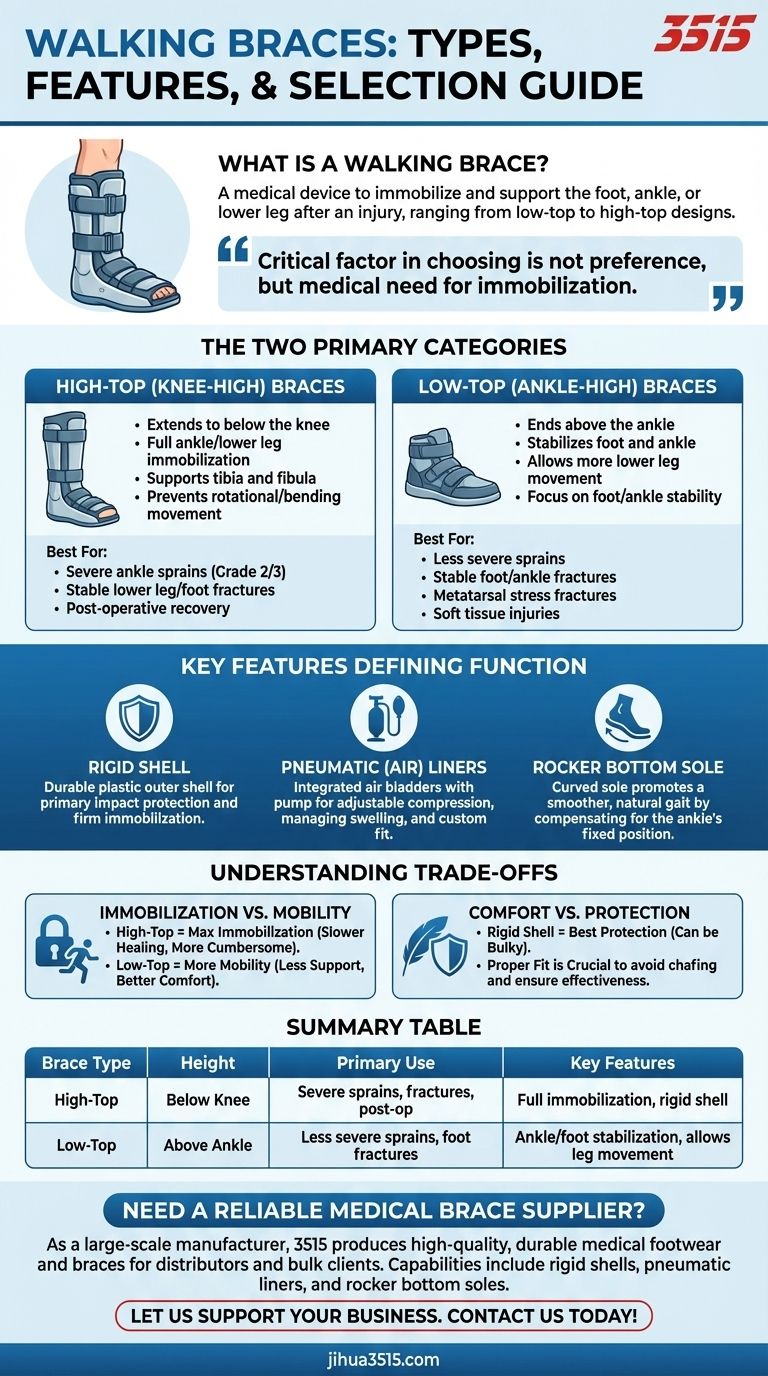
Visual Guide
Related Products
- Wholesale Safety Boots Manufacturer for Custom & Private Label Orders
- Premium Lightweight Safety Shoes for Wholesale & Bulk Orders
- Customizable Slip-On Safety Shoes Direct from the Factory for Wholesale
- Wholesale Durable & Breathable Training Shoes for Custom Brands
- Lightweight Breathable Training Shoes for Wholesale & Custom OEM Manufacturing
People Also Ask
- Why is proper storage important for safety boots? Preserve Protection and Extend Lifespan
- How should safety boots be cleaned to avoid damage? A Gentle Guide to Preserve Your Boots
- What are the risks of using ordinary rubber boots in forest clearing? Why professional safety boots are essential
- What are the key features of safety boots? Essential Protection for Hazardous Workplaces
- What are the consequences of not wearing safety boots? Protect Your Finances and Career









