
It is only safe to begin bearing weight in a walking boot when your attending healthcare provider—such as an orthopedic surgeon or physical therapist—gives you explicit clearance. This decision is based on the specific type and severity of your injury, the stability of the fracture or repair, and evidence of healing shown on imaging like X-rays.
The core principle is that weight bearing must be delayed until the bone or soft tissue has healed enough to withstand the load without compromising the repair or causing further damage. This timeline is not standardized; it is uniquely determined by your provider based on your individual injury and healing progress.
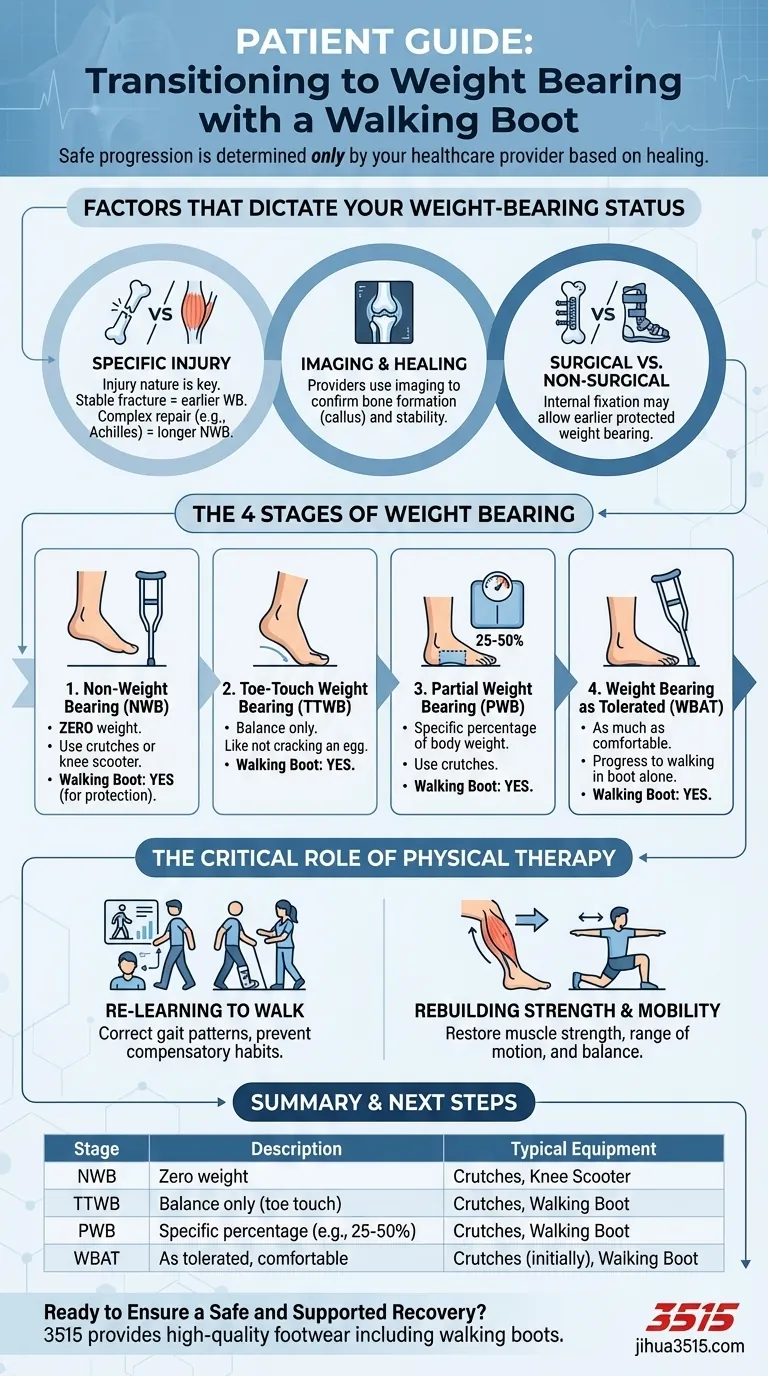
The Factors That Dictate Your Weight-Bearing Status
Your provider synthesizes several critical pieces of information to determine when you can safely start putting weight on your injured leg. This is a clinical judgment call that balances the need for protection with the benefits of early mobility.
Your Specific Injury is the Primary Driver
The nature of your injury is the most important factor. A simple, stable, non-displaced fracture will have a much different timeline than a complex, surgically-repaired one.
For example, a stable ankle fracture might be cleared for weight bearing as tolerated (WBAT) in a boot almost immediately or within a few weeks. In contrast, a complex repair like an Achilles tendon rupture often requires a strict non-weight-bearing (NWB) period of 4-6 weeks or more to protect the delicate surgical repair.
Healing is Assessed with Imaging
Providers rely on objective evidence, not just time, to make their decision. Follow-up X-rays are crucial for assessing bone healing.
The provider looks for signs of a "callus," which is new bone formation bridging the fracture gap. Until this callus is mature enough to provide stability, putting weight on the limb could displace the fracture and reset the healing clock.
Surgical vs. Non-Surgical Treatment Matters
How your injury was treated significantly impacts the timeline.
If you had surgery with internal fixation (plates, screws, rods), this hardware provides initial stability. This can sometimes allow for an earlier, protected return to weight bearing compared to an injury managed non-surgically in a cast or boot alone.
Understanding the Stages of Weight Bearing
Your provider will not simply switch you from "no weight" to "full weight." It is a gradual, controlled process, and the walking boot is the tool that facilitates it.
Non-Weight Bearing (NWB)
This is the initial, most protective phase. You are instructed to put zero weight on the injured leg. You will use crutches or a knee scooter for all mobility. This allows the initial, fragile stages of healing to occur without disruption.
Toe-Touch Weight Bearing (TTWB)
This is the first step in reintroducing load. You are allowed to let your foot touch the floor for balance only, with the amount of pressure being similar to what you'd use to keep an egg from cracking. The boot protects the foot and ankle as you re-learn to stand on two feet.
Partial Weight Bearing (PWB)
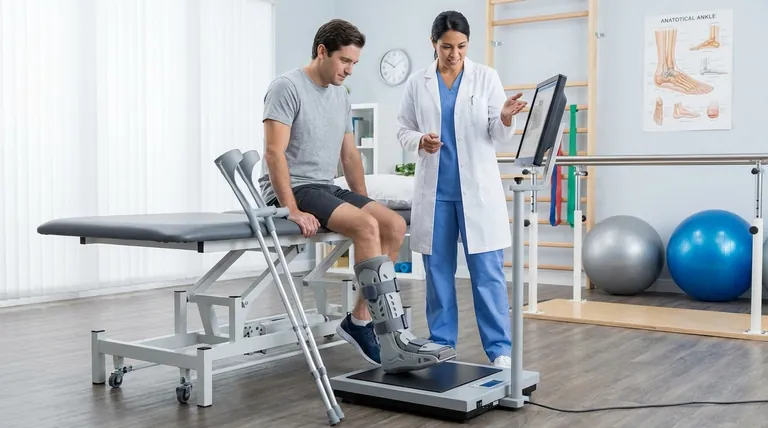
You will be cleared to put a specific amount of weight through the leg, often prescribed as a percentage (e.g., 25% or 50% of your body weight). A physical therapist may have you use a scale to learn what this feels like. Crutches are still required to offload the remaining percentage.
Weight Bearing as Tolerated (WBAT)
This is the final stage before transitioning out of the boot. You are cleared to put as much weight on the leg as you can comfortably tolerate. You may start with two crutches, progress to one, and then eventually walk in the boot alone without assistance. The boot provides essential support and stability during this transition.
The Critical Role of Physical Therapy
A physical therapist is your essential partner in this process. Once your provider clears you for weight bearing, a therapist will guide you on how to do it safely and correctly.
Re-learning to Walk
You will need to re-learn your normal walking (gait) pattern. A therapist ensures you do not develop compensatory habits—like limping—that can lead to other problems in your hip or back.
Rebuilding Strength and Mobility
The muscles in your leg will have weakened (atrophied) from disuse. Physical therapy focuses on targeted exercises to restore strength, range of motion, and balance, which are all critical for a successful return to normal activity.
Making the Right Choice for Your Recovery
Navigating the recovery process requires patience and strict adherence to your medical team's instructions. Attempting to bear weight before you are cleared can lead to significant setbacks.
- If your primary focus is a safe and complication-free recovery: Follow your provider's weight-bearing instructions exactly as prescribed, even if you feel you can do more.
- If your primary focus is regaining full function as quickly as possible: Engage fully with your physical therapist to correctly progress your weight bearing, rebuild strength, and restore a normal gait pattern.
- If you are unsure about your status or instructions: Always contact your surgeon's office or physical therapist for clarification before making any changes.
Ultimately, your recovery is a structured process where each step builds upon the last, and the decision to bear weight is a critical milestone determined solely by your medical provider.
Summary Table:
| Stage of Weight Bearing | Description | Typical Equipment Needed |
|---|---|---|
| Non-Weight Bearing (NWB) | Zero weight on the injured leg. | Crutches, knee scooter. |
| Toe-Touch Weight Bearing (TTWB) | Foot touches floor for balance only. | Crutches, walking boot. |
| Partial Weight Bearing (PWB) | A specific percentage of body weight (e.g., 25-50%). | Crutches, walking boot. |
| Weight Bearing as Tolerated (WBAT) | As much weight as is comfortable. Progressing to walking in the boot alone. | Crutches (initially), walking boot. |
Ready to Ensure a Safe and Supported Recovery?
Navigating the stages of weight bearing requires the right protective gear. As a large-scale manufacturer, 3515 produces a comprehensive range of high-quality footwear, including the specialized walking boots essential for post-injury rehabilitation. Our products offer the durability and support needed by distributors, brand owners, and bulk clients who serve patients and medical facilities.
Let us provide the reliable footwear solutions that protect your customers during their critical healing process. Contact our team today to discuss your needs and how we can support your business.
Visual Guide
Related Products
- Wholesale Durable Camouflage Canvas Shoes with High-Traction Cleated Rubber Sole
- Durable Rubber Sole Outdoor Shoes Wholesale & Custom Manufacturing
- Durable Goodyear Welt Leather Work Boots for Wholesale & Private Label
- Wholesale High-Traction Camo Boots - Custom Manufacturer for Brands
- Heavy-Duty Waterproof Nubuck Safety Boots Safety Shoes for Bulk Supply
People Also Ask
- Why is the selection of high-strength fabric materials necessary in the production of canvas shoes and training shoes?
- What are the properties of canvas as a shoe material? A Guide to Lightweight Comfort & Style
- Can canvas shoes be worn in rainy conditions? The Truth About Water Resistance
- What are some examples of vulcanized shoes? Discover the Flexibility and Board Feel of Classic Sneakers
- What are the characteristics of canvas as a shoe material? A Guide to Lightweight, Breathable Footwear



















