
When properly constructed and correctly fitted, a quality pair of cowboy boots provides significant foot support. Their traditional design, born from the functional needs of horseback riding, incorporates a rigid structure that stabilizes the foot and supports the arch during extended periods of walking, standing, or working. The key is understanding that this support comes from structure, not soft cushioning.
The support offered by a cowboy boot is fundamentally different from that of an athletic shoe. It relies on a rigid steel shank for arch integrity and a firm heel counter for stability, creating a supportive platform that molds to your foot over time.
Deconstructing Cowboy Boot Support
To understand how a cowboy boot provides support, you must look at its core components. The magic isn't in a single feature, but in how several elements work together as a system.
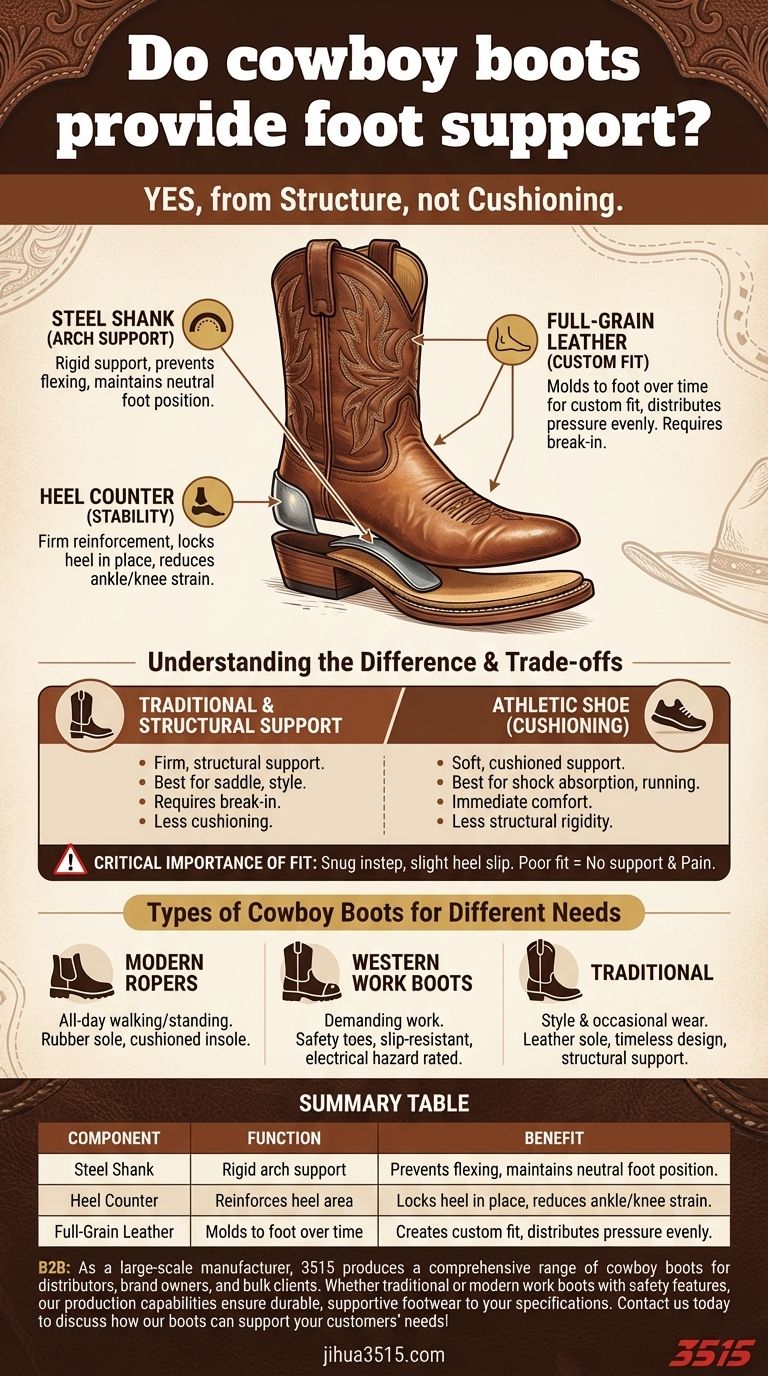
The Steel Shank: Your Arch's Best Friend
The shank is a small, rigid piece of metal (usually steel) built into the space between the insole and outsole, directly under the arch of your foot.
This component is the primary source of arch support. It prevents the boot from flexing or collapsing in the middle, ensuring your arch is held in a stable, neutral position.
The Heel Counter: A Foundation of Stability
The heel counter is a firm, cup-like insert that reinforces the back of the boot, cradling your heel.
This crucial element prevents your foot from rolling inward or outward (pronating or supinating). It locks your heel in place, providing a stable foundation for every step and reducing strain on your ankles and knees.
How Leather Creates a Custom Fit
High-quality boots are made from full-grain leather, which is initially stiff. While this requires a break-in period, it's a critical part of the support process.
As you wear the boots, the warmth and pressure from your foot cause the leather to gradually mold to your unique contours. This creates a custom-like fit that distributes pressure evenly and eliminates friction points, enhancing both comfort and support.
Not All Cowboy Boots Are Created Equal
The term "cowboy boot" covers a wide range of products, from fashion-focused designs to heavy-duty work equipment. The level and type of support vary significantly between them.
Traditional vs. Modern Designs
Traditional boots are built for the saddle, with smooth leather soles and tall, angled heels designed to hold a stirrup securely. While they offer excellent structural support, they may lack the cushioning and traction needed for all-day walking on hard surfaces.
Modern boots, often called "ropers" or "western work boots," are designed with walking and standing in mind. They frequently feature rubber outsoles for better grip and shock absorption, along with more cushioned insoles.
The Work Boot Hybrid
A growing category of cowboy boots integrates advanced safety and support features. These boots merge the classic Western aesthetic with the functionality of a dedicated work boot.
They often include steel or composite safety toes, slip-resistant outsoles, and electrical hazard ratings, proving the cowboy boot platform can be adapted for the most demanding environments.
Understanding the Trade-offs
While well-made cowboy boots offer excellent support, it's essential to understand their limitations and the factors that can lead to a poor experience.
The Break-in Period is Real
The very stiffness that allows the leather to mold to your foot means most new boots will feel tight or uncomfortable at first. This is a necessary trade-off for achieving a long-lasting, custom fit.
Support Without Cushioning
The support in a traditional cowboy boot is firm and structural. If you are accustomed to the soft, pillowy feel of modern sneakers, the initial feel can be jarring. The boot is designed to hold your foot correctly, not to feel like a slipper.
The Critical Importance of Fit
No design feature can compensate for a poor fit. A cowboy boot should be snug across the instep (the top of your foot) while allowing for a small amount of heel slip when you walk. If it's too loose or too tight, it will fail to provide support and will cause pain.
Making the Right Choice for Your Needs
To ensure your boots provide the support you need, match the boot's features to your primary activity.
- If your primary focus is all-day walking or standing: Look for a modern boot with a durable rubber sole and a cushioned, removable insole for shock absorption.
- If your primary focus is demanding physical work: Choose a dedicated Western work boot with the specific safety ratings (e.g., safety toe, slip resistance) your job requires.
- If your primary focus is style and occasional wear: A traditional leather-soled boot will provide excellent structural support and timeless style.
A well-chosen cowboy boot is more than footwear; it's a durable tool engineered to support you from the ground up.
Summary Table:
| Component | Function | Benefit |
|---|---|---|
| Steel Shank | Rigid arch support | Prevents flexing, maintains neutral foot position |
| Heel Counter | Reinforces heel area | Locks heel in place, reduces ankle/knee strain |
| Full-Grain Leather | Molds to foot over time | Creates custom fit, distributes pressure evenly |
As a large-scale manufacturer, 3515 produces a comprehensive range of cowboy boots for distributors, brand owners, and bulk clients. Whether you need traditional leather-soled boots for style or modern work boots with safety toes and cushioned insoles, our production capabilities ensure durable, supportive footwear built to your specifications. Contact us today to discuss how our boots can support your customers' needs!
Visual Guide
Related Products
- Wholesale High-Traction Camo Boots - Custom Manufacturer for Brands
- High-Traction Suede Tactical Boots Wholesale & Custom Manufacturing
- Wholesale Lightweight Tactical Boots Custom Manufacturer for Desert & Combat Use
- Durable Leather Tactical Boots Wholesale & Custom Manufacturing for Brands
- Wholesale Durable Mid-Cut Tactical Boots for Custom & Private Label Brands
People Also Ask
- What are the key features of the new line of camo boots? Built for Extreme Cold & Rugged Terrain
- Are camo boots necessary for hunting success? Prioritize Performance Over Pattern
- How does the Rank Score Test identify the primary causes of premature failure in tactical and work boots? Key Insights
- What is the technical logic behind using closed-eye testing for tactical boots? Unlocking Peak Footwear Stability
- What shoes to wear for a security job? Durable, Protective Footwear for Long Shifts

















