
When choosing socks for Wellington boots, the two most critical factors are length and material. Your socks must be taller than the boot shaft to prevent the rim from rubbing against your skin, and the material must be chosen to manage moisture and temperature based on your specific activity and environment.
The core principle is to view your socks and boots as a single system. Because traditional rubber wellingtons are not breathable, the sock bears the entire responsibility for managing sweat and maintaining a stable temperature for your foot.

Why Your Sock Choice Is as Important as Your Boot
While the boot protects you from the outside world, the sock manages the environment immediately surrounding your foot. Getting this wrong leads to discomfort, blisters, and cold, clammy feet.
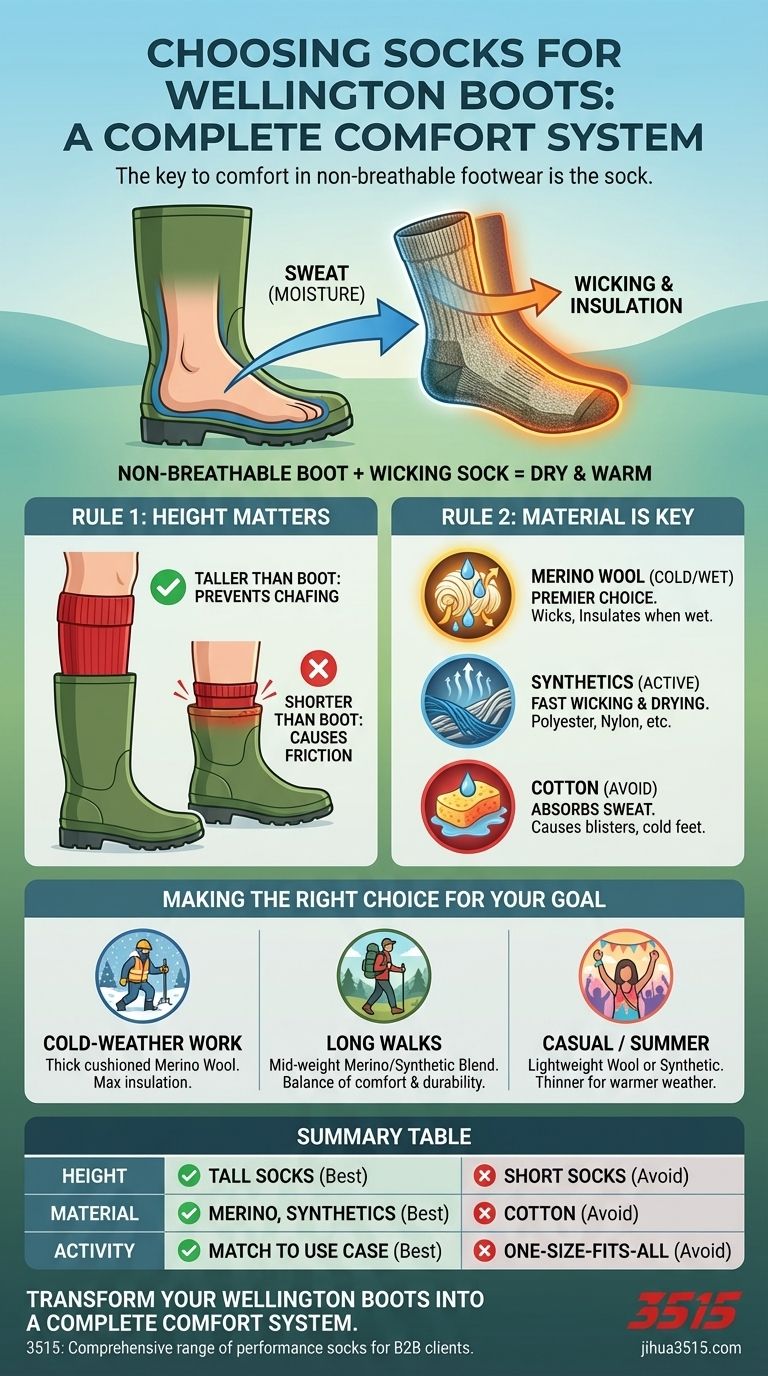
The First Rule: Height Matters
The top edge of a Wellington boot can cause significant friction and chafing against your bare leg during a walk.
Your sock must act as a protective barrier. Always choose a sock that extends several inches above the top of your boot, ensuring no part of the boot rim ever touches your skin.
Managing Temperature and Moisture
Your feet sweat, even in cold conditions. In a non-breathable rubber boot, that moisture has nowhere to go.
A sock's primary job in a welly is to pull that sweat away from your skin (a process called wicking) and hold it in the fabric so your foot feels dry. This is essential for preventing blisters and keeping feet warm, as damp skin loses heat much faster.
Matching Sock Material to Your Environment
The material is the most important decision you will make. It directly dictates the comfort and performance of your entire footwear system.
For Cold and Wet Conditions: Merino Wool
Merino wool is the premier choice for most Wellington boot applications, especially in cool or cold weather.
It is exceptionally good at wicking moisture and can absorb up to 30% of its weight in water before it even begins to feel damp. Crucially, it continues to insulate and feel warm even when wet.
For Active Use and Versatility: Synthetics
Synthetic materials like polyester, nylon, and acrylic are excellent at wicking moisture. They pull sweat away from the skin very quickly and dry fast.
These are a great choice for more active use where you anticipate heavy sweating. Many high-performance socks blend synthetics with wool to get the benefits of both.
The Material to Almost Always Avoid: Cotton
Cotton is highly absorbent, which is precisely what you don't want in a Wellington boot.
It soaks up sweat like a sponge and holds it directly against your skin. This leads to friction, blisters, and rapid heat loss, leaving your feet feeling cold and damp. Avoid cotton socks for anything other than very brief, casual wear.
Understanding the Trade-offs: The Non-Breathable Boot
The primary limitation of a traditional Wellington boot is its lack of breathability. This places an enormous demand on your socks.
The Problem with Rubber
Rubber and neoprene are completely waterproof, which is excellent for keeping external water out. However, they are also completely non-breathable, trapping all the perspiration your feet produce.
This creates a warm, humid microclimate inside the boot, which is the perfect environment for blisters and discomfort if your sock isn't up to the task.
How Wicking Socks Create Comfort
A high-performance wicking sock (wool or synthetic) effectively creates a "dry zone" around your skin, even as the sock itself becomes damp.
It pulls moisture away from the foot and spreads it across a larger surface area within the sock's fibers. This function is the single most important factor for all-day comfort in wellies.
Making the Right Choice for Your Goal
Select your socks based on the intended activity, not just the boot.
- If your primary focus is warmth for cold-weather work: Choose a thick, cushioned Merino wool sock for maximum insulation and moisture management.
- If your primary focus is comfort on long country walks: Opt for a mid-weight sock made from a Merino wool and synthetic blend to balance cushioning, durability, and wicking.
- If your primary focus is casual use at a summer festival: A lightweight wool or synthetic sock is still best, but you can prioritize a thinner design for comfort in warmer weather.
Investing in the right socks transforms your Wellington boots from a simple piece of rubber footwear into a comfortable and effective system.
Summary Table:
| Factor | Key Consideration | Best Choice | Avoid |
|---|---|---|---|
| Height | Must extend above boot shaft to prevent chafing | Tall socks (several inches above boot) | Socks shorter than boot rim |
| Material | Manages moisture and temperature based on activity | Merino wool (cold/wet), synthetics (active) | Cotton (holds moisture) |
| Activity | Match sock to use case (warmth, walking, casual) | Thick wool for work, blends for walks, lightweight for summer | One-size-fits-all approach |
Transform Your Wellington Boots into a Complete Comfort System
As a large-scale manufacturer, 3515 produces a comprehensive range of performance socks and footwear for distributors, brand owners, and bulk clients. Our expertise ensures your feet stay dry, warm, and blister-free—whether for work, walking, or casual wear.
Contact us today to discuss custom sock solutions that perfectly complement your Wellington boots!
Visual Guide
Related Products
- Durable Waterproof Rain Boots | Custom Manufacturer for Wholesale & Brands
- Premium Wholesale Tactical Style Safety Shoes Boots with Quick Lacing
- Wholesale Waterproof Tactical Boots Custom Suede & High-Traction Soles
People Also Ask
- What are the main materials for waterproof rain boots? Choose the Right Material for Durability & Comfort
- What is the overall recommendation for choosing rain boot materials? A Guide to Rubber vs. PVC
- How does boot height affect waterproofing? Choose the Right Height for Ultimate Protection
- Why are rain boots more flexible and comfortable than snow boots? The Key Differences Explained
- What are the best types of shoes for different gardening conditions? Find Your Perfect Match.


