
To convert adult wellington boot sizes, you will find a consistent, linear scale where European (EU) sizes range from 36 to 51, corresponding directly to United Kingdom (UK) sizes from 3 to 15. The most reliable method is to follow a standard conversion chart, but always verify with the specific brand's guidelines for the most accurate fit.
While a standard conversion chart provides a solid starting point, the unique design of wellingtons—often worn with thick socks and needing to fit the calf—means that relying solely on a direct number conversion can be misleading.
The Standard Adult Wellington Size Conversion
The conversion between EU and UK sizing for adult footwear is generally consistent across most brands. It follows a predictable pattern that is easy to reference.
UK to EU Conversion Chart
This table provides a direct, at-a-glance conversion for the most common adult wellington boot sizes.
| UK Size | EU Size |
|---|---|
| 3 | 36 |
| 4 | 37 |
| 5 | 38 |
| 6 | 39/40 |
| 7 | 41 |
| 8 | 42 |
| 9 | 43 |
| 10 | 44/45 |
| 11 | 46 |
| 12 | 47 |
| 13 | 48 |
| 14 | 49/50 |
| 15 | 51 |
The Core Formula
For a quick mental calculation, the general rule is to subtract 33 from the European size to get the approximate UK size. For example, an EU size 42 minus 33 equals a UK size 9.
Unisex Sizing Conventions
Unlike more tailored footwear, most wellington boots are sold in unisex sizes. The conversion chart above applies equally to men's and women's boots, though some brands may offer models with a narrower fit.
Beyond the Chart: Factors for a Perfect Fit
A simple size number doesn't tell the whole story. The functional design of a wellington boot introduces other variables that are critical for comfort and usability.
The "Welly Fit" Factor
Wellingtons are often designed with extra room to accommodate thick, warm socks. This is a key difference from standard shoes or trainers.
Calf Width and Boot Height
The most common reason a wellington boot doesn't fit has nothing to do with your feet. Calf width is a critical measurement that determines if you can even get the boot on comfortably.
Always check the manufacturer's specifications for the boot's calf circumference and height to ensure it matches your leg measurements.
Inevitable Brand Variation
Every brand uses a different "last"—the mold that a boot is shaped around. This means an EU 42 from one brand can feel noticeably different from an EU 42 in another.
Common Pitfalls to Avoid
Understanding the conversion is the first step. Avoiding common mistakes is the next, and it is crucial for a successful purchase, especially online.
Assuming a "True to Size" Fit
Directly converting your standard shoe size might result in a boot that's too snug once you put on winter socks. If you are between sizes, sizing up is often the safest choice.
Ignoring the Intended Use
A boot for heavy-duty farm work requires a different fit than one for casual dog walking. A snugger fit prevents rubbing on long walks, while a looser fit is fine for slipping on and off for garden use.
Trusting Generic Charts Over Brand Guides
A generic conversion chart is an excellent guide, but it should never replace the manufacturer's specific size chart. Always prioritize the measurements provided by the brand you intend to purchase.
Making the Right Choice for Your Goal
Use your intended activity to guide your final sizing decision.
- If your primary focus is a snug, performance fit for long walks: Measure your foot precisely and compare it to the brand's chart, factoring in the thickness of your preferred socks.
- If your primary focus is a comfortable, all-purpose fit for casual use: Sizing up, especially if you fall between sizes, is a reliable strategy to ensure room for warm socks.
- If you are buying online without trying them on: Do not guess. Always measure your foot length and calf circumference and cross-reference them with the brand’s specific product measurements.
Trusting the manufacturer's detailed measurements is the single best way to ensure your wellingtons fit perfectly from day one.
Summary Table:
| UK Size | EU Size |
|---|---|
| 3 | 36 |
| 4 | 37 |
| 5 | 38 |
| 6 | 39/40 |
| 7 | 41 |
| 8 | 42 |
| 9 | 43 |
| 10 | 44/45 |
| 11 | 46 |
| 12 | 47 |
| 13 | 48 |
| 14 | 49/50 |
| 15 | 51 |
Need Perfect-Fitting Wellington Boots in Bulk?
As a large-scale manufacturer, 3515 produces a comprehensive range of durable wellingtons and footwear for distributors, brand owners, and bulk clients. We understand that a perfect fit is crucial for comfort and performance. Our production capabilities encompass all types of shoes and boots, ensuring we can meet your exact specifications and volume requirements.
Let us help you deliver the right fit to your customers. Contact our team today to discuss your manufacturing needs.
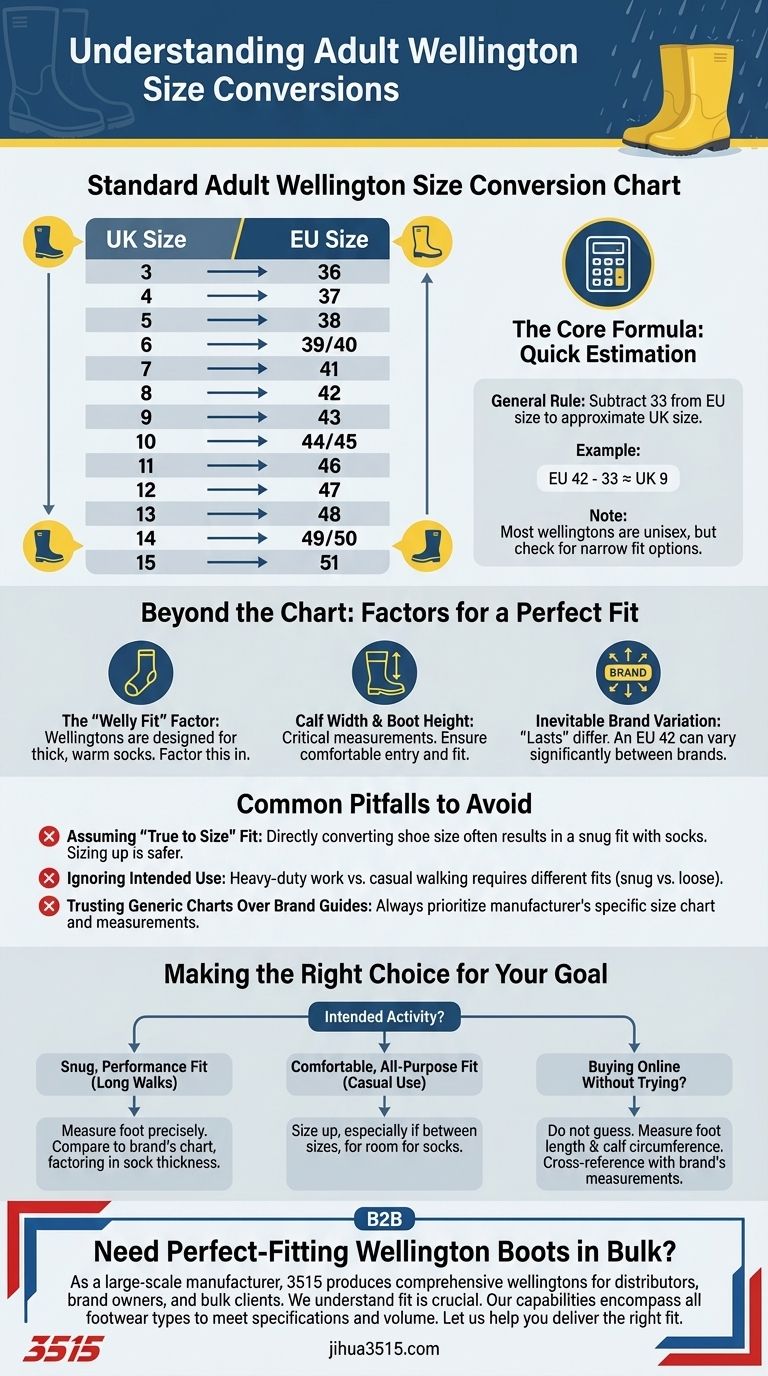
Visual Guide
Related Products
- Durable Waterproof Rain Boots | Custom Manufacturer for Wholesale & Brands
- Durable Goodyear Welt Leather Work Boots for Wholesale & Private Label
- Wholesale Durable Leather Work Boots | 8-Inch Goodyear Welt Manufacturer
- Premium Wholesale Tactical Style Safety Shoes Boots with Quick Lacing
- Durable High-Ankle Tactical Boots Wholesale Manufacturer for Custom & Bulk Orders
People Also Ask
- What are the main materials for waterproof rain boots? Choose the Right Material for Durability & Comfort
- What is the overall recommendation for choosing rain boot materials? A Guide to Rubber vs. PVC
- How does boot height affect waterproofing? Choose the Right Height for Ultimate Protection
- Why are rain boots more flexible and comfortable than snow boots? The Key Differences Explained
- What are the best types of shoes for different gardening conditions? Find Your Perfect Match.



















