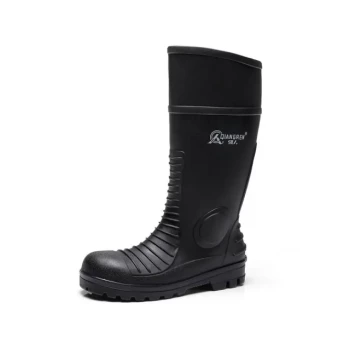
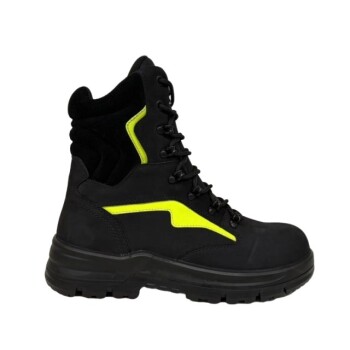
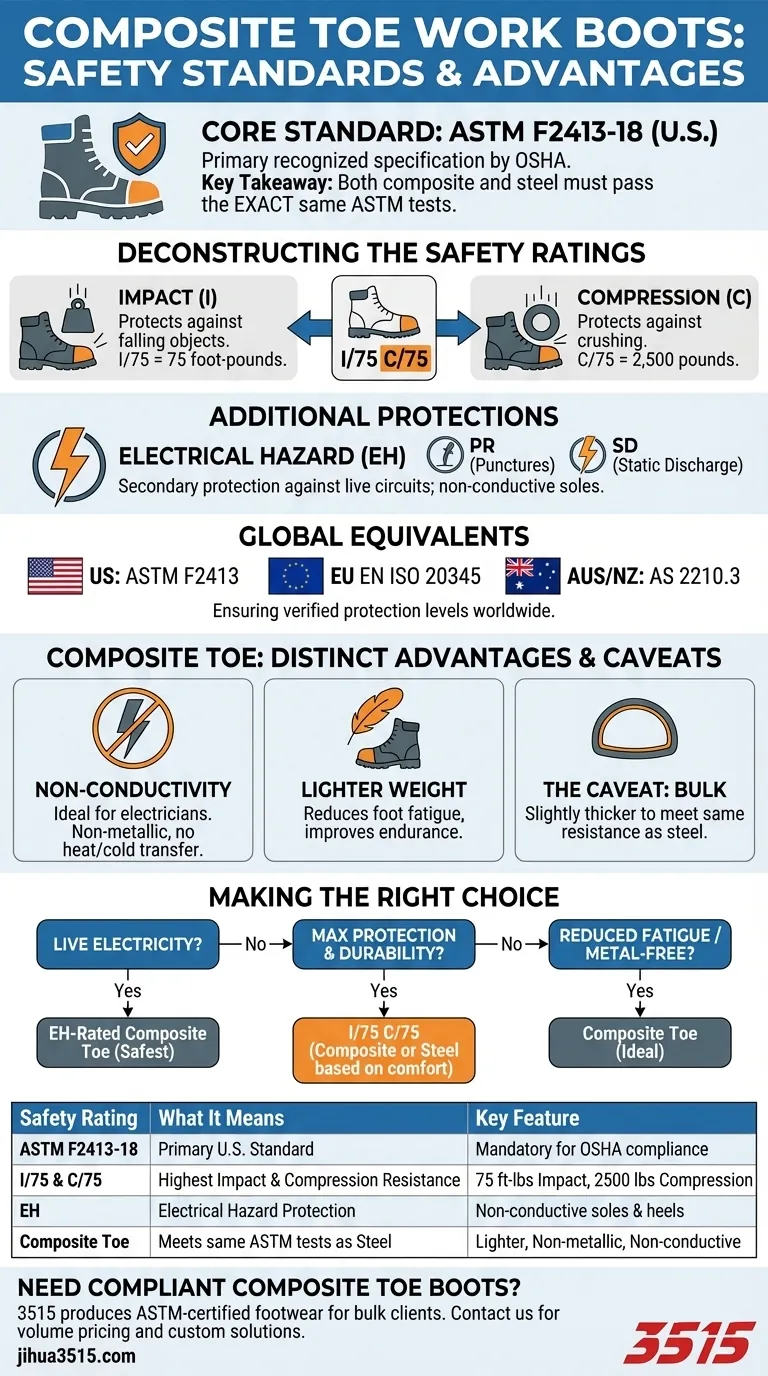
In short, composite toe work boots sold in the United States must meet the ASTM F2413 standard for protective footwear. This is the primary safety specification recognized by the Occupational Safety and Health Administration (OSHA). The most current version of this standard is often cited as ASTM F2413-18, indicating it was last updated in 2018.
The key takeaway is that both composite and steel toe boots must pass the exact same ASTM tests for impact and compression resistance. The standard does not differentiate; if a boot is certified, it is considered protective, regardless of the toe cap material.
Deconstructing the Core Safety Standard: ASTM F2413
The ASTM F2413 standard is the benchmark for safety toe footwear in the U.S. It establishes the minimum performance requirements for a boot to be considered protective.
The Foundation: Impact and Compression
The most critical function of a safety toe boot is to protect your feet from falling objects and crushing forces.
The ASTM standard has two specific ratings for this:
- Impact (I): This tests the boot's ability to protect the toe from a heavy object dropping on it.
- Compression (C): This tests the boot's ability to protect the toe from a heavy object rolling over it.
Boots are rated on a scale, with "75" being the highest level of protection, capable of withstanding 75 foot-pounds of impact and 2,500 pounds of compression. A compliant boot will be labeled I/75 and C/75.
Beyond the Toe Cap: Additional Protections
The ASTM standard also covers other potential workplace hazards. A boot's label will list specific codes for the additional protections it offers.
One of the most common is Electrical Hazard (EH). An EH-rated boot is constructed with non-conductive, shock-resistant soles and heels, providing a secondary source of protection against accidental contact with live electrical circuits.
Other ratings can include protection against punctures (PR) or static discharge (SD).
Regulatory Oversight and Global Standards
It's important to understand how different organizations' rules apply to your footwear.
The Role of OSHA
The Occupational Safety and Health Administration (OSHA) is a regulatory agency that sets and enforces workplace safety rules.
OSHA does not certify footwear itself. Instead, it requires employers to ensure their employees wear protective footwear that meets an accepted standard, such as ASTM F2413, when working in hazardous areas.
International Equivalents
While ASTM F2413 is the U.S. standard, other countries have their own certifying bodies.
Internationally, you will often see boots that comply with EN ISO 20345, which is the European and international standard. Australia and New Zealand use AS 2210.3. These standards serve the same purpose as ASTM, ensuring a verified level of protection.
Understanding the Trade-offs
While composite and steel toe boots must meet the same minimum safety requirements, the material differences create distinct advantages for different work environments.
Key Advantage: Non-Conductivity
Composite materials do not conduct electricity, making them the superior choice for electricians or anyone working in an environment with a risk of electrical shock. They also do not conduct heat or cold, offering better comfort in extreme temperatures.
Key Advantage: Lighter Weight
Composite toe caps are typically lighter than steel ones. This reduction in weight can lead to significantly less foot fatigue over a long workday, improving overall comfort and endurance.
The Caveat: Bulk
To achieve the same level of impact and compression resistance as steel, a composite toe cap often needs to be slightly thicker or bulkier. While modern designs have minimized this, it remains a fundamental difference in the materials.
Making the Right Choice for Your Workplace
To select the right boot, match its specific safety ratings to the known hazards of your job.
- If your primary focus is working with live electricity: A boot rated for Electrical Hazard (EH) with a composite toe is the safest possible choice.
- If your primary focus is maximum protection in a construction or heavy industrial setting: Any boot rated I/75 and C/75 will suffice, so your choice between composite and steel can be based on weight and comfort.
- If your primary focus is reducing daily fatigue or passing through metal detectors: The lighter weight and non-metallic nature of composite toes make them the ideal solution.
Ultimately, understanding the specific codes on the boot's tag is the key to ensuring you have the right protection for the job.
Summary Table:
| Safety Rating | What It Means | Key Feature |
|---|---|---|
| ASTM F2413-18 | Primary U.S. standard for protective footwear | Mandatory for OSHA compliance |
| I/75 & C/75 | Highest level of impact & compression resistance | Protects against 75 ft-lbs impact & 2,500 lbs compression |
| EH (Electrical Hazard) | Secondary protection against live circuits | Non-conductive soles and heels |
| Composite Toe | Meets same ASTM tests as steel toe | Lighter weight, non-metallic, non-conductive |
Need compliant composite toe boots for your team?
As a large-scale manufacturer, 3515 produces a comprehensive range of ASTM-certified work boots for distributors, brand owners, and bulk clients. Our production capabilities ensure you get the right protective footwear—combining safety, comfort, and durability—tailored to your specific workplace hazards.
Contact us today for volume pricing and custom solutions.
Visual Guide
Related Products
- Wholesale Durable Safety Boots Manufacturer Customizable Steel Toe Work Boots
- Durable Leather Moc Toe Work Boots for Wholesale & Custom Manufacturing
- Durable Moc-Toe Wedge Work Boots | Wholesale Manufacturing for Brands
- Durable Moc Toe Wedge Sole Work Boots for Wholesale and Private Label
- Wholesale Customizable Safety Boots Durable & Protective Footwear Manufacturing
People Also Ask
- What are the pros and cons of steel toe work boots? A Guide to Maximum Protection vs. Comfort
- What are the different types of steel toe work boots? Choose the Right Boot for Your Job
- What is the history of steel toe work boots? From German Invention to Modern Safety Standard
- How much weight can steel toe work boots withstand? Unpacking the 3,372 lb. Safety Standard
- What are some common myths about steel toe work boots? Debunked for Modern Workers