
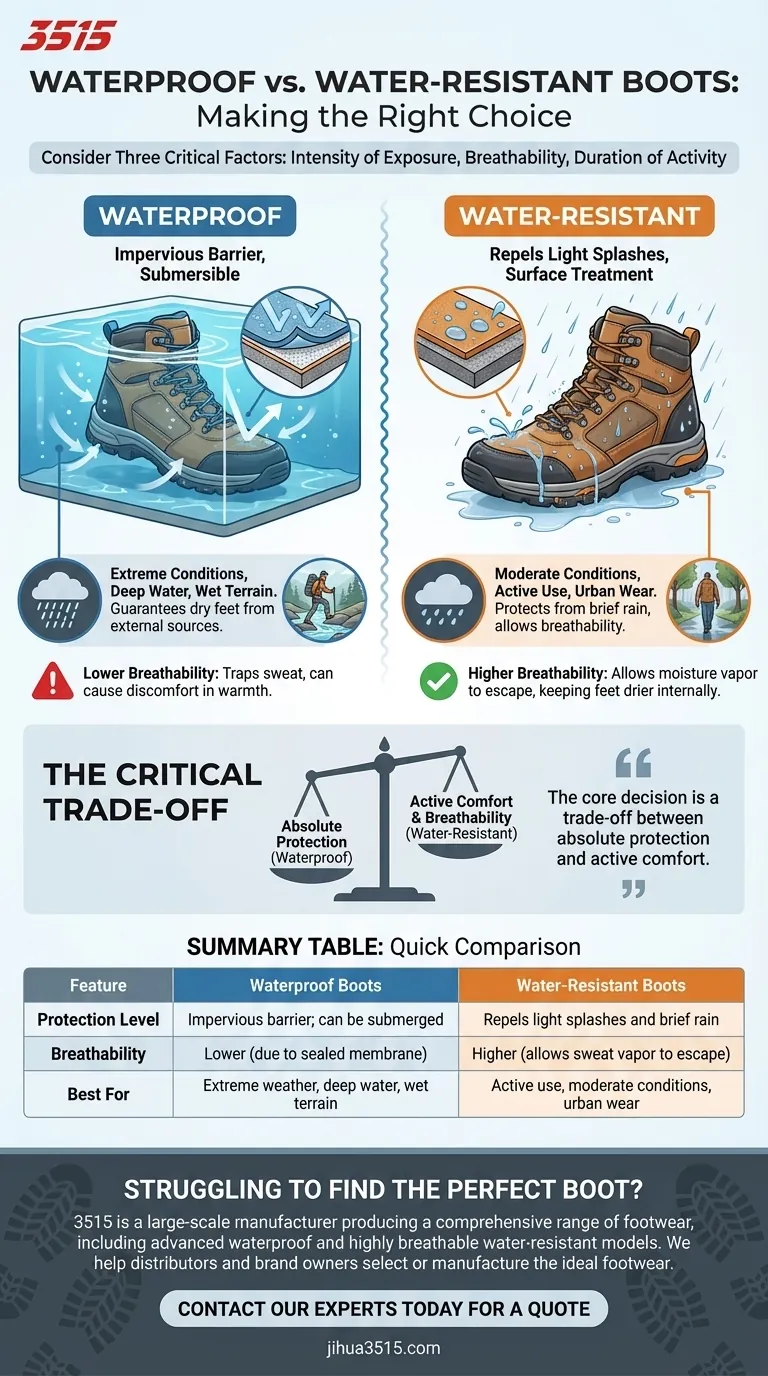
The choice between waterproof and water-resistant boots hinges on three critical factors. Your decision must be based on the intensity of water exposure you expect, the importance of breathability for your comfort, and the duration of your activity. Waterproof boots offer a complete, submersible barrier against moisture, making them essential for extreme conditions. Water-resistant boots provide protection from light splashes or brief rain while allowing your feet to breathe, making them superior for moderate conditions and active use.
The core decision is a trade-off between absolute protection and active comfort. Waterproof boots guarantee dry feet from external water at the cost of internal breathability, while water-resistant boots prioritize foot comfort and breathability at the cost of complete protection.
Defining the Levels of Protection
To make an informed choice, you must first understand what these terms mean in practice. The difference lies not in degree, but in fundamental construction and performance limits.
What "Waterproof" Truly Means
A waterproof boot is designed to be a completely impervious barrier to water. This means it can be fully submerged for extended periods without allowing moisture to penetrate.
This level of protection is achieved through a waterproof membrane or lining, such as Gore-Tex, built into the boot's structure. Crucially, all components—including the seams, sole attachment, and tongue—are sealed to prevent any point of entry for water.
Understanding "Water-Resistant"
A water-resistant boot is treated to repel water from its surface. The material itself, often leather or tightly woven synthetics, will cause water to bead up and roll off initially.
However, this protection is limited. Under sustained exposure, heavy rain, or any kind of pressure, water will eventually saturate the material and seep through. The terms water-resistant and water-repellent are often used interchangeably to describe this surface-level defense.
The Submersion Test
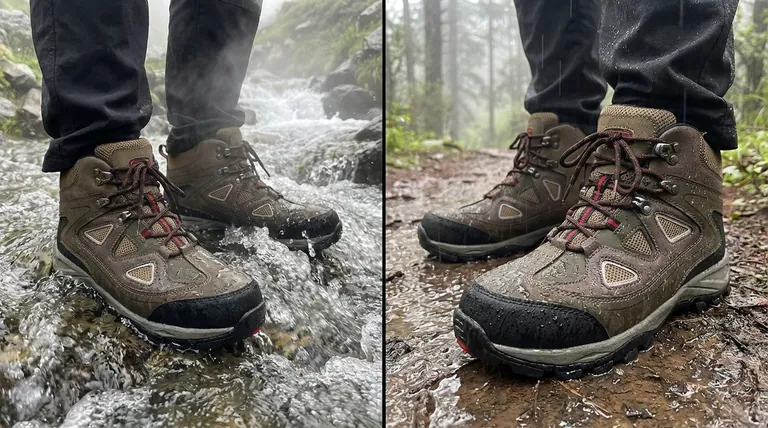
The simplest way to conceptualize the difference is with a submersion test. You can stand in a deep puddle or a shallow stream with waterproof boots and your feet will remain dry. Attempting this with water-resistant boots will result in wet feet.
The Critical Trade-off: Breathability
The primary drawback of a fully waterproof system is its impact on breathability. Preventing water from getting in also makes it much harder for sweat and water vapor to get out.
The Cost of a Perfect Seal
Because a waterproof membrane is a non-porous barrier, it significantly limits the escape of sweat vapor from your feet.
During strenuous activity or in warmer weather, this can lead to damp, clammy feet even if no external water gets in. This moisture can lead to blisters and discomfort just as easily as a leak.
The Advantage of Breathability
Water-resistant boots, lacking a sealed membrane, allow water vapor to escape much more effectively. This keeps your feet drier from the inside out and regulates temperature more efficiently.
For long hikes in fair weather or active work in moderate conditions, the breathability of a water-resistant boot provides a significant comfort advantage.
Making the Right Choice for Your Activity
Your decision should be guided entirely by the environment and activity you have planned.
-
If your primary focus is extreme weather or wet terrain: Choose true waterproof boots. For hiking through streams, working in deep mud, or facing relentless downpours, nothing else will keep you dry.
-
If your primary focus is all-day comfort during active use: Opt for water-resistant boots. For long trail hikes with a chance of a shower or demanding work in damp (but not soaked) conditions, their breathability is essential.
-
If your primary focus is urban commuting or casual wear: Water-resistant footwear offers the ideal balance. It provides more than enough protection for a rainy walk from the train while remaining comfortable indoors.
Ultimately, selecting the correct boot is about accurately matching the footwear's specific capabilities to the demands of your environment.
Summary Table:
| Feature | Waterproof Boots | Water-Resistant Boots |
|---|---|---|
| Protection Level | Impervious barrier; can be submerged | Repels light splashes and brief rain |
| Breathability | Lower (due to sealed membrane) | Higher (allows sweat vapor to escape) |
| Best For | Extreme weather, deep water, wet terrain | Active use, moderate conditions, urban wear |
Struggling to find the perfect boot for your specific needs?
As a large-scale manufacturer, 3515 produces a comprehensive range of footwear for distributors, brand owners, and bulk clients. Our production capabilities encompass all types of shoes and boots, including both advanced waterproof and highly breathable water-resistant models. We can help you select or manufacture the ideal footwear to match your target market's demands.
Contact our experts today to discuss your requirements and get a quote!
Visual Guide
Related Products
- Wholesale Durable Safety Boots | Custom Steel Toe & Puncture-Resistant Manufacturing
- Premium Wholesale Tactical Style Safety Shoes Boots with Quick Lacing
- Durable Goodyear Welt Leather Work Boots for Wholesale & Private Label
- Durable Leather Work Boots for Wholesale & Custom Manufacturing
- Premium Wholesale Waterproof Safety Boots High Performance Protection for Industrial Markets
People Also Ask
- What materials are commonly used for outsoles in safety boots? A Guide to Durability, Grip, and Comfort
- What are the consequences of not wearing safety boots? Protect Your Finances and Career
- Why is proper storage important for safety boots? Preserve Protection and Extend Lifespan
- What are the risks of using ordinary rubber boots in forest clearing? Why professional safety boots are essential
- What are the key features of safety boots? Essential Protection for Hazardous Workplaces



















