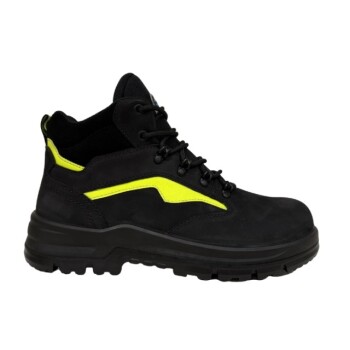
At its core, the ASTM F2413-18 standard is the benchmark specification for protective footwear in the United States. It establishes the minimum performance requirements for safety features, beginning with the mandatory protective toe cap and including several other critical hazard protections.
This standard is not a single, all-encompassing rating. Instead, it certifies a boot's foundational toe protection and provides a clear labeling system for any additional safety features the footwear may possess, from puncture resistance to electrical hazard protection.

The Foundation: Impact and Compression
To receive any ASTM F2413-18 certification, a boot must first pass two fundamental tests related to its safety toe cap. These are non-negotiable requirements for the standard.
Impact Resistance (I/75)
This test evaluates the toe cap's ability to protect your foot from a falling object.
A weight of 75 foot-pounds is dropped onto the toe. For a boot to pass, it must maintain a minimum interior clearance after the impact: a half-inch for men's footwear and 15/32 of an inch for women's.
Compression Resistance (C/75)
This test measures the toe cap's ability to withstand a slow, crushing force, such as from a vehicle wheel rolling over the foot.
The toe area is subjected to 2,500 pounds of pressure. To pass, the boot must maintain the same minimum clearance heights as the impact test.
Additional Protections: Decoding the Labels
Beyond the mandatory toe cap rating, ASTM F2413-18 specifies codes for other hazards. A certified boot will only have the protections that are explicitly listed on its label.
Metatarsal Protection (Mt)
This rating signifies the boot has an integrated guard that protects the upper part of your foot (the metatarsal bones) from impact.
Electrical Hazard (EH)
An EH-rated boot is designed with non-conductive, shock-resistant soles and heels. It provides a secondary source of protection against accidental contact with live electrical circuits.
Puncture Resistance (PR)
Footwear with a PR label has a puncture-resistant plate built into the sole to protect the bottom of the foot from sharp objects like nails.
Conductive Protection (Cd)
This is a highly specialized rating for boots that actively dissipate static electricity from the body into the ground. This is critical in environments where a static spark could ignite flammable materials or damage sensitive electronics.
Static Dissipative (SD)
SD footwear also reduces the build-up of static electricity, but to a lesser degree than conductive (Cd) footwear. It provides a balance of static reduction and some mild electrical resistance.
Understanding the Common Pitfalls
Choosing the right boot requires you to look beyond the general certification and understand the specifics. A misunderstanding here can lead to a false sense of security.
Not All Certified Boots Are Equal
The most common mistake is assuming that any boot labeled "ASTM F2413-18" has every possible protection.
A boot is only certified for the hazards listed on its specific tag. A boot may be I/75 and C/75 compliant but offer no electrical hazard (EH) or puncture resistance (PR) if those codes are not present.
The Importance of the "-18"
The number following the standard (e.g., -11, -18) indicates the year the standard was revised. ASTM F2413-18 is a more recent version than ASTM F2413-11.
Using footwear certified to the latest standard ensures you are protected by the most up-to-date safety criteria.
Steel Toe vs. Composite Toe
The standard does not favor one material over another. Both steel and composite toe caps can meet the I/75 and C/75 requirements.
The choice between them is a matter of workplace conditions. Composite toes are lighter and do not conduct temperature, but steel toes can sometimes be thinner.
How to Apply This to Your Role
Ultimately, your specific job hazards dictate which ratings are essential. Use the boot's label as a checklist against the risks you face.
- If your primary focus is construction or heavy industry: Prioritize boots with I/75, C/75, Mt, and PR ratings for comprehensive protection against impact and punctures.
- If your primary focus is work as an electrician: An EH rating is a non-negotiable requirement for your safety against shock.
- If your primary focus is working with flammable materials or sensitive electronics: You must look for Cd or SD ratings to control static discharge.
By understanding this labeling system, you can select footwear that is not just compliant, but perfectly suited to protect you on the job.
Summary Table:
| Protection Code | Hazard Protected | Key Requirement |
|---|---|---|
| I/75 | Impact Resistance | Withstands 75 ft-lb impact force |
| C/75 | Compression Resistance | Withstands 2,500 lbs of pressure |
| Mt | Metatarsal Protection | Guards the top of the foot |
| EH | Electrical Hazard | Shock-resistant soles and heels |
| PR | Puncture Resistance | Sole plate stops sharp objects |
| Cd/SD | Static Electricity | Controls static discharge |
Ensure Your Team Has the Right Protection
As a large-scale manufacturer, 3515 produces a comprehensive range of ASTM-certified work boots for distributors, brand owners, and bulk clients. Our production capabilities encompass all types of safety footwear, ensuring you get the exact hazard protection your workforce needs.
Let us help you source the perfect safety boots for your specific job hazards. Contact our team today to discuss your requirements and get a quote.
Visual Guide

Related Products
- Customizable Anti-Smash Safety Boots for Wholesale & Private Label Manufacturing
- Wholesale Durable Safety Boots Manufacturer Customizable Steel Toe Work Boots
- Premium Grain Leather Safety Boots for Bulk Supply
- Durable Leather Work Boots for Wholesale & Custom Manufacturing
- Wholesale Durable 6-Inch Work Boots | Custom & Private Label Manufacturer
People Also Ask
- What are the requirements of BS EN345 safety regulations for security guard safety boots? | EN ISO 20345 Guide
- What are the key performance benchmarks set by the EN ISO 20345 standard for safety boots? A Guide to Selecting the Right Protection
- What additional protections are defined by the EN ISO 20345 norm? Match Footwear to Specific Hazards
- How is compliance with the EN ISO 20345 standard certified? The Path to Independent Verification
- Why are industrial safety boots with steel toes necessary for machine operators? Essential Foot Protection for Safety