At its core, a temperature rating on a snow boot is a manufacturer's guideline. It indicates the approximate lowest temperature at which the boot is designed to keep your feet warm during a moderate level of activity. A boot rated for -25°F is built with the insulation and materials intended to perform down to that temperature.
The temperature rating is a starting point, not an absolute guarantee. Real-world warmth depends more on your activity level, circulation, sock choice, and exposure time than on the number printed on the box.
Deconstructing the Temperature Rating
To make an informed decision, you must understand what this number truly represents and, more importantly, what it leaves out. It's a benchmark created under specific, controlled conditions that may not match your own.
What the Rating Assumes
A boot's rating is often based on a person engaged in moderate, continuous activity, like brisk walking. This is a critical detail because activity generates body heat, which is what the boot's insulation is designed to trap.
The Critical Role of Activity Level
Your personal warmth is a direct result of how much heat your body is producing.
A rating of -20°F might be perfect for someone walking their dog but completely insufficient for someone standing still for hours at a sporting event. Conversely, it could be far too warm for someone snowshoeing vigorously up a mountain.
Personal and Environmental Variables
The rating is a single data point that cannot account for crucial variables. These include your personal circulation, the type of socks you wear, your metabolism, and environmental factors like wind chill or damp conditions.
What Truly Determines Warmth
Instead of focusing solely on the temperature rating, a more reliable approach is to assess the boot's core components. These features are the true drivers of performance.
Insulation (Type and Amount)
Insulation is the engine of warmth. Look for the amount, typically measured in grams (e.g., 200g, 400g). Higher gram counts mean more insulation and more warmth, which is ideal for sedentary activities. Lower gram counts offer more breathability for active pursuits.
Waterproofing and Breathability
Your feet will get cold if they are wet, either from snow melting in or from sweat building up. A truly effective winter boot must have a reliable waterproof membrane (like GORE-TEX) to block external moisture while still allowing sweat vapor to escape.
The Importance of Proper Fit
Even the warmest boot will fail if it's too tight. A constricted fit restricts blood flow to your toes, which is the primary way your feet stay warm. You should have enough room to wiggle your toes freely, even with thick winter socks on.
Understanding the Trade-offs
Choosing a boot is about balancing competing needs. The "warmest" boot is not always the best boot for the job.
Warmth vs. Weight
Extreme cold-weather boots with high insulation values are inherently heavier and bulkier. This is excellent for keeping warm while stationary but can lead to fatigue and discomfort during active use like winter hiking.
Insulation vs. Breathability
Heavily insulated boots are less breathable. If your activity causes your feet to sweat, and that moisture can't escape, your socks will become damp and your feet will get cold regardless of the boot's rating.
How to Choose the Right Boot for You
Match the boot's features to your primary use case, not just its temperature rating.
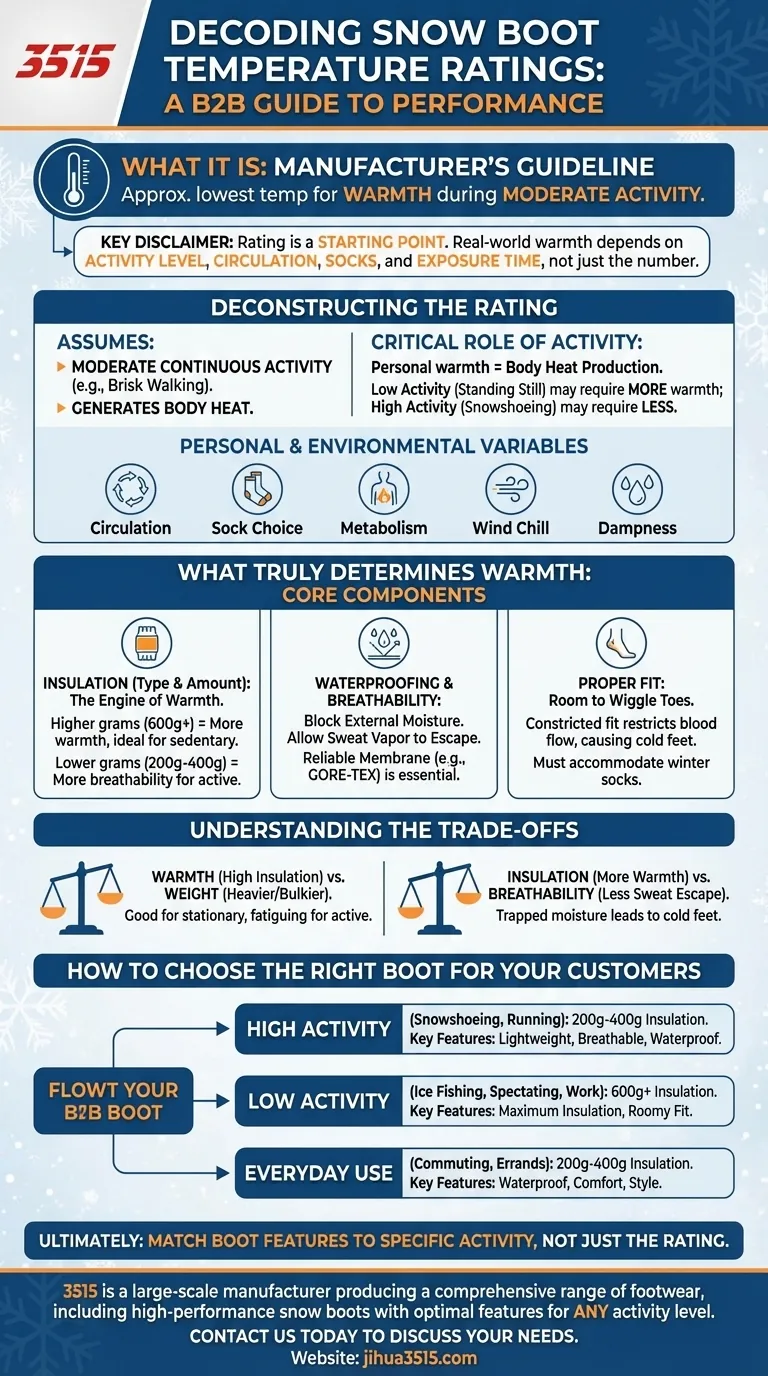
- If your primary focus is high-activity sports (snowshoeing, winter running): Prioritize a lighter boot with moderate insulation (200g-400g) and excellent breathability.
- If your primary focus is low-activity use (ice fishing, spectating, outdoor work): Choose a boot with a high insulation value (600g+) and a generous fit to ensure maximum warmth while stationary.
- If your primary focus is everyday casual wear (commuting, errands): A moderately insulated (200g-400g), waterproof boot that emphasizes comfort and style is your most practical choice.
Ultimately, understanding how a boot is constructed for your specific activity will serve you far better than relying on a single temperature rating.
Summary Table:
| Activity Level | Recommended Insulation (grams) | Key Features to Prioritize |
|---|---|---|
| High Activity (e.g., snowshoeing) | 200g - 400g | Lightweight, breathable, waterproof |
| Low Activity (e.g., ice fishing) | 600g+ | Maximum insulation, roomy fit |
| Everyday Use (e.g., commuting) | 200g - 400g | Waterproof, comfort, style |
As a large-scale manufacturer, 3515 produces a comprehensive range of footwear for distributors, brand owners, and bulk clients. Our production capabilities encompass all types of shoes and boots, including high-performance snow boots designed with optimal insulation, waterproofing, and breathability for any activity level. Let us help you provide your customers with the perfect winter footwear solution. Contact us today to discuss your specific needs and explore our extensive catalog!
Visual Guide
Related Products
- Premium Insulated Safety Boots and Shoes for Wholesale & Bulk Orders
- Durable Waterproof Rain Boots | Custom Manufacturer for Wholesale & Brands
- Factory Direct Wholesale Rain Boots Durable Waterproof & Fully Customizable
- Wholesale Waterproof Tactical Boots Custom Suede & High-Traction Soles
- Wholesale Lightweight Tactical Boots Custom Manufacturer for Desert & Combat Use
People Also Ask
- What are the recommended insulation ratings for mild winter conditions? A Guide for Active & Stationary Workers
- How does insulation thickness correlate with temperature ranges? A Guide to Choosing the Right Warmth
- What insulation level is needed for severe cold and stationary work? 1200g or Higher is Essential
- What safety advantages do insulated boots offer beyond warmth? Dielectric Protection & Superior Grip
- How does fleece lining contribute to the warmth of insulated boots? Trapping Air for Superior Cold Protection