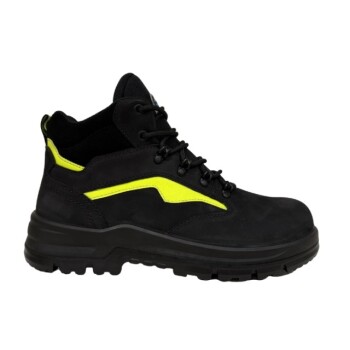
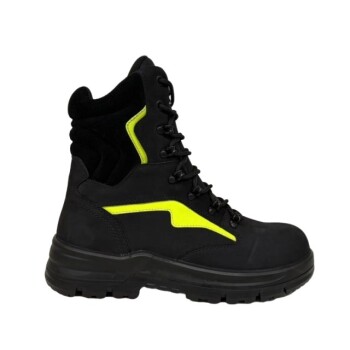
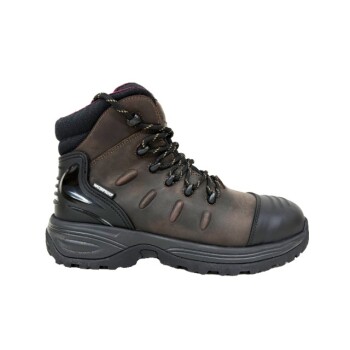
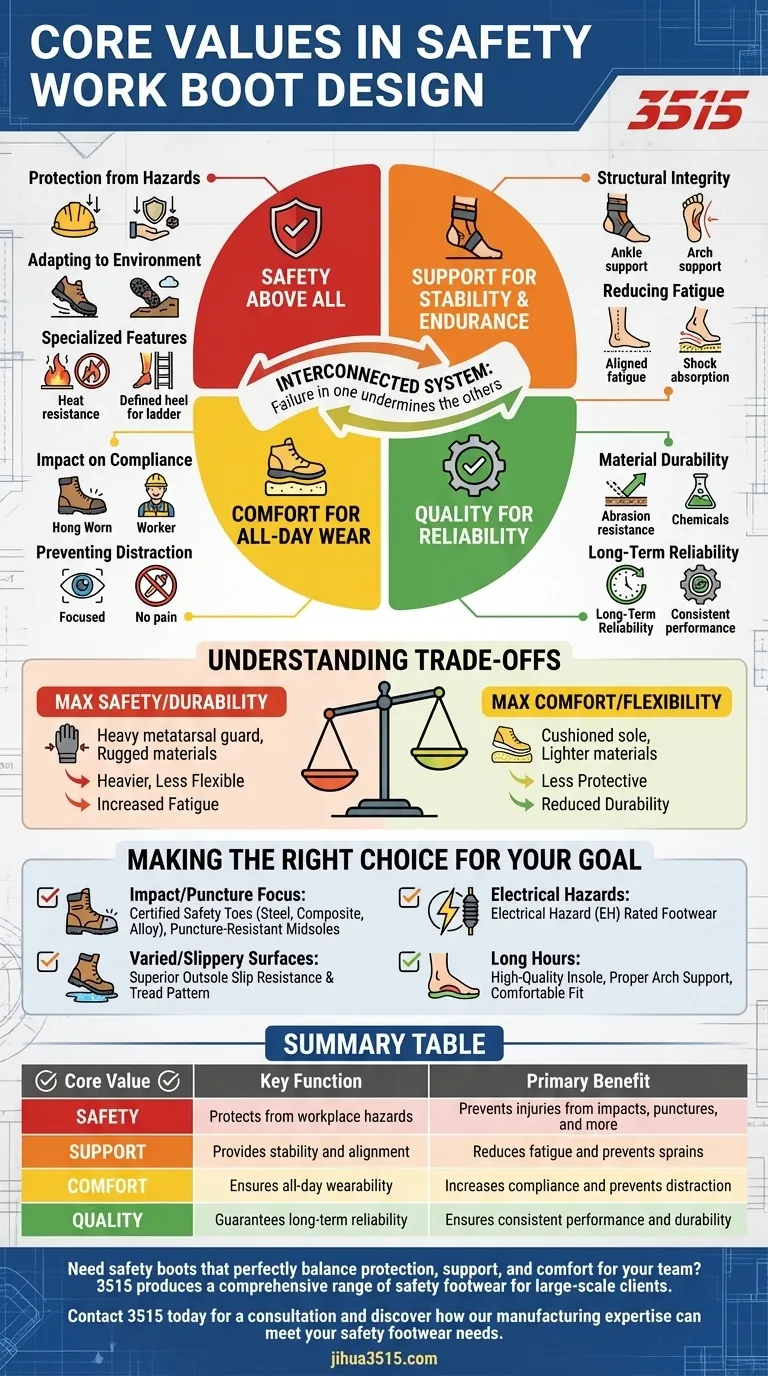
At their core, the design of safety work boots is built upon four fundamental values: safety, support, comfort, and quality. These principles work in concert to deliver the protection, stability, and endurance required for demanding work environments.
The crucial insight is that these are not independent features but an interconnected system. A failure in one value, such as comfort, can undermine the effectiveness of another, like safety, because a painful boot is a dangerous distraction.
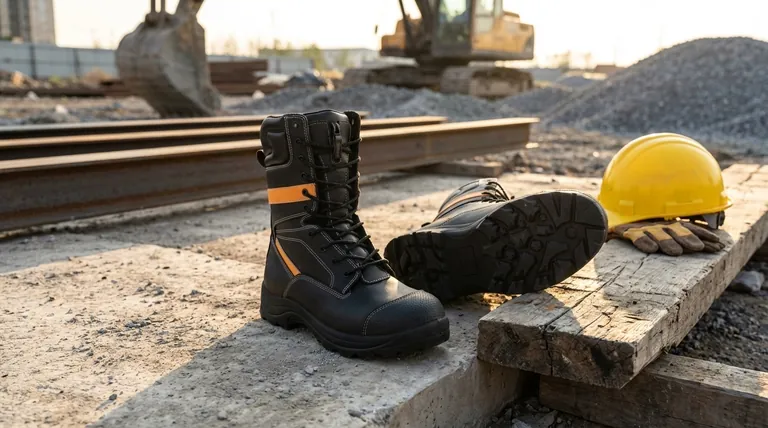
The Foundation: Safety Above All
The primary function of any safety boot is to protect the wearer from workplace hazards. This goes far beyond a simple steel toe and requires a design that anticipates the specific risks of an environment.
Protection from Specific Hazards
Effective safety design begins with a thorough hazard assessment. Boots are engineered to counter threats like falling or rolling objects, sharp items that could puncture the sole, and exposure to corrosive substances.
Adapting to the Work Environment
Safety features must be matched to the job site. A boot's tread pattern, for example, needs to provide aggressive slip resistance for muddy surfaces but may be different for smooth concrete floors.
Specialized Protective Features
For unique risks, specialized features are essential. A defined heel is critical for workers who frequently use ladders, while heat-resistant soles capable of withstanding up to 572ºF are non-negotiable for those in road resurfacing or welding.
The Enabler: Support for Stability and Endurance
Proper support is what allows a worker to remain stable and effective throughout a long day. It’s a key factor in preventing common workplace injuries.
Structural Integrity
A well-designed boot provides crucial ankle and arch support. This structure helps prevent sprains and twists, especially when navigating uneven or unpredictable terrain.
Reducing Physical Fatigue
By properly aligning the foot and absorbing impact, a supportive boot reduces muscle strain and overall fatigue. This allows for greater focus and lowers the risk of accidents caused by exhaustion.
The Necessity: Comfort for All-Day Wear
Comfort is not a luxury; it is a critical component of safety and performance. An uncomfortable boot is a liability on any job site.
Impact on Compliance
If a boot is painful or ill-fitting, workers are less likely to wear it correctly or consistently. The most protective boot in the world is useless if it’s left in the locker.
Preventing Distraction
Pain from blisters, chafing, or poor cushioning creates a constant distraction. A lapse in focus, even for a moment, can lead to serious injury in a hazardous environment.
The Guarantee: Quality for Reliability
Quality is the assurance that the boot's safety, support, and comfort features will perform as expected over the entire lifespan of the footwear.
Material Durability
High-quality materials ensure the boot can withstand the rigors of the job. This includes resistance to abrasion, chemicals, and environmental extremes without degrading its protective qualities.
Long-Term Reliability
Quality construction means the boot will not fail when it is needed most. It represents an investment in consistent, reliable protection day after day.
Understanding the Trade-offs
Choosing the right boot often involves balancing these core values. No single boot is perfect for every possible task.
Safety vs. Comfort
A boot with maximum protection, such as one with heavy metatarsal guards for logging, may be heavier and less flexible than a boot designed for warehouse work.
Durability vs. Weight
The most rugged and durable materials can add significant weight to a boot. This can increase fatigue if the job requires constant walking or climbing.
Specialized vs. General Use
A boot designed with a specific feature, like high heat resistance, may not have the optimal tread for cold, icy conditions. The key is to prioritize the primary hazards of your specific role.
Making the Right Choice for Your Goal
Your selection should be guided by a clear understanding of your primary workplace hazards.
- If your primary focus is protection from impacts and punctures: Prioritize boots with certified safety toes (steel, composite, or alloy) and puncture-resistant midsoles.
- If your primary focus is navigating varied or slippery surfaces: Scrutinize the outsole design, ensuring the tread pattern and material offer superior slip resistance for your specific environment.
- If your primary focus is working near electrical currents: Ensure your footwear is explicitly rated for Electrical Hazard (EH) protection to provide a secondary source of insulation.
- If your primary focus is long hours on your feet: Do not compromise on a high-quality insole, proper arch support, and a comfortable fit, as these are crucial for preventing fatigue-related accidents.
Ultimately, the best safety boot is one where these core values are precisely balanced to meet the specific demands of your work environment.
Summary Table:
| Core Value | Key Function | Primary Benefit |
|---|---|---|
| Safety | Protects from workplace hazards | Prevents injuries from impacts, punctures, and more |
| Support | Provides stability and alignment | Reduces fatigue and prevents sprains |
| Comfort | Ensures all-day wearability | Increases compliance and prevents distraction |
| Quality | Guarantees long-term reliability | Ensures consistent performance and durability |
Need safety boots that perfectly balance protection, support, and comfort for your team?
As a large-scale manufacturer, 3515 produces a comprehensive range of safety footwear for distributors, brand owners, and bulk clients. Our production capabilities encompass all types of safety shoes and boots, engineered to meet the specific demands of your industry.
We can help you source reliable, high-performance footwear that protects your workforce and enhances productivity.
Contact 3515 today for a consultation and discover how our manufacturing expertise can meet your safety footwear needs.
Visual Guide
Related Products
- Customizable Anti-Smash Safety Boots for Wholesale & Private Label Manufacturing
- Wholesale Durable Safety Boots Manufacturer Customizable Steel Toe Work Boots
- Wholesale Customizable Safety Boots Durable & Protective Footwear Manufacturing
- Wholesale Durable 6-Inch Work Boots | Custom & Private Label Manufacturer
- Durable Leather Safety Boots for Wholesale & Custom OEM Manufacturing
People Also Ask
- What are the requirements of BS EN345 safety regulations for security guard safety boots? | EN ISO 20345 Guide
- What are the key performance benchmarks set by the EN ISO 20345 standard for safety boots? A Guide to Selecting the Right Protection
- What additional protections are defined by the EN ISO 20345 norm? Match Footwear to Specific Hazards
- How is compliance with the EN ISO 20345 standard certified? The Path to Independent Verification
- Why are industrial safety boots with steel toes necessary for machine operators? Essential Foot Protection for Safety