
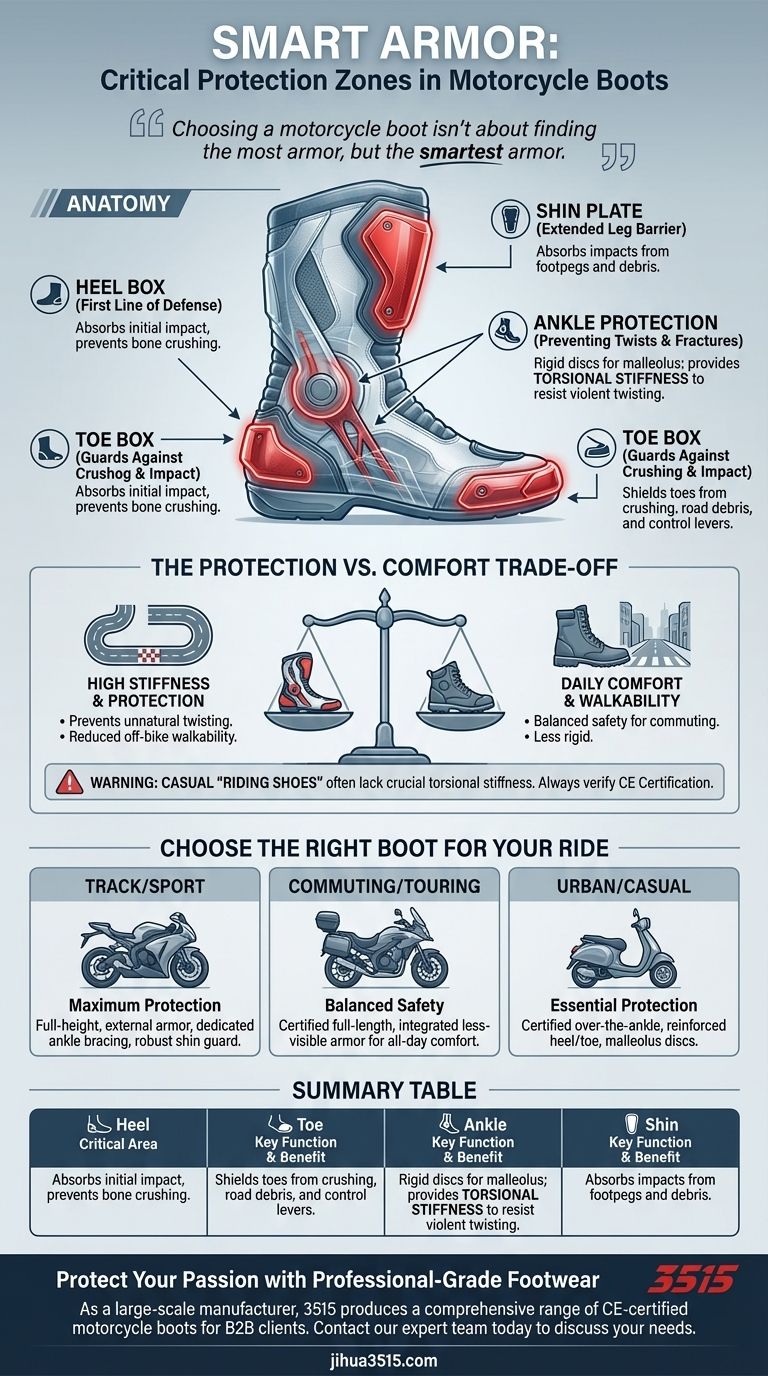
The most critical areas for armor in any motorcycle boot are the heel, the toe, and the ankles. These three zones are engineered to protect your feet from the most common and severe forces in a motorcycle accident: impact, crushing, and twisting. Taller boots will also extend this protection up to the shin.
Choosing a motorcycle boot isn't about finding the most armor, but the smartest armor. True protection comes from reinforcing the specific areas of the foot that are biomechanically vulnerable to the unique physics of a motorcycle crash.
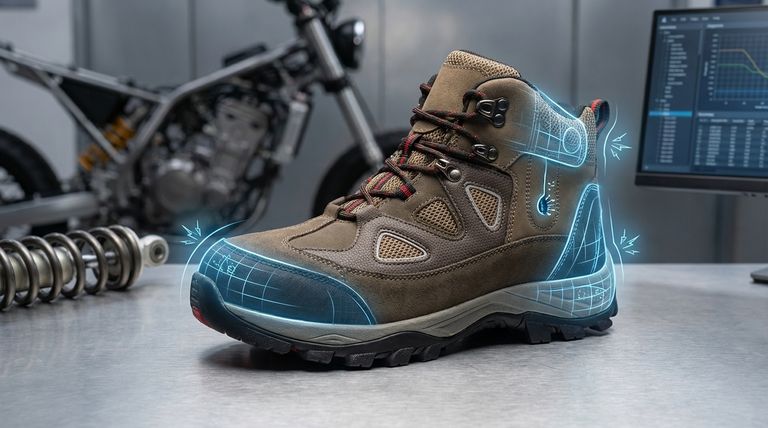
The Anatomy of a Safe Motorcycle Boot
A truly protective boot is a system designed to counter specific threats. Simply covering the foot is insufficient; the armor must be placed in key structural areas to be effective.
Heel Protection: The First Line of Defense
The heel cup is one of the most important safety features. In many low-side crashes, the outer edge of your heel is one of the first parts of your body to make contact with the pavement.
A reinforced heel box absorbs this initial impact and prevents the small bones in your heel and rearfoot from being crushed if your foot gets trapped under the bike.
Toe Protection: Guarding Against Crushing and Impact
The toe box serves a dual purpose. It protects your toes from being crushed by the weight of the motorcycle in a fall and shields them from impacts with road debris or other vehicles.
It also provides the structural rigidity needed to prevent your toes from being bent back or crushed against the controls, like the gear shifter, during an accident.
Ankle Protection: Preventing Twists and Fractures
Your ankle is an incredibly complex joint that is highly susceptible to rotational injuries. This is where basic work boots or hiking boots critically fail.
Motorcycle boots use integrated armor, often in the form of rigid discs, to protect the malleolus bones—the bony protrusions on each side of your ankle. More importantly, the boot's overall structure provides torsional stiffness, which resists the violent twisting that can lead to debilitating ligament damage and fractures.
Beyond the Foot: The Role of Shin Guards
For boots that extend over the calf, a shin plate is standard. This piece of armor is designed to absorb impacts from the motorcycle's footpegs or from debris kicked up from the road. In a forward collision, it provides an essential barrier for your lower leg.
Understanding the Trade-offs: Protection vs. Comfort
More armor is not always better if it makes the boot unusable for your needs. Understanding the balance between robust protection and daily usability is key.
The Stiffness Factor
A highly protective boot will be very stiff. This rigidity is what prevents your foot and ankle from twisting into unnatural positions.
The trade-off is a significant reduction in off-the-bike comfort and walkability. A race boot is phenomenal on the track but impractical for walking around a city.
The Deception of "Riding Shoes"
Many casual-looking motorcycle shoes offer reinforced toes and heels. However, they often lack the crucial torsional stiffness and dedicated ankle armor required to prevent rotational injuries.
Always verify that any riding footwear has a CE or other safety certification, which ensures it has passed standardized tests for abrasion, impact, and crush resistance.
How to Choose the Right Boot for Your Ride
Your choice should be dictated by your primary riding style and risk exposure.
- If your primary focus is maximum track or sport riding protection: Seek a full-height boot with extensive external armor, a dedicated ankle-bracing system for torsional control, and robust shin protection.
- If your primary focus is daily commuting or touring: A certified full-length touring boot with integrated, less-visible armor in the heel, toe, and ankles provides an excellent balance of safety and all-day comfort.
- If your primary focus is casual, short-distance urban riding: Prioritize certified over-the-ankle short boots that still feature reinforced heel and toe boxes and dedicated malleolus protection discs.
Investing in a boot with properly engineered armor is a direct investment in your ability to walk away from an accident.
Summary Table:
| Critical Protection Area | Key Function & Benefit |
|---|---|
| Heel | Absorbs initial impact, prevents rearfoot bone crushing. |
| Toe | Shields toes from crushing and road debris impacts. |
| Ankle | Prevents rotational injuries with rigid discs and torsional stiffness. |
| Shin (on taller boots) | Protects lower leg from impacts with footpegs and debris. |
Protect Your Passion with Professional-Grade Footwear
As a large-scale manufacturer, 3515 produces a comprehensive range of CE-certified motorcycle boots for distributors, brand owners, and bulk clients. Our production capabilities encompass all types of protective footwear, from high-stiffness race boots to comfortable touring models, ensuring every pair meets the highest standards for impact, abrasion, and crush resistance.
Let us help you equip riders with the right protection. Contact our expert team today to discuss your specific needs and explore our catalog.
Visual Guide
Related Products
- Wholesale Tactical Boots High-Traction & Reflective for Bulk & Brand Orders
- High Performance Fire-Retardant Waterproof Safety Boots
- Durable Goodyear Welt Leather Work Boots for Wholesale & Private Label
- Wholesale High-Traction Camo Boots - Custom Manufacturer for Brands
- Heavy-Duty Waterproof Nubuck Safety Boots Safety Shoes for Bulk Supply
People Also Ask
- How do tactical boots protect against injuries? Discover the Integrated Safety System
- What boots do navy SEALs run in? Discover the Mission-Driven Footwear Philosophy
- What are the structural advantages of durable tactical boots? Elevate Performance in Rugged & Non-Standard Terrains
- What materials are used in tactical boot uppers? A Guide to Durability & Performance
- What types of boots are used by Bravo in SEAL Team? Salomon & Merrell for Elite Performance



















