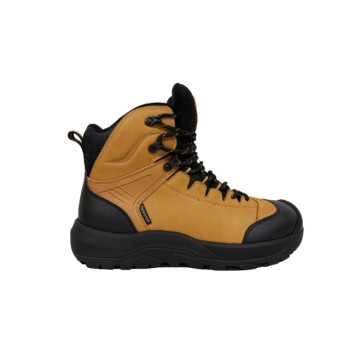
For mild winter conditions, typically ranging from 20°F to 40°F, the standard recommendation is an insulation rating of 100g to 200g. This level of insulation provides essential warmth without the bulk, making it ideal for situations where you are generating your own body heat through activity.
The number on the tag is only half the equation. The right insulation level depends less on the outdoor temperature alone and more on the balance between that temperature and your personal activity level.
Why Activity Level is the Deciding Factor
When you see an insulation rating, it's a simple measurement of weight. The number represents the grams of insulation material per square meter of fabric. More grams mean more material to trap air, which in turn provides more warmth. However, this simple metric doesn't account for the most powerful heater you have: your own body.
The High-Activity Scenario
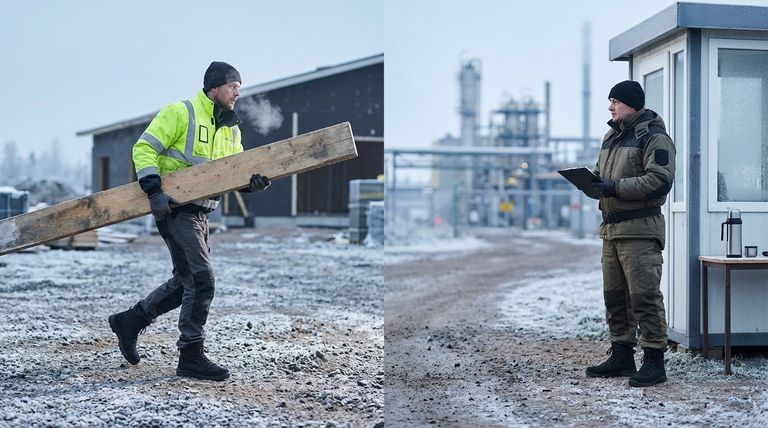
For active tasks like construction work, hiking, or even brisk walking, your body generates a significant amount of heat.
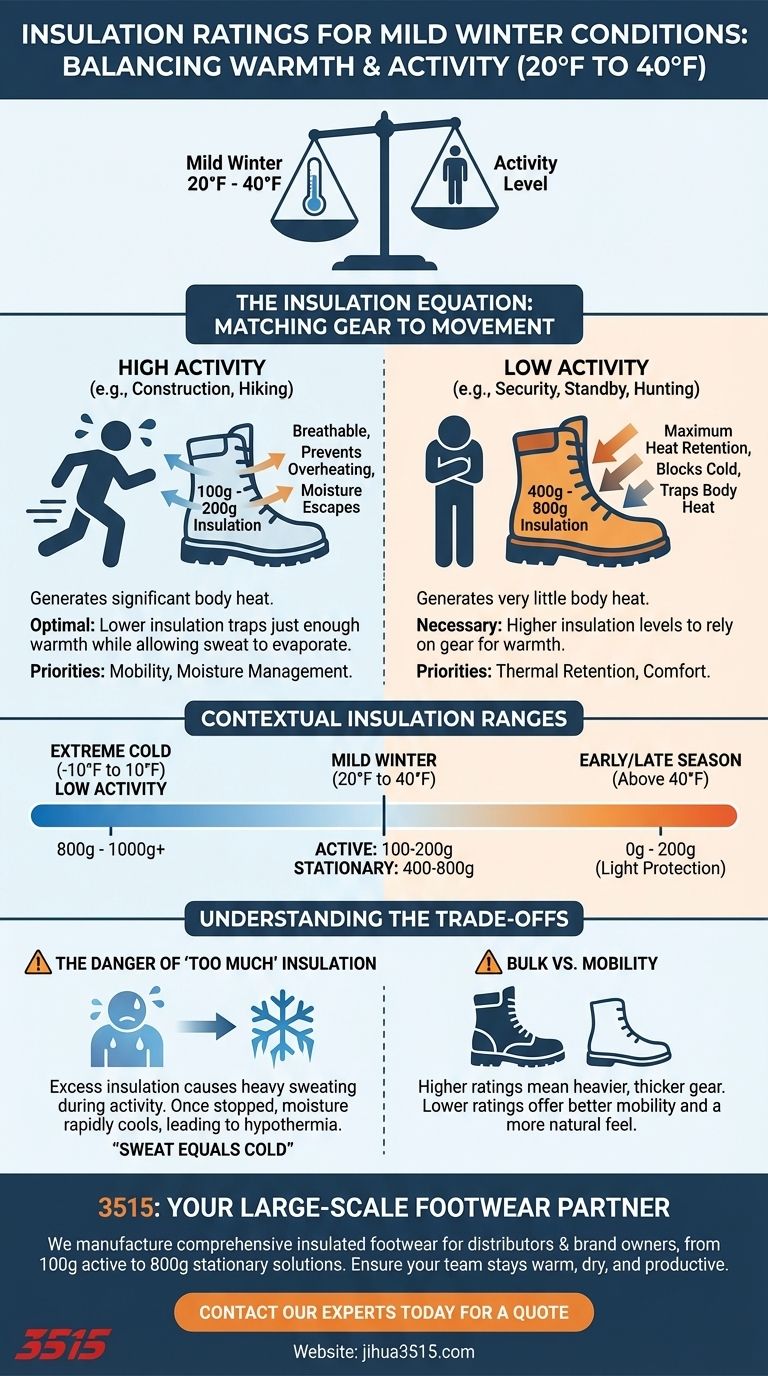
In this case, a lower insulation rating of 100g to 200g is optimal. It traps just enough of your body heat to keep you warm while remaining breathable enough to let excess heat and moisture escape.
The Low-Activity Scenario
If you are stationary for long periods—such as a security guard, a utility worker on standby, or a hunter in a treestand—your body generates very little heat.
Here, you rely almost entirely on your gear to keep you warm. Even in mild 20°F to 40°F weather, a higher insulation level of 400g to 800g might be necessary to trap what little heat you produce.
Matching Insulation to Temperature and Task
Think of insulation as a system you need to tune based on two key variables: the thermometer and your expected movement.
Mild Conditions (20°F to 40°F)
For this common winter range, 100g to 200g is the baseline for active individuals. It provides lightweight warmth that prevents overheating during exertion.
Extremely Cold Conditions (-10°F to 10°F)
In severely cold temperatures, especially with low activity, much higher insulation levels are required. Ratings of 800g to 1000g (or more) are designed to provide maximum thermal retention when you are not moving.
Early or Late Season (Above 40°F)
For transitional weather or high-output activities in cool, but not cold, temperatures, 0g (uninsulated) to 200g is often best. The primary goal here is usually moisture management and light protection from the chill.
Understanding the Trade-offs
Choosing the wrong insulation can be as bad as choosing none at all. The goal is to stay warm and dry, and making the wrong choice can compromise both.
The Danger of "Too Much" Insulation
The most common mistake is over-insulating for your activity level. Excess insulation during physical work will cause you to sweat heavily.
Once you stop moving, that moisture will rapidly cool, leaving you colder and more miserable than if you had started with less insulation. This is why "sweat equals cold" is a core principle of outdoor gear.
Bulk vs. Mobility
Higher insulation ratings mean thicker, heavier, and less flexible gear. While 1000g boots are exceptionally warm, they are also bulky and can make agile movement difficult. Lower-gram insulation offers better mobility and a more natural feel.
Making the Right Choice for Your Goal
Select your insulation based on your most common use case.
- If your primary focus is high activity in mild weather: Choose a 100g to 200g rating to prioritize breathability and prevent moisture buildup.
- If your primary focus is staying stationary in mild weather: Consider a 400g to 800g rating to compensate for your lack of body heat generation.
- If your activity level will vary significantly: A moderate 400g rating can offer a versatile middle ground, or you can use a layering system with your socks to adjust warmth.
Ultimately, the best insulation is the one that correctly balances the external environment with your internal engine.
Summary Table:
| Activity Level | Recommended Insulation | Key Consideration |
|---|---|---|
| High Activity (e.g., construction, hiking) | 100g - 200g | Prevents overheating and moisture buildup during exertion. |
| Low Activity (e.g., security, standby) | 400g - 800g | Compensates for low body heat generation when stationary. |
As a large-scale manufacturer, 3515 produces a comprehensive range of insulated footwear for distributors, brand owners, and bulk clients. We can help you select or custom-manufacture the perfect boots with the right insulation—from 100g for active crews to 800g for stationary workers—ensuring your team stays warm, dry, and productive in mild winter conditions.
Contact our experts today to discuss your specific needs and get a quote!
Visual Guide
Related Products
- Premium Insulated Safety Boots and Shoes for Wholesale & Bulk Orders
- High Performance Fire-Retardant Waterproof Safety Boots
- Premium Wholesale Waterproof Safety Boots High Performance Protection for Industrial Markets
- Durable Waterproof Rain Boots | Custom Manufacturer for Wholesale & Brands
- Wholesale Waterproof Tactical Boots Custom Suede & High-Traction Soles
People Also Ask
- How does insulation thickness correlate with temperature ranges? A Guide to Choosing the Right Warmth
- What insulation level is needed for severe cold and stationary work? 1200g or Higher is Essential
- What safety advantages do insulated boots offer beyond warmth? Dielectric Protection & Superior Grip
- How does fleece lining contribute to the warmth of insulated boots? Trapping Air for Superior Cold Protection
- What are the key features of insulated boots designed for cold weather? A Guide to Warmth, Dryness & Safety