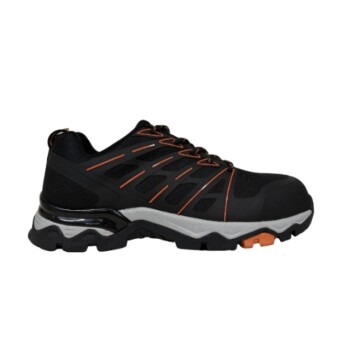
Professional safety shoes serve as the fundamental defensive barrier for personnel executing confined space operations within the water supply industry. Their primary functions are to provide superior traction to mitigate slipping hazards in damp environments, shield feet from crushing impacts caused by heavy equipment, and offer puncture resistance against sharp debris hidden in sludge.
Professional safety shoes in this sector are not merely footwear; they are stability control devices. They transform unpredictable, slippery, and debris-laden environments into manageable workspaces by simultaneously addressing the risks of mechanical impact and environmental instability.
Mitigating Environmental Hazards
Navigating Wet and Sludge-Filled Surfaces
Water supply operations, such as pipe maintenance and sludge removal, inherently involve damp and slippery conditions. Accumulated water and viscous sludge create a high risk for loss of balance. Professional safety shoes address this through high-traction outsoles and specialized grip patterns.
Enhancing Operational Stability
The specialized outsoles provide superior ground adhesion, which is critical for preventing falls in flooded or muddy confined spaces. By anchoring the worker effectively to the surface, these shoes significantly enhance stability, allowing personnel to focus on the task rather than their footing.
Protection Against Mechanical Injuries
Preventing Crush Injuries
Confined spaces often force workers to handle heavy tools and equipment components in tight quarters. This proximity increases the risk of dropping objects. Safety shoes utilize integrated reinforced toe caps to resist impact. This feature is essential for protecting the toes from fractures and crush injuries caused by falling heavy objects.
Shielding Against Sharp Debris
In environments involving sludge removal or loading activities, the ground condition is often obscured. Puncture-resistant midsoles are a critical component of professional footwear. They act as a shield against sharp ground materials, preventing dangerous penetration wounds from debris hidden beneath the water or sludge.
Common Pitfalls to Avoid
Overlooking Comprehensive Protection
A common error is selecting footwear that addresses only one hazard—such as slipping—while ignoring mechanical risks. In water supply confined spaces, partial protection is insufficient. A shoe with excellent grip but no toe cap leaves the worker vulnerable to fractures, just as a reinforced boot with poor traction creates a fall hazard. True safety requires a shoe that integrates anti-slip, anti-smash, and anti-puncture features simultaneously.
Making the Right Choice for Your Goal
To ensure maximum safety during water supply operations, prioritize the feature that aligns best with your specific working environment:
- If your primary focus is working in flooded or muddy pipes: Prioritize shoes with specialized grip outsoles and anti-slip patterns to ensure maximum ground adhesion.
- If your primary focus is heavy equipment maintenance or pipe fitting: Ensure the footwear features reinforced toe caps to prevent crushing injuries from falling tools.
- If your primary focus is sludge removal or clearing debris: Verify the presence of puncture-resistant midsoles to protect against hidden sharp objects on the ground.
Equipping your team with the correct professional safety shoes provides the essential mechanical and environmental protection required for safe, efficient operations.
Summary Table:
| Hazard Category | Key Protection Feature | Primary Benefit in Confined Spaces |
|---|---|---|
| Slippery/Wet Surfaces | High-Traction Outsoles | Prevents falls and ensures operational stability in sludge. |
| Falling Equipment | Reinforced Toe Caps | Guards against crush injuries and fractures from heavy tools. |
| Hidden Sharp Debris | Puncture-Resistant Midsoles | Prevents penetration wounds from objects obscured by water. |
| Damp Environments | Moisture-Resistant Design | Maintains foot health and structural integrity of the shoe. |
Secure Your Team's Safety with 3515 Footwear Solutions
As a large-scale manufacturer serving distributors and brand owners, 3515 offers comprehensive production capabilities for all footwear types, anchored by our flagship Safety Shoes series. Our professional-grade safety footwear is engineered to transform unpredictable, slippery water supply environments into stable, manageable workspaces.
Beyond specialized industrial safety boots, our extensive portfolio covers work and tactical boots, outdoor shoes, training shoes, sneakers, and Dress & Formal shoes to meet your diverse bulk requirements.
Ready to elevate your inventory with industry-leading protection?
Contact Us Today to Discuss Your Bulk Requirements
References
- Hamiza Ngah, Mohd Nazri Shafei. Assessment of Knowledge, Attitude, and Practice on Safe Working in Confined Space among Male Water Services Workers in the Central Region of Malaysia. DOI: 10.3390/ijerph19127416
This article is also based on technical information from 3515 Knowledge Base .
Related Products
- Premium Suede Sport Safety Shoes for Wholesale & Bulk Orders
- Premium Lightweight Safety Shoes for Wholesale & Bulk Orders
- Premium KPU Injection Athletic Style Safety Shoes
- Advanced KPU Athletic Safety Shoe with Steel Toe Cap Anti-Slip Rotary Lacing System
- Premium Safety Shoes with Rotating Buckle Safety Sneakers
People Also Ask
- What industries have specific OSHA footwear requirements? Ensure Compliance & Protect Your Workforce
- What role do specialized safety shoes play in preventing falls? Engineering Stability in Industrial Environments
- Why should ergonomics and comfort be prioritized when selecting safety shoes? Boost Compliance & Worker Health
- Why is barefoot walking used as a baseline in gait safety research? Unlocking Natural Biomechanics for Shoe Design
- What are the main components of safety shoes? A Guide to Protective Footwear Design