
At its core, the choice between rubber and leather soles on cowboy boots comes down to your primary use case. Rubber soles are engineered for durability, all-weather traction, and comfort in demanding work environments. In contrast, traditional leather soles are prized for their ability to mold to your foot, their breathability, and their smooth surface, which is ideal for activities like dancing or horseback riding.
The decision is a trade-off between modern utility and traditional function. Rubber offers rugged, all-purpose grip and longevity, while leather provides a classic feel and specific performance benefits for riding and dancing.
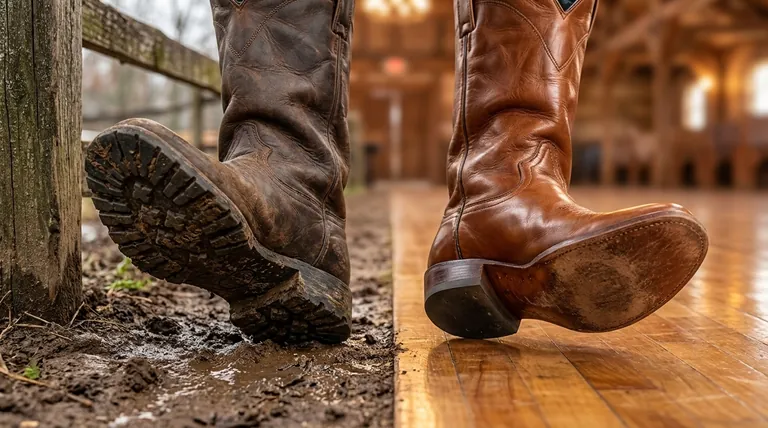
The Case for Rubber Soles
Rubber-soled boots are the modern workhorse, designed for performance and resilience in varied conditions. They prioritize function and protection above all else.
Superior Traction and Stability
A rubber sole’s primary advantage is its unmatched grip. The material and tread patterns are designed to provide excellent traction on slick, uneven, or loose surfaces like worksites or wet pavement.
This makes them a significantly safer and more stable option for anyone who isn't on a smooth, predictable floor.
Unmatched Durability for Work
Rubber is inherently more durable and resistant to abrasion than leather. This makes it the clear choice for rigorous activities, construction work, or prolonged standing on hard surfaces.
These soles are built to withstand the punishment of a demanding environment, offering superior longevity for daily wear and tear.
All-Weather Performance and Comfort
Rubber is naturally weather-resistant and waterproof, keeping your feet dry in rain or mud.
Additionally, rubber compounds provide far greater shock absorption and cushioning than leather, reducing fatigue during long days on your feet.
The Case for Leather Soles
Leather is the original, time-honored material for boot soles. Its benefits are rooted in tradition, natural properties, and a unique connection to the wearer.
Traditional Feel and Breathability
As a natural material, leather is highly breathable. This allows moisture and heat to escape, keeping your feet cooler and more comfortable, especially in warm climates.
This breathability is a key comfort feature that synthetic materials cannot fully replicate.
Molds to Your Foot Over Time
The most celebrated characteristic of a leather sole is its ability to mold to the unique shape of your foot. Over time, this creates a custom-like fit that is exceptionally comfortable.
This break-in process results in a boot that feels like a natural extension of your foot.
The Choice for Dancers and Riders
Leather soles are perfect for dancing because they allow for a smooth glide across the floor. They start slippery but develop a perfect slide-to-grip ratio as they get scuffed.
For horseback riding, a leather sole allows the foot to slide easily and safely in and out of the stirrup, a critical safety and performance feature.
Understanding the Trade-offs
Neither sole is perfect for every situation. Understanding their limitations is key to making an informed choice.
The Slippery Nature of New Leather
Brand-new leather soles are notoriously slippery on smooth surfaces. They require a break-in period where the sole must be scuffed on rough surfaces like concrete to develop texture and grip.
The Resole-ability Factor
Traditionally, high-quality leather-soled boots are easy for a cobbler to resole, extending the life of the boot indefinitely.
Many rubber soles, unless attached with a specific method like a Goodyear welt, cannot be replaced. This can make the boot disposable once the sole wears out.
The Weight and Flexibility Difference
Rubber soles are generally thicker, heavier, and less flexible out of the box. Leather soles are lighter and offer more initial flexibility, contributing to their classic feel.
Making the Right Choice for Your Use Case
Your daily environment and intended activities are the only factors that matter.
- If your primary focus is work or all-weather wear: Choose rubber soles for their superior durability, traction, and comfort.
- If your primary focus is dancing or formal events: Choose leather soles for their classic look and ability to glide smoothly.
- If your primary focus is horseback riding: Choose leather soles to ensure your foot can move freely and safely in the stirrup.
- If your primary focus is general daily comfort: The choice is personal; lean toward leather for a custom fit over time or rubber for out-of-the-box cushion and grip.
Ultimately, select the sole that is engineered to support what you do most.
Summary Table:
| Feature | Rubber Sole | Leather Sole |
|---|---|---|
| Best For | Work, All-Weather, Harsh Conditions | Dancing, Riding, Formal Events |
| Traction | Excellent grip on varied surfaces | Slippery when new, molds over time |
| Durability | Highly abrasion-resistant | Can be easily resoled for longevity |
| Comfort | Superior shock absorption, cushioning | Breathable, molds to your foot's shape |
| Weight/Flexibility | Heavier, less flexible | Lighter, more flexible |
Ready to find the perfect sole for your cowboy boots?
As a large-scale manufacturer, 3515 produces a comprehensive range of durable and comfortable footwear for distributors, brand owners, and bulk clients. Our production capabilities encompass all types of work, riding, and fashion boots with both rubber and leather soles.
Let us help you select or manufacture the ideal boot for your target market. Contact our experts today to discuss your needs and get a quote!
Visual Guide

Related Products
- High-Traction Suede Tactical Boots Wholesale & Custom Manufacturing
- Wholesale High-Traction Camo Boots - Custom Manufacturer for Brands
- Wholesale Lightweight Tactical Boots Custom Manufacturer for Desert & Combat Use
- Durable Leather Tactical Boots Wholesale & Custom Manufacturing for Brands
- Wholesale Durable Mid-Cut Tactical Boots for Custom & Private Label Brands
People Also Ask
- Why is sequential analysis utilized to evaluate tactical boots? Master Dynamic Boot Development and Ergonomic Performance
- How does the material of tactical boots affect their performance? Choose the Right Material for Your Mission
- How do tactical boots differ from regular boots? Performance, Durability & Design Explained
- How do military uniforms and tactical boots impact the prediction of thermal risk? Essential Safety Insights
- What are the benefits of integrating FES and sEMG into tactical boots? Safety, Reliability & Field-Ready Performance


















