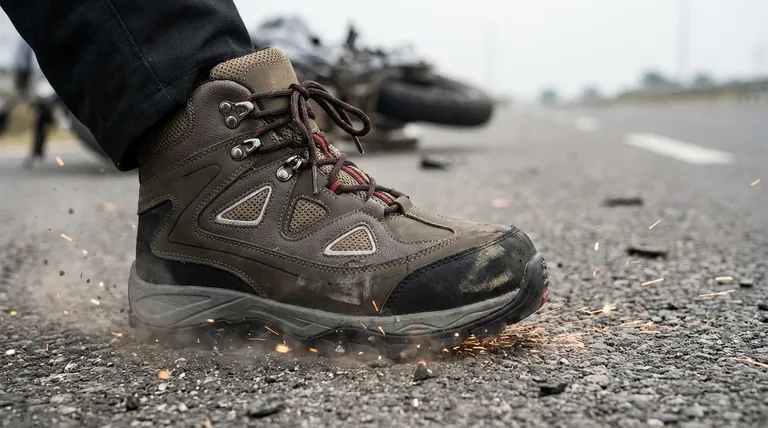
The Anatomy of a Simple Mistake
It happens in a fraction of a second. A patch of unseen gravel, a moment of lost focus. The bike is on its side, and you are sliding.
In that instant, your mind isn't processing complex physics. It's processing a singular, primal thought: survival.
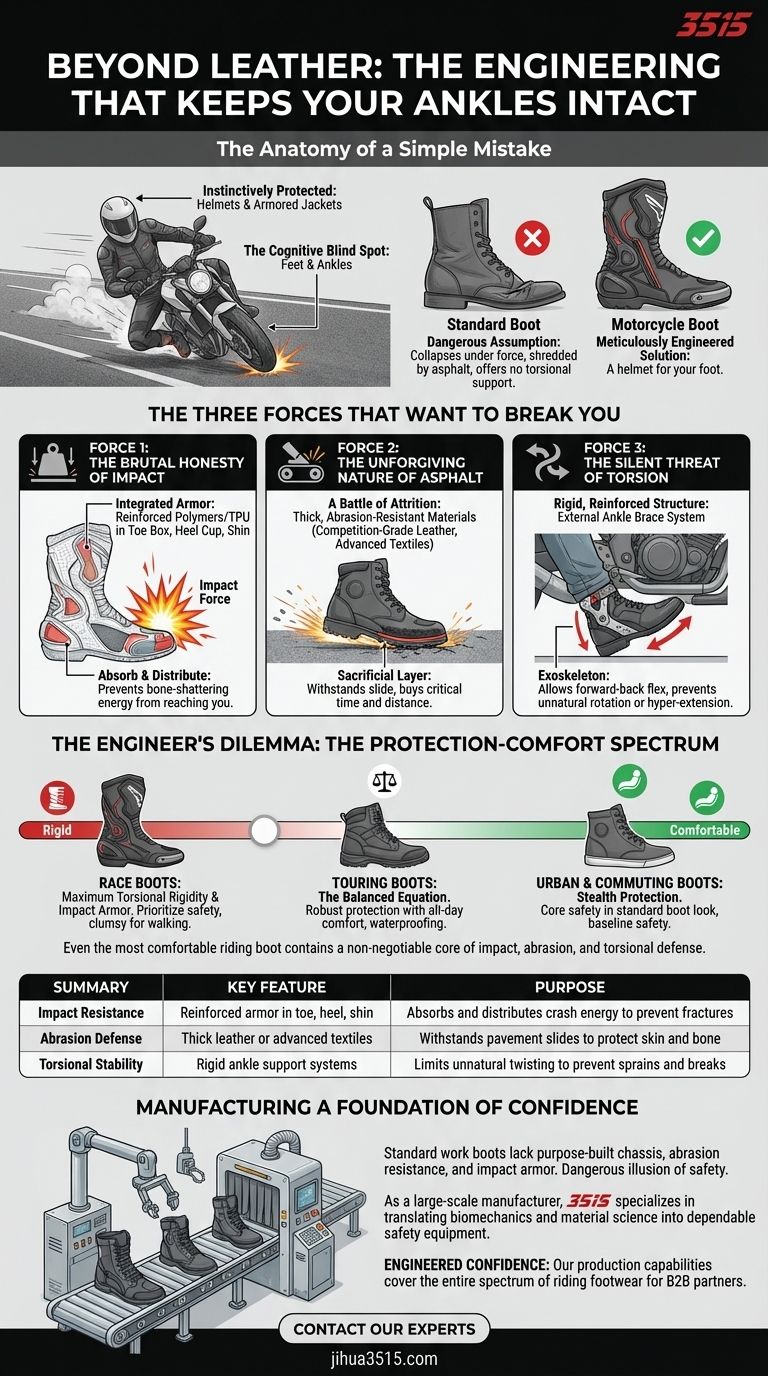
We instinctively protect our head and torso, investing heavily in helmets and armored jackets. But we often suffer from a peculiar cognitive blind spot when it comes to our foundation: our feet and ankles. We assume any sturdy boot will do.
This is a dangerous assumption. A true motorcycle boot is not just footwear; it is a meticulously engineered solution to a violent, specific set of problems.
The Three Forces That Want to Break You
A motorcycle crash subjects the human body to a trio of brutal forces. The design of every dedicated riding boot is a direct response to neutralizing them.
Force 1: The Brutal Honesty of Impact
When the bike falls, it often falls on your foot. Or your foot hits a curb. This is a moment of pure, concentrated kinetic energy.
A standard boot collapses. A motorcycle boot fights back.
It does this with integrated armor—reinforced polymers or TPU shields in the toe box, heel cup, and shin. These components are designed to do one job: absorb and distribute the force of an impact, preventing the bone-shattering energy from reaching you. It's a helmet for your foot.
Force 2: The Unforgiving Nature of Asphalt
Sliding on pavement is like being attacked by a belt sander with infinite power. Fabric, denim, and even standard leather are shredded in seconds, exposing skin and bone to the road.
This is a battle of attrition. Motorcycle boots are built with thick, highly abrasion-resistant materials, like competition-grade leather or advanced textiles. They act as a sacrificial layer, designed to withstand the slide and buy you the critical time and distance needed to slow down safely.
Force 3: The Silent Threat of Torsion
This is the most insidious force, and the one most often ignored. Even in a zero-mph tip-over, the weight of the bike can trap your foot and twist it at an unnatural angle. The leverage is immense, leading to severe sprains or complex fractures.
This is where a motorcycle boot proves its engineering superiority. A rigid, reinforced structure, often with an external ankle brace system, creates torsional stability. It acts as an exoskeleton, allowing for necessary forward-and-back flex while preventing the ankle from rotating or hyper-extending into an injury-causing range.
The Engineer's Dilemma: The Protection-Comfort Spectrum
Absolute protection would mean encasing your foot in a steel box. But a rider also needs to feel the controls and walk when they dismount. This creates a fundamental engineering trade-off.
Every boot exists on a spectrum, balancing rigidity with flexibility.
- Race Boots: Maximum torsional rigidity and impact armor. They prioritize safety above all else, making them clumsy for walking.
- Touring Boots: The balanced equation. They blend robust protection with features like waterproofing and all-day comfort for riders who spend hours in the saddle.
- Urban & Commuting Boots: Stealth protection. They integrate core safety features into a package that looks and feels more like a standard boot, offering a baseline of safety without screaming "motorcycle gear."
The key is that even the most comfortable riding boot contains a non-negotiable core of impact, abrasion, and torsional defense that separates it from street footwear.
| Protection Type | Key Feature | Purpose |
|---|---|---|
| Impact Resistance | Reinforced armor in toe, heel, shin | Absorbs and distributes crash energy to prevent fractures |
| Abrasion Defense | Thick leather or advanced textiles | Withstands pavement slides to protect skin and bone |
| Torsional Stability | Rigid ankle support systems | Limits unnatural twisting to prevent sprains and breaks |
Manufacturing a Foundation of Confidence
Your work boots or hiking boots feel tough. This feeling is a dangerous illusion.
They lack a purpose-built chassis for torsional support. Their soles are not designed to resist abrasion. They have no armor to manage impact. In a crash, they offer a false sense of security that vanishes the moment physics takes over.
Creating footwear that truly protects requires a deep understanding of these forces. As a large-scale manufacturer, 3515 specializes in translating the principles of biomechanics and material science into dependable safety equipment. Our production capabilities cover the entire spectrum of riding footwear, allowing us to build boots that provide the specific, engineered protection riders need.
We don't just assemble boots; we engineer the confidence a rider feels knowing their foundation is secure. Whether for distributors, brand owners, or bulk clients, ensuring rider safety begins with a manufacturing partner who understands the physics of the fall. Contact Our Experts
Visual Guide
Related Products
- Wholesale Tactical Boots High-Traction & Reflective for Bulk & Brand Orders
- High Performance Fire-Retardant Waterproof Safety Boots
- Durable Goodyear Welt Leather Work Boots for Wholesale & Private Label
- Wholesale High-Traction Camo Boots - Custom Manufacturer for Brands
- Heavy-Duty Waterproof Nubuck Safety Boots Safety Shoes for Bulk Supply
Related Articles
- Why Your Tactical Boots Keep Failing—And Why 'Tougher' Isn't the Answer
- The Agility-Protection Paradox: Deconstructing Safety in Modern Tactical Footwear
- Why Your Tactical Boots Wear Out So Fast—And the Procurement Mistake Behind It
- How WWII Revolutionized Camouflage: Tactical Adaptations That Shaped Modern Warfare
- The Jump Boot Fallacy: Why Your 'Classic' Tactical Boots Are Failing Customers



















