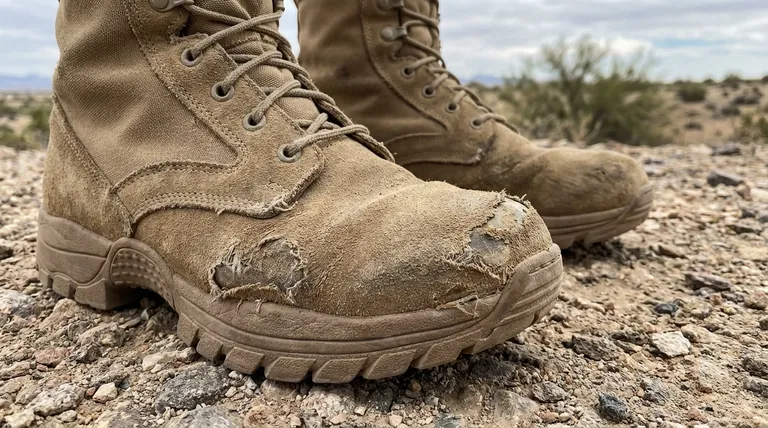
You invested heavily in top-tier tactical footwear for your team, expecting rugged performance and long-term durability. But the reports from the field tell a different story. The toes are shredded, the seams are giving out, and you're facing another expensive replacement cycle far sooner than you budgeted for.
You're not alone. Many organizations find themselves trapped in this frustrating loop, asking the same question: Why do these expensive, "tough" boots fail so quickly?
The Costly Cycle of 'Tougher' Solutions
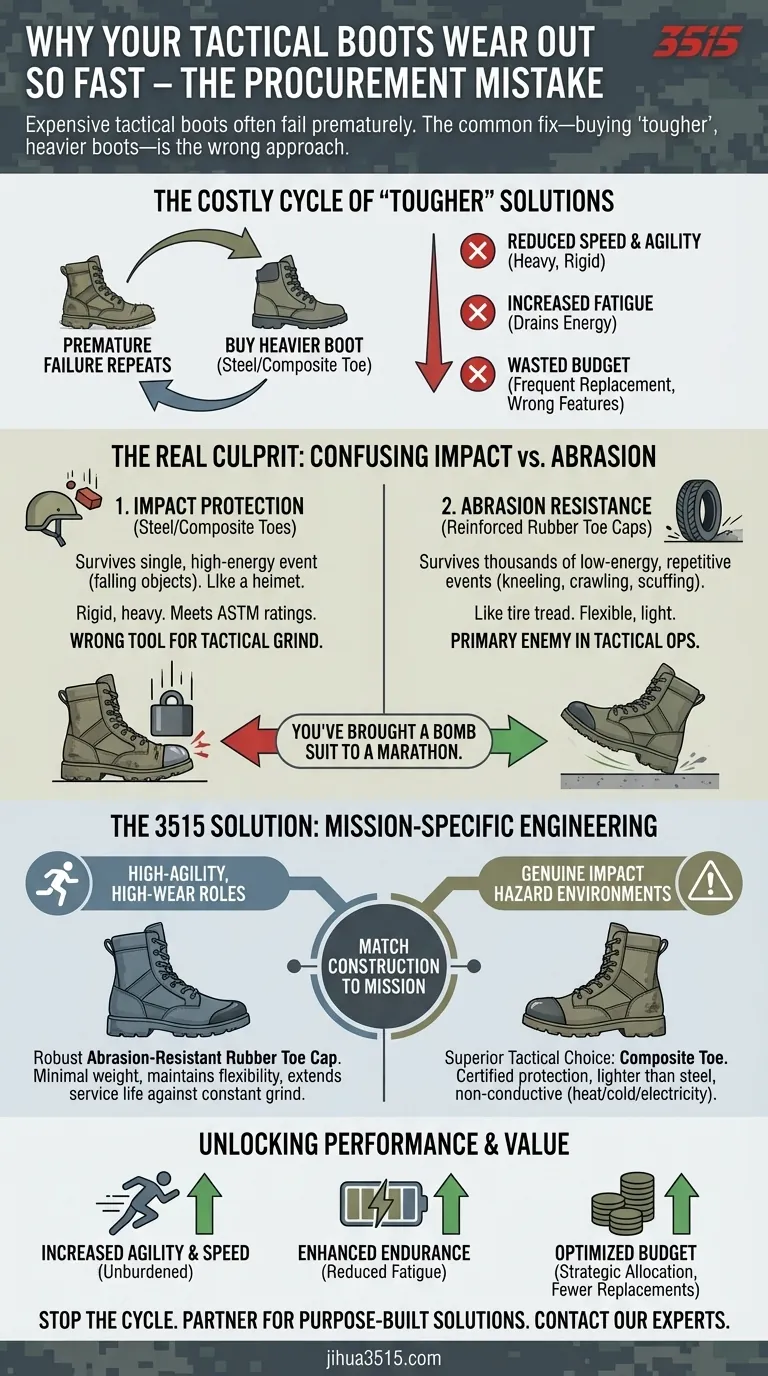
When faced with premature boot failure, the typical reaction is logical: find a "tougher" boot. This often means choosing footwear with more reinforcement, heavier materials, or even a certified safety toe, like steel or composite. The thinking is that if the boot is rated for industrial impact, it must be able to handle tactical environments.
This approach rarely works. In fact, it often makes the problem worse.
The new, heavier boots may still wear out in the same way, but now they come with added consequences:
- Reduced Operational Speed: The extra weight and rigidity slow your team down, turning quick movements into sluggish efforts.
- Increased Fatigue: Every extra ounce on the foot drains energy over a long patrol or shift, directly impacting team endurance and effectiveness.
- Wasted Budget: You're not only replacing boots constantly, but you're paying a premium for "safety" features that don't address the real reason for the failure, and which actively hinder performance.
The problem isn't that your boots aren't tough enough. The problem is that you're solving for the wrong threat.
The Real Culprit: Confusing Impact Protection with Durability
Here is the fundamental truth that most overlook: The feature that protects a foot from a falling toolbox is completely different from the one that protects a boot from being dragged across concrete.
We're talking about two distinct engineering principles:
1. Impact Protection (Steel & Composite Toes)
This is about surviving a single, high-energy event. Think of it like a helmet. Its job is to absorb a massive, potentially catastrophic blow to prevent injury. Steel and composite toes are designed for environments with overhead drop hazards, like construction sites or warehouses. They are rigid, add weight, and are built to meet specific impact-resistance ratings (e.g., ASTM F2413).
2. Abrasion Resistance (Reinforced Rubber Toe Caps)
This is about surviving thousands of low-energy, repetitive events. Think of it like the tread on a tire. Its purpose isn't to stop a single major impact, but to withstand constant friction, scuffing, and scraping. In tactical operations, this is the primary enemy of footwear. Every time a user kneels, crawls, kicks through debris, or climbs, the toe of their boot is grinding against an abrasive surface.
The "tough" steel-toe boot fails in a tactical role because it was built to solve a problem that rarely exists in that environment, all while ignoring the one that happens every single day. You've brought a bomb suit to a marathon—it's protective, but it's the wrong tool for the job and will guarantee failure.
Building the Right Tool for the Mission
To break the cycle of failed footwear, you must stop buying off-the-shelf boots and start deploying mission-specific solutions. This requires a partner who understands the critical difference between impact safety and operational durability—and has the manufacturing capability to deliver precisely what you need.
At 3515, we don't just sell boots; we engineer footwear solutions based on a deep understanding of your team's real-world operational demands.
Our approach is to match the construction to the mission:
- For High-Agility, High-Wear Roles: For teams that need to be fast, mobile, and light on their feet, the ideal solution is a boot with a robust, abrasion-resistant rubber toe cap. It adds minimal weight, maintains flexibility, and dramatically extends the boot's service life by protecting the underlying leather or fabric from the constant grind of fieldwork.
- For Environments with Genuine Impact Hazards: If your teams operate in areas with known drop or compression risks and require a formal safety rating, a composite toe is the superior tactical choice. It provides certified protection at a fraction of the weight of steel, and it won't conduct heat, cold, or electricity.
By diagnosing the true cause of wear and tear, we can construct a boot that doesn't just survive, but thrives in its intended environment.
Beyond Durability: Unlocking Performance and Value
When you equip your teams with the correctly specified footwear, the benefits extend far beyond simply buying boots less often.
You unlock a new level of operational potential. Teams become faster and more agile because they aren't burdened by unnecessary weight. They can stay effective for longer because proper boot construction reduces fatigue. Your budget is freed from a reactive replacement cycle and can be allocated to other critical gear. Brand owners who partner with us can confidently market their footwear as purpose-built, creating a loyal customer base that trusts their equipment to perform.
Your team's mission is unique, and their footwear should be too. It’s time to move beyond the one-size-fits-all approach and start building a solution that delivers a clear strategic advantage. Let's discuss the specific challenges your teams face and engineer the exact boot they need to succeed.
Visual Guide
Related Products
- Durable Leather Tactical Boots Wholesale & Custom Manufacturing for Brands
- High-Traction Suede Tactical Boots Wholesale & Custom Manufacturing
- Durable Leather High-Ankle Tactical Boots for Wholesale & Custom Manufacturing
- Durable Mid-Cut Tactical Boots for Wholesale & Private Label
- Wholesale Waterproof Tactical Boots Custom Suede & High-Traction Soles
Related Articles
- The Agility-Protection Paradox: Deconstructing Safety in Modern Tactical Footwear
- Why Your Tactical Boots Keep Failing—And Why 'Tougher' Isn't the Answer
- How Tactical Boots Deliver Long-Term Value: A Cost & Performance Breakdown
- The Procurement Officer's Gamble: Why 'Tough Enough' Isn't Good Enough for Tactical Boots
- Why Your Team Hates Their New Tactical Boots: A Buyer's Guide to What Really Matters















