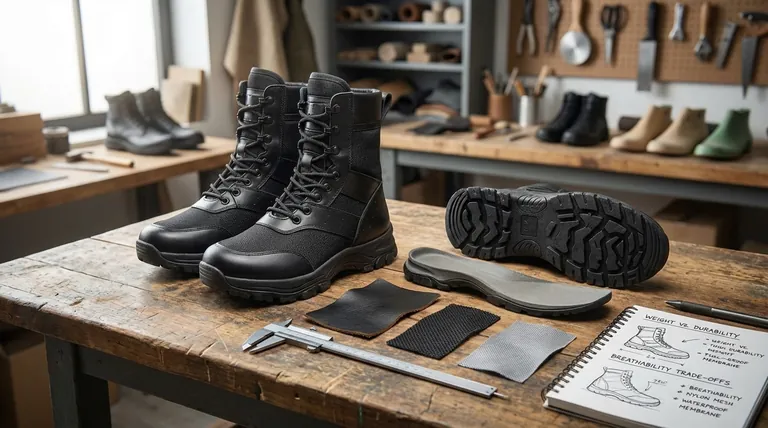
You did everything by the book. You researched the top-rated tactical boots, invested a significant budget, and equipped your team with what was supposed to be the best gear on the market. A few weeks later, the feedback is in, and it’s not good.
One group complains the boots are heavy and unbearably hot during long urban patrols. Another team, working in a rural environment, reports a lack of grip on loose terrain. The "perfect" boot is failing everyone, just in different ways. Your investment feels wasted, and team morale is taking a hit.
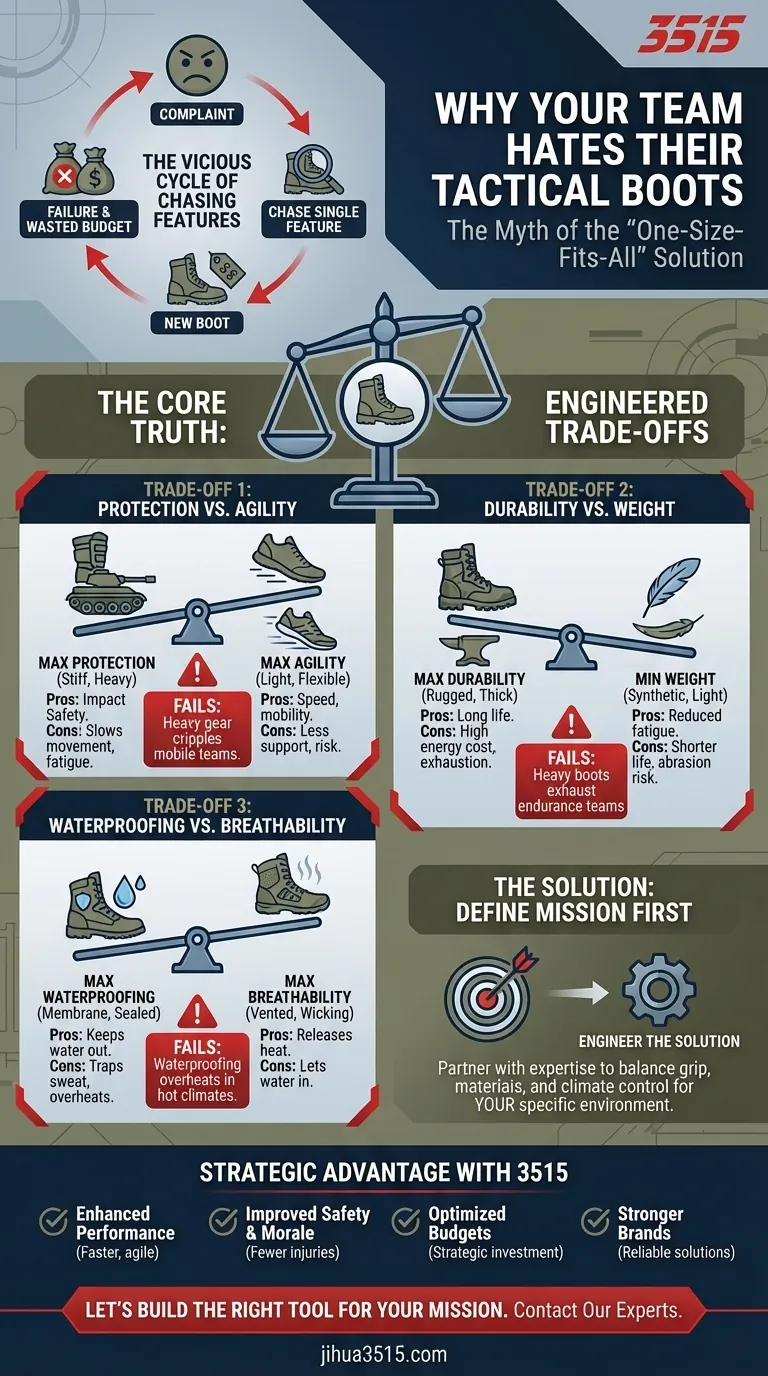
The Vicious Cycle of Chasing Features
This scenario is frustratingly common for procurement managers, distributors, and brand owners. When faced with poor feedback, the typical reaction is to hunt for a new boot, this time focusing on a different feature.
- "Last time they were too hot. This time, we'll get the fully waterproof, insulated model."
- "The last boots weren't durable enough. This time, we need full-grain leather and a Goodyear welt, no exceptions."
- "Let's just buy the model labeled 'Special Forces'—it has to be the best, right?"
This approach is a costly guessing game. It treats the problem as a simple feature mismatch, leading to a cycle of purchasing, complaints, and re-purchasing. The negative business consequences pile up: wasted budgets, compromised team performance, increased risk of injury from inappropriate footwear, and a warehouse full of boots no one wants to wear.
The problem isn't that you're choosing bad boots. The problem is that you're asking the wrong question.
The Real Reason Your Boots Fail: The Myth of the "One-Size-Fits-All" Solution
The core issue isn't a single feature, but a fundamental misunderstanding of what a tactical boot is. A high-performance boot is not a single product; it is a system of engineered trade-offs. Every design choice that enhances one attribute inevitably compromises another.
The "perfect boot" that excels in every environment doesn't exist. The common solutions fail because they chase an ideal without acknowledging the underlying physics and material science.
Trade-Off 1: Protection vs. Agility
Think of it as the difference between a tank and a running shoe.
- Maximum Protection: A boot with a stiff sole, reinforced composite toe, and thick leather uppers provides incredible protection from impact and rough terrain. However, that rigidity and weight actively work against mobility, slowing the wearer down and causing fatigue over long distances.
- Maximum Agility: A lightweight boot with a flexible sole and nylon upper allows for speed and athletic movement, but offers far less ankle support and protection from crushing force.
Why feature-chasing fails: Choosing a heavily armored boot for a team that needs to be fast and mobile is a recipe for failure, regardless of its "5-star" rating.
Trade-Off 2: Durability vs. Weight
The most rugged materials are almost always the heaviest.
- Maximum Durability: Thick, full-grain leather and heavy-duty construction methods like a Goodyear welt create a boot that can last for years. This added weight, however, requires more energy with every step, contributing to exhaustion on a 12-hour shift.
- Minimum Weight: Modern synthetic fabrics are incredibly light and can reduce fatigue significantly. The trade-off is often a shorter service life and less resistance to abrasion.
Why feature-chasing fails: Insisting on the "most durable" materials for a mission that prioritizes endurance and low fatigue can cripple a team's effectiveness.
Trade-Off 3: Waterproofing vs. Breathability
This is perhaps the most misunderstood trade-off.
- Maximum Waterproofing: A boot with a waterproof membrane is excellent at keeping water out. This is critical in cold, wet climates.
- Maximum Breathability: That same membrane that blocks water from entering also traps sweat and heat inside. In a hot, arid environment, a "waterproof" boot can be a liability, quickly leading to moisture buildup, blisters, and overheating. A breathable, non-waterproof design with moisture-wicking liners would be far superior.
Why feature-chasing fails: Buying a waterproof boot for a desert-based team because "waterproof" sounds like a premium feature is a classic mistake rooted in ignoring the mission's climate.
Moving From 'Buying Boots' to 'Engineering a Solution'
The solution isn't to find the mythical "perfect boot." The solution is to define the mission first and then select or manufacture a boot that makes the right trade-offs. To solve this root problem, you need a partner who understands that footwear is engineered equipment, not a commodity.
This is where a manufacturer's perspective becomes invaluable. At 3515, we don't just see a boot; we see a system of components designed to solve a specific operational challenge.
- Our extensive production capabilities allow us to create boots with the precise balance of outsole grip and sole flexibility your environment demands.
- We can help you select the optimal upper materials—be it rugged leather for maximum durability or lightweight synthetics for agility and breathability.
- Our expertise means we can build a boot with the exact climate-control features needed for your team's specific theater of operations, avoiding the common waterproofing vs. breathability trap.
Our role is to help you move beyond the label on the box and focus on the engineering inside the boot. We provide the manufacturing expertise to deliver footwear that is not just "tactical," but mission-specific.
Beyond Comfort: The Strategic Advantage of Mission-Specific Footwear
When you stop searching for a single best boot and start sourcing the right boot for each mission, the benefits go far beyond simply eliminating complaints.
- Enhanced Performance: Teams become faster, more agile, and less fatigued, allowing them to focus fully on their objectives.
- Improved Safety & Morale: The risk of slips, falls, and foot-related injuries plummets. A team equipped with gear that truly works for them is a more confident and effective team.
- Optimized Budgets: You stop wasting money on inappropriate footwear. Your procurement becomes a strategic investment in operational capability, not a recurring expense to fix past mistakes.
- Stronger Brands & Distribution: For our brand and distributor partners, this approach allows you to offer a more sophisticated, valuable product line that solves real-world problems for your end-users, building a reputation for expertise and reliability.
Getting footwear right isn't just an equipment issue; it's a strategic advantage. Whether you are outfitting a security force, developing a new product line for a specific market, or sourcing reliable gear for your distribution network, navigating these trade-offs is the key to success. Our team specializes in exactly that. We don't just manufacture boots; we partner with you to engineer the optimal footwear solution for your unique operational environment. Let's build the right tool for your mission. Contact Our Experts.
Visual Guide
Related Products
- Durable Leather Tactical Boots Wholesale & Custom Manufacturing for Brands
- High-Traction Suede Tactical Boots Wholesale & Custom Manufacturing
- Durable Leather High-Ankle Tactical Boots for Wholesale & Custom Manufacturing
- Wholesale Waterproof Tactical Boots Custom Suede & High-Traction Soles
- Durable Mid-Cut Tactical Boots for Wholesale & Private Label
Related Articles
- Why Your Tactical Boots Wear Out So Fast—And the Procurement Mistake Behind It
- The Agility-Protection Paradox: Deconstructing Safety in Modern Tactical Footwear
- Why Your Tactical Boots Keep Failing—And Why 'Tougher' Isn't the Answer
- How Tactical Boots Deliver Long-Term Value: A Cost & Performance Breakdown
- The Procurement Officer's Gamble: Why 'Tough Enough' Isn't Good Enough for Tactical Boots
















