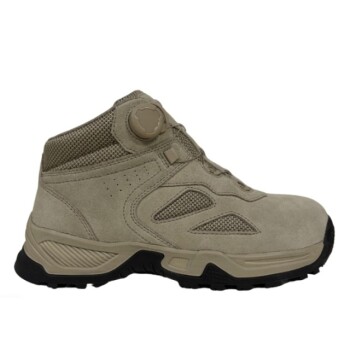
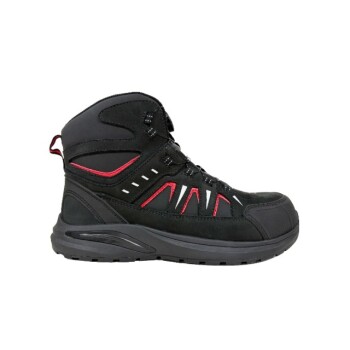
The combination of thickened calf leather and synthetic materials offers a critical balance between physical resilience and structural integrity in industrial footwear. Calf leather, specifically between 1.4 to 1.6 millimeters thick, provides superior abrasion resistance and natural breathability, while synthetic fiber inserts reinforce the boot's stability and shield against external contaminants.
This hybrid construction leverages the natural tear strength and breathability of leather while utilizing synthetics to enhance durability and protection. It creates a safety boot capable of withstanding complex industrial environments involving scratches, splashes, and heavy wear.
The Specific Role of Calf Leather
Optimized Thickness for Durability
The selection of calf leather with a specific thickness of 1.4 to 1.6 millimeters is a calculated engineering choice. This gauge provides excellent abrasion resistance and high tear strength, ensuring the upper can withstand contact with rough surfaces without failing.
Natural Breathability
Despite its toughness, leather retains the ability to "breathe." This allows for better air circulation compared to non-porous materials, helping to manage moisture and temperature inside the boot during extended wear.
Long-Term Shape Retention
Leather is valued for its ability to mold to the user's foot while maintaining its general shape. This property ensures that the boot continues to provide excellent support even after months of daily use.
The Function of Synthetic Inserts
Enhancing Structural Stability
While leather provides the flexible skin of the boot, synthetic fiber inserts act as the skeleton. These inserts are integrated to enhance the structural stability of the boot, preventing the upper from collapsing or deforming under heavy stress.
Protection Against Contaminants
Synthetics provide a necessary shield against environmental hazards that might damage natural hide. They offer enhanced protection against external contaminants, minor chemical splashes, and deep scratches that occur in complex industrial settings.
Understanding the Trade-offs
The Break-in Period
Unlike fully synthetic footwear, which often feels flexible immediately, a boot with a thick leather upper requires a break-in period. Users should expect the material to feel stiff initially until it conforms to the specific shape of their foot.
Maintenance Requirements
While the synthetic components are generally low-maintenance, the leather portion requires care to maintain its water resistance and durability. Without regular cleaning and conditioning, the leather can dry out and crack, compromising the boot's integrity.
Making the Right Choice for Your Environment
When selecting safety footwear, the ratio of leather to synthetic material should be dictated by your specific work conditions.
- If your primary focus is abrasion resistance: Prioritize boots that strictly adhere to the 1.4 to 1.6 mm leather thickness standard to ensure maximum tear strength.
- If your primary focus is stability in messy environments: Ensure the design features substantial synthetic fiber inserts to protect against splashes and maintain boot structure.
The ideal safety boot uses this hybrid approach to deliver protection that neither material could achieve on its own.
Summary Table:
| Feature | Calf Leather (1.4-1.6mm) | Synthetic Fiber Inserts | Benefit to User |
|---|---|---|---|
| Function | Primary Upper Material | Structural Reinforcement | Balanced flexibility & support |
| Strength | High Abrasion & Tear Resistance | Enhanced Shape Retention | Long-lasting durability in rough sites |
| Climate | Natural Breathability | Protection from Contaminants | Moisture control with external shielding |
| Maintenance | Requires regular conditioning | Low maintenance / Shielding | Reliable performance in messy environments |
Partner with 3515 for High-Performance Industrial Footwear
As a large-scale manufacturer serving global distributors and brand owners, 3515 offers comprehensive production capabilities for all footwear types. Our flagship Safety Shoes series is engineered with the precise 1.4-1.6mm leather-synthetic hybrid technology discussed above to ensure your workforce or customers receive maximum protection and longevity.
Beyond safety boots, our extensive portfolio covers work and tactical boots, outdoor shoes, training shoes, sneakers, and Dress & Formal shoes to meet your diverse bulk requirements.
Ready to elevate your product line with industry-leading durability? Contact us today to discuss your bulk manufacturing needs
References
- Ewa Puszczałowska-Lizis, Jarosław Omorczyk. Evaluation of safety boots and their relationships with the foot structure of female and male industrial workers. DOI: 10.1186/s12891-025-08983-4
This article is also based on technical information from 3515 Knowledge Base .
Related Products
- Premium Waterproof High-Cut Industrial Safety Boots for Wholesale and Bulk Orders
- Puncture-Resistant Velcro Safety Boots for Wholesale & Custom Manufacturing
- Premium Wholesale Waterproof Safety Boots High Performance Protection for Industrial Markets
- Premium Wholesale Wheat Nubuck Safety Boot with Rapid Lacing System
- Customizable Anti-Smash Safety Boots for Wholesale & Private Label Manufacturing
People Also Ask
- Why are oil-resistant and anti-slip properties critical for industrial safety boots? Expert Outsole Engineering Guide
- What are the primary protective functions of industrial safety boots in oil palm plantations? Master Rough Terrain Safety
- What functions do industrial safety boots serve? Essential Protection for Footwear Sole & Stockfit Processing
- How do industrial safety boots assist maintenance personnel working on high-level palm oil factory structures?
- What protective functions do industrial-grade safety boots provide in construction and mining? Maximize Worker Safety