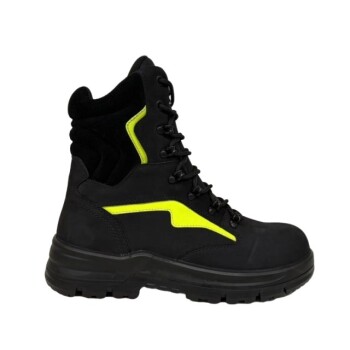
Slip resistance is a fundamental performance indicator in hospital environments because essential sanitation protocols actively compromise floor safety. The frequent application of industrial-grade disinfectants and hand sanitizers reduces the coefficient of friction on walking surfaces, creating an immediate slip hazard. High-grip footwear is required to counteract this environmental risk and compensate for the physical limitations imposed by full-body protective gear.
The Core Reality Hospital safety relies on a delicate balance: the very chemicals used to sterilize the environment destabilize the walking surface. Protective footwear serves as the critical mechanical interface that restores stability, compensating for the fact that protective suits significantly impair a worker's natural ability to balance and navigate.
The Environmental Hazard
The Impact of Sanitization Agents
Hospital floors are subjected to a constant regimen of industrial-grade disinfectants and hand sanitizers. These agents are non-negotiable for infection control, yet they act as lubricants that coat walking surfaces.
Reduction of Friction
The primary result of these sanitization protocols is a significant decrease in the coefficient of friction. Standard flooring materials lose their natural grip when coated with these fluids, necessitating footwear that can mechanically override the slippery conditions.
The Human Factor
Impaired Mobility
Protective footwear does not operate in a vacuum; it supports workers often wearing full protective suits. This gear inherently restricts range of motion, making it difficult for a worker to regain their balance after a minor slip.
Compromised Vision
In addition to limited movement, protective gear often causes blurred vision or restricted fields of view. Workers cannot always visually identify wet patches or hazards on the floor, making reliable underfoot grip their only defense against falls.
The Mechanism of Protection
Outsole Textures and Materials
To combat low-friction floors, effective footwear utilizes specific outsole textures and material formulations. These elements are engineered to bite through fluid layers and establish physical contact with the floor.
Prevention of Trauma
The ultimate goal of slip resistance is the reduction of physical injuries, such as falls and fractures. By providing necessary physical friction, the footwear effectively lowers the incidence of trauma in high-risk zones.
Understanding the Trade-offs: The Safety Paradox
Protection vs. Agility
There is an inherent trade-off in hospital PPE: as biological protection increases (full suits), physical agility decreases. The more protected a worker is from viruses, the more vulnerable they become to mechanical injuries like falls.
Reliance on Equipment Over Perception
Because protective gear blurs vision, workers are forced to trade their visual situational awareness for equipment reliance. You cannot trust your eyes to spot the hazard, so you must trust your footwear to handle the hazard blindly.
Making the Right Choice for Your Goal
When selecting protective footwear for hospital environments, consider the specific constraints of your staff:
- If your primary focus is High-Sanitization Zones: Prioritize footwear with specialized material formulations capable of maintaining friction specifically against industrial disinfectants.
- If your primary focus is Full-PPE Teams: Prioritize maximum outsole grip texture to compensate for the severe mobility and vision deficits caused by protective suits.
Invest in slip resistance not just as a feature, but as the foundational support system that allows infection control protocols to exist safely.
Summary Table:
| Hazard Factor | Impact on Worker Safety | Footwear Requirement |
|---|---|---|
| Sanitization Agents | Reduces floor friction (coefficient of friction). | Specialized slip-resistant outsoles. |
| Full PPE Suits | Restricts range of motion and physical agility. | Maximum stability and grip support. |
| Blurred Vision | Prevents visual detection of floor hazards. | Reliable mechanical traction. |
| High-Risk Zones | Increased incidence of falls and fractures. | Industrial-grade material formulations. |
Secure Your Medical Staff with High-Performance Footwear
As a leading large-scale manufacturer, 3515 specializes in providing distributors and brand owners with professional-grade safety solutions. We understand that in hospital environments, slip resistance is non-negotiable for infection control teams.
Our manufacturing expertise ensures that every pair of shoes—from our flagship Safety Shoes series to specialized medical training shoes—offers the mechanical grip needed to withstand industrial disinfectants and support workers in full PPE. Partner with us to access:
- Bulk Production Capabilities: Comprehensive footwear manufacturing across all types.
- Flagship Safety Technology: Engineered outsoles designed for high-risk environments.
- Versatile Portfolio: Tactical boots, sneakers, and formal shoes to meet diverse bulk requirements.
Contact 3515 Today to discuss your bulk footwear needs and protect those who protect others.
References
- Chaona Gao, Honglin Dong. Investigation and analysis of occupational physical injuries among healthcare staffs during allopatric medical aid for the fight against COVID-19. DOI: 10.13075/mp.5893.01222
This article is also based on technical information from 3515 Knowledge Base .
Related Products
- Premium Suede Sport Safety Shoes for Wholesale & Bulk Orders
- Premium Lightweight Safety Shoes for Wholesale & Bulk Orders
- Premium Waterproof Nubuck Safety Boots for Wholesale
- Wholesale Customizable Safety Boots Durable & Protective Footwear Manufacturing
- Wholesale Anti-Smash & Puncture-Proof Safety Shoes Custom Manufacturing for Brands
People Also Ask
- What are the primary functions of professional safety shoes? Maximize Safety in Water Supply Confined Spaces
- What industries have specific OSHA footwear requirements? Ensure Compliance & Protect Your Workforce
- What role do specialized safety shoes play in preventing falls? Engineering Stability in Industrial Environments
- What happens during the cutting stage of safety shoes manufacturing? Precision, Process & Quality
- How do the 3R principles influence green footwear design? Master Sustainable Safety Shoe Manufacturing