Proper support in a walking shoe is the single most important factor for preventing pain and injury. It provides a stable foundation that aligns your foot, absorbs impact, and guides your natural walking motion, reducing stress not just on your feet but on your knees, hips, and back.
Support is not about creating a rigid, uncomfortable shoe. It is about engineering a stable platform that corrects for your specific biomechanical needs, allowing your foot to move efficiently and safely with every step.

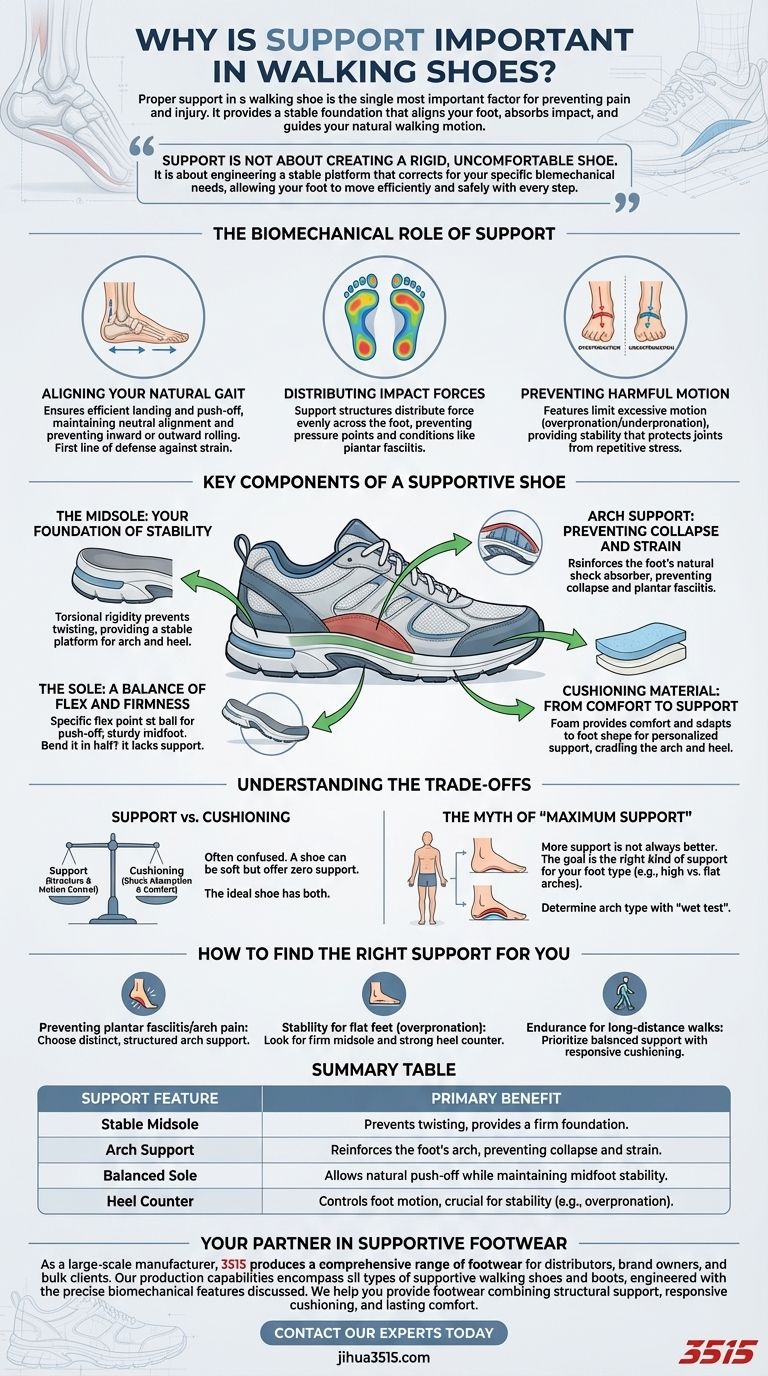
The Biomechanical Role of Support
To understand why support is critical, we must first look at the mechanics of walking. Each step is a complex sequence of movements that puts significant force on your body.
Aligning Your Natural Gait
A supportive shoe ensures your foot lands and pushes off in the most efficient way possible. It helps maintain a neutral alignment, preventing the foot from rolling too far inward or outward.
This proper alignment is the first line of defense against strain and fatigue during long walks.
Distributing Impact Forces
With every step, your foot absorbs a force several times your body weight. Support structures, particularly in the midsole and arch, are designed to distribute this pressure evenly across the entire foot.
Without this, force becomes concentrated in vulnerable areas like the heel or the ball of the foot, leading to pain and conditions like plantar fasciitis.
Preventing Harmful Motion
Many people have feet that naturally roll too far inward (overpronation), often associated with low arches, or not far enough (underpronation), common with high arches.
A supportive shoe has features that limit this excessive motion, providing stability that protects your joints from the repetitive stress that causes chronic injury.
Key Components of a Supportive Shoe
Support isn't a single feature but a system of components working together. When evaluating a shoe, look for these specific elements.
The Midsole: Your Foundation of Stability
The midsole is the layer between the insole and the outsole. In a supportive walking shoe, it should be firm and relatively inflexible through the middle of the foot.
This torsional rigidity prevents the shoe from twisting, providing a stable platform for your arch and heel.
Arch Support: Preventing Collapse and Strain
The arch of your foot acts as a natural shock absorber. Proper arch support in a shoe reinforces this structure, preventing it from collapsing under your weight.
This is crucial for preventing plantar fasciitis, a common and painful inflammation of the tissue running along the bottom of your foot.
The Sole: A Balance of Flex and Firmness
A well-designed walking shoe has a specific flex point. It should bend easily at the ball of the foot to allow for a natural push-off.
However, it should remain sturdy and unbending through the midfoot. If you can bend a shoe in half, it lacks the fundamental support needed for walking.
Cushioning Material: From Comfort to Support
Materials like foam can play a dual role. While providing comfort, certain foams also adapt to your foot shape over time, offering a degree of personalized support.
This is particularly helpful in cradling the arch and heel, reducing pain and the risk of injury.
Understanding the Trade-offs
Choosing a shoe always involves balancing competing factors. Understanding these trade-offs is key to making an informed decision.
Support vs. Cushioning
These two terms are often confused. Cushioning is about shock absorption and comfort, while support is about structure and motion control.
A shoe can feel very soft and cushioned but offer zero support, potentially worsening biomechanical issues. The ideal walking shoe has both.
The Myth of "Maximum Support"
More support is not always better. The goal is to find the right kind of support for your foot type.
A person with high arches and underpronation needs a different support structure than someone with flat feet and overpronation. Getting the wrong type can be as problematic as having no support at all. You can determine your arch type with a simple "wet test" by examining your footprint on a dry surface.
How to Find the Right Support for You
Your specific goal will determine which support features you should prioritize.
- If your primary focus is preventing plantar fasciitis or arch pain: Choose a shoe with distinct, structured arch support that matches the contour of your foot.
- If your primary focus is stability for flat feet (overpronation): Look for a shoe with a firm midsole and a strong heel counter to control the inward rolling of your foot.
- If your primary focus is endurance for long-distance walks: Prioritize a balanced shoe that combines reliable structural support with responsive cushioning to absorb impact over many miles.
Ultimately, choosing a shoe with the correct support transforms a simple walk into a truly safe and beneficial exercise for your entire body.
Summary Table:
| Support Feature | Primary Benefit |
|---|---|
| Stable Midsole | Prevents twisting, provides a firm foundation. |
| Arch Support | Reinforces the foot's arch, preventing collapse and strain. |
| Balanced Sole | Allows natural push-off while maintaining midfoot stability. |
| Heel Counter | Controls foot motion, crucial for stability (e.g., overpronation). |
Ready to find the perfect supportive walking shoe for your needs?
As a large-scale manufacturer, 3515 produces a comprehensive range of footwear for distributors, brand owners, and bulk clients. Our production capabilities encompass all types of supportive walking shoes and boots, engineered with the precise biomechanical features discussed in this article.
We can help you provide your customers with footwear that combines structural support, responsive cushioning, and lasting comfort.
Contact our experts today to discuss your specific requirements and discover how 3515 can be your reliable manufacturing partner.
Visual Guide
Related Products
- Durable Rubber Sole Outdoor Shoes Wholesale & Custom Manufacturing
- Wholesale Durable Camouflage Canvas Shoes with High-Traction Cleated Rubber Sole
- Premium Suede Sport Safety Shoes for Wholesale & Bulk Orders
- Wholesale Comfortable Business Casual Shoes Custom Manufacturing
- Premium Lightweight Safety Shoes for Wholesale & Bulk Orders
People Also Ask
- What is the function of the sole in outdoor shoes? Find the Perfect Grip and Support
- What role do outdoor shoes and sneakers play in navigating external terrains? Engineered Stability for Every Surface
- How is AI utilized in the design of outdoor and safety footwear? Harnessing Big Data for Market-Driven Shoe Innovation
- Why is durability important when selecting outdoor shoes? A Guide to Safety & Long-Term Value
- What are the key components of outdoor shoes that affect comfort and sturdiness? A Guide to Durable, High-Performance Footwear