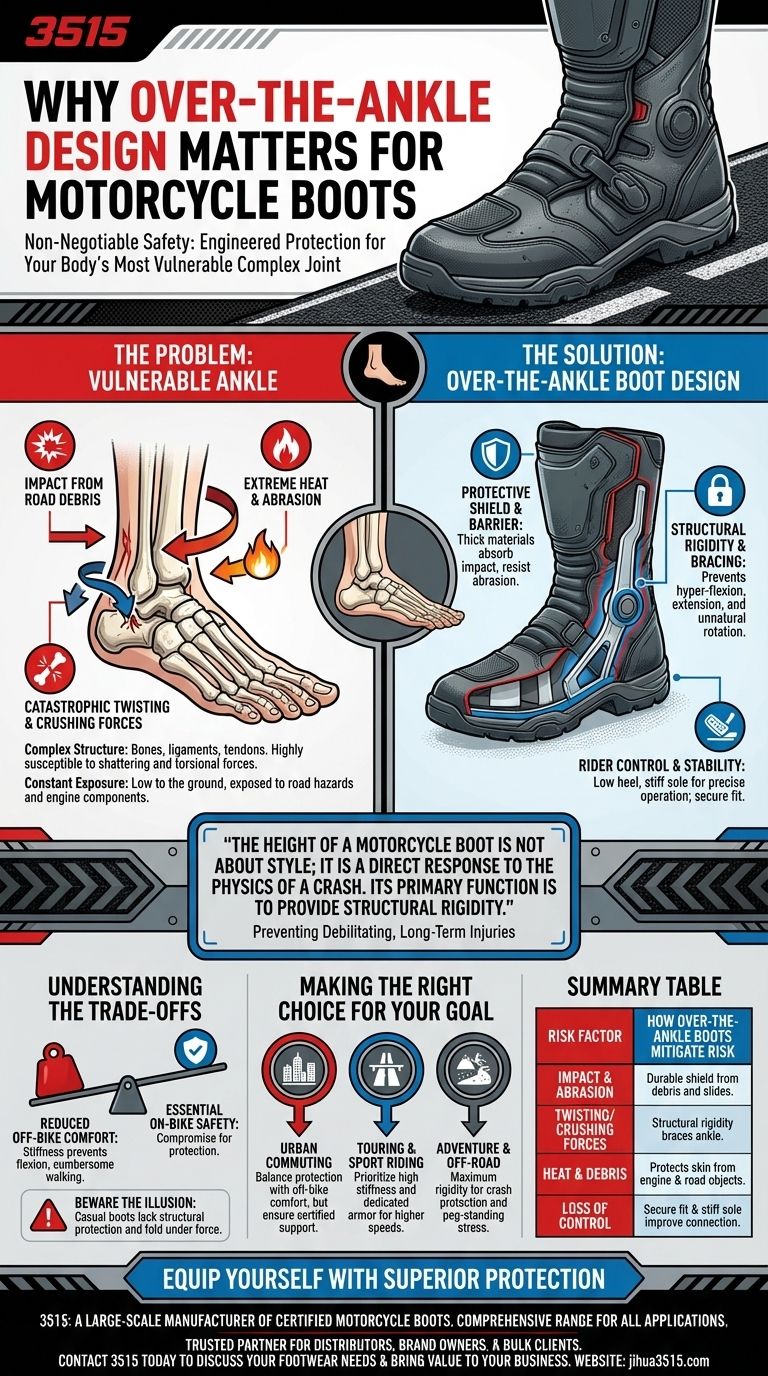
At its core, an over-the-ankle motorcycle boot design is a non-negotiable safety feature engineered to protect one of the most complex and vulnerable parts of your body. Your ankles are directly exposed to impact from road debris, extreme heat from the engine, and catastrophic twisting forces during a fall. A proper boot provides a critical shield and structural brace against these specific, high-risk hazards.
The height of a motorcycle boot is not about style; it is a direct response to the physics of a crash. Its primary function is to provide structural rigidity to prevent the hyper-flexion, extension, and rotation that cause debilitating, long-term ankle injuries.
The Anatomy of a Motorcycle Injury Risk
To understand the solution, you must first appreciate the problem. The ankle is uniquely susceptible to the specific dangers inherent in riding a motorcycle.
A Complex and Vulnerable Joint
Your ankle is a complex structure of bones, ligaments, and tendons. This complexity allows for a wide range of motion but makes it incredibly vulnerable to shattering impacts and torsional forces that a simple shoe or low-cut boot cannot mitigate.
Constant Impact and Abrasion Hazards
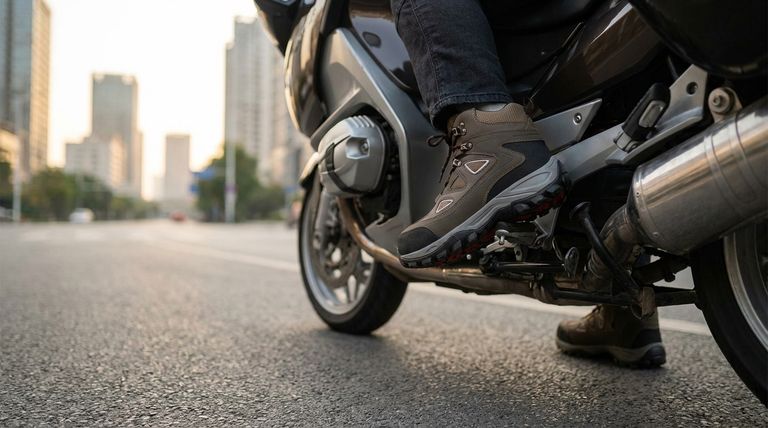
While riding, your feet are low to the ground and exposed. Over-the-ankle coverage provides a direct shield against stones, road debris, and other objects kicked up from the road surface. It also protects your skin from abrasion during a slide and from direct contact with hot engine and exhaust components.
The True Danger: Twisting and Crushing Forces
The most severe injuries in a crash often come from the bike falling on the rider's leg or the foot being caught and twisted. These events generate enormous crushing and rotational (torsional) forces. An over-the-ankle design is the first line of defense against these catastrophic, life-altering injuries.
How Over-the-Ankle Design Mitigates Risk
A certified motorcycle boot uses its height and construction to provide layers of protection that go far beyond simple coverage.
Providing a Protective Shield
The most basic function is shielding. The thick leather and synthetic materials create a durable barrier between your ankle and the outside world, absorbing the energy from impacts and resisting abrasion far better than standard footwear.
Creating Structural Rigidity
This is the most critical function. A well-designed boot incorporates a stiff structure and ankle support systems. This rigidity acts as an external brace, locking the heel in place and severely restricting the ankle's ability to bend or twist in unnatural directions during the chaos of a crash.
Ensuring Rider Control
A secure, over-the-ankle boot improves your connection to the motorcycle. The low heel and stiff sole are designed for precise operation of the foot controls, and the secure fit prevents your foot from slipping off the pegs, which is essential for maintaining stability.
Understanding the Trade-offs
True expertise requires acknowledging the compromises. While essential, the protective design of motorcycle boots comes with practical considerations.
Reduced Off-Bike Comfort
A boot with a high stiffness rating designed to prevent flexion will inherently be less comfortable for walking. The features that make it safe on the bike—rigidity and a snug fit—make it cumbersome off the bike.
The Illusion of Protection
Many casual or work-style boots go over the ankle but offer none of the necessary structural protection. A boot made of heavy leather might resist abrasion, but without built-in stiffness and impact armor, it will fold and twist under the forces of a crash, providing a false sense of security.
Making the Right Choice for Your Goal
Your choice should be dictated by your specific riding needs, but the principle of over-the-ankle protection is universal.
- If your primary focus is urban commuting: Seek a certified boot that balances protection with off-bike walking comfort, but never sacrifice certified ankle support.
- If your primary focus is touring or sport riding: Prioritize boots with higher stiffness ratings and dedicated armor, as the potential for higher speeds demands more robust protection.
- If your primary focus is adventure or off-road riding: You need the maximum level of rigidity and support to handle both crash protection and the stresses of standing on the pegs over uneven terrain.
Ultimately, choosing a proper over-the-ankle motorcycle boot is a foundational decision in managing the inherent risks of riding.
Summary Table:
| Risk Factor | How Over-the-Ankle Boots Mitigate Risk |
|---|---|
| Impact & Abrasion | Provides a thick, durable shield from road debris and slides. |
| Twisting/Crushing Forces | Offers structural rigidity to brace the ankle and prevent hyper-flexion. |
| Heat & Debris | Protects skin from hot engine parts and objects kicked up from the road. |
| Loss of Control | Improves connection to the bike with a secure fit and stiff sole for precise control. |
Equip Yourself with Superior Protection
Your safety is non-negotiable. As a large-scale manufacturer, 3515 produces a comprehensive range of certified over-the-ankle motorcycle boots designed for maximum protection, durability, and rider control. We are the trusted partner for distributors, brand owners, and bulk clients seeking high-performance footwear.
Our production capabilities encompass all types of motorcycle boots and boots for any application. Let us help you deliver the safety and quality your customers demand.
Contact 3515 today to discuss your footwear needs and discover how we can bring value to your business.
Visual Guide
Related Products
- High Performance Fire-Retardant Waterproof Safety Boots
- Premium High-Cut Waterproof Safety Boots Manufacturing & Wholesale Solutions
- Wholesale Tactical Boots High-Traction & Reflective for Bulk & Brand Orders
- Durable Goodyear Welt Leather Work Boots for Wholesale & Private Label
- Wholesale High-Traction Camo Boots - Custom Manufacturer for Brands
People Also Ask
- Why are waterproof safety boots recommended for certain work environments? Essential Protection for Wet & Hazardous Jobs
- What roles do 3D vision systems and industrial robots play in the manufacturing of fire safety boots? Smart Automation
- How does boot construction affect waterproofing? The Science Behind Truly Dry Feet
- How can you ensure your feet stay dry during winter walks? A Two-Part Defense System for Total Comfort
- How should you maintain waterproof boots? A Simple 3-Step Guide to Long-Lasting Performance