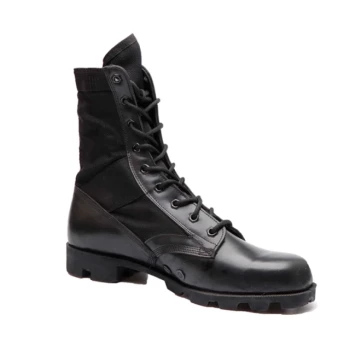
Mold Compression Technology is the industry standard for military footwear because it utilizes high-pressure rubber molds to fuse the outsole directly to the upper, creating a bond that is far superior to traditional adhesives. This process eliminates common structural failures like delamination while enabling the automation necessary to produce consistent, high-quality boots at a massive scale.
By replacing standard gluing methods with high-pressure direct bonding, Mold Compression Technology resolves the primary cause of boot failure—sole separation—while ensuring the production consistency required for military logistics.
The Mechanics of Structural Integrity
Creating a Cohesive Unit
The defining feature of this technology is the use of high-pressure rubber molds. Rather than simply gluing two separate parts together, the process bonds the outsole directly to the upper under intense pressure. This creates a unified structure where the connection point is as strong as the materials themselves.
Eliminating Delamination Risks
In combat environments, boots undergo extreme stress. The firm yet flexible connection created by mold compression ensures the sole does not peel away (delaminate). The bond remains intact even when subjected to moisture, heat, and rough terrain.
Withstanding Repetitive Stress
Military boots must endure constant flexing. This manufacturing method allows the boot to handle repetitive bending without suffering structural damage. The materials move together rather than pulling apart, significantly extending the lifespan of the footwear.
Operational Performance Benefits
Enhanced Impact Resistance
Protection is just as important as durability. Mold Compression Technology significantly improves the impact resistance of the boot. The densified rubber resulting from the compression process offers better shock absorption, protecting the wearer during high-impact maneuvers.
Consistent Quality Control
Because the process is highly automated, it minimizes human error. Every boot produced undergoes the exact same pressure and molding conditions. This ensures that every pair issued meets the same rigorous safety and durability standards.
The Logistics of Mass Production
Meeting High-Volume Demands
Military contracts often require thousands of units to be delivered on tight schedules. This technology is a key enabler for large-scale production. Its automated nature allows manufacturers to output vast quantities of boots without sacrificing the integrity of the individual unit.
Understanding the Trade-offs
High Initial Tooling Costs
While efficient for mass production, the creation of the specific high-pressure molds is expensive. This creates a high barrier to entry and makes the technology less cost-effective for small batches or limited production runs.
Limited Design Flexibility
Once a mold is cast, the design is fixed. Unlike hand-stitched or cemented construction, making changes to the sole design or tread pattern requires manufacturing entirely new molds. This can slow down rapid prototyping or quick design iterations.
Making the Right Choice for Your Goal
When evaluating military-grade footwear manufacturing, align your choice with your primary operational requirements:
- If your primary focus is field durability: Prioritize Mold Compression for its ability to prevent sole delamination and resist structural damage during repetitive bending.
- If your primary focus is large-scale procurement: Rely on this technology to ensure consistent product quality and reliable volume delivery through automation.
Ultimately, Mold Compression Technology offers the critical balance between tactical reliability for the soldier and logistical efficiency for the supply chain.
Summary Table:
| Feature | Mold Compression Technology | Traditional Adhesives |
|---|---|---|
| Bond Strength | Direct fusion under high pressure | Surface-level chemical bonding |
| Durability | High resistance to delamination | High risk of sole separation |
| Scale | Ideal for high-volume automation | Often labor-intensive manual work |
| Impact Resistance | Enhanced through densified rubber | Standard shock absorption |
| Consistency | High (machine-controlled) | Variable (human-dependent) |
Partner with 3515 for High-Volume Tactical Solutions
As a large-scale manufacturer serving distributors and brand owners worldwide, 3515 leverages advanced Mold Compression Technology to deliver footwear that withstands the world's harshest environments. Our comprehensive production capabilities cover all footwear types, anchored by our flagship Safety Shoes series.
From work and tactical boots to outdoor shoes, training shoes, and dress & formal footwear, we provide the durability and scale your brand requires. Contact us today to discuss your bulk requirements and discover how our manufacturing expertise can strengthen your product line.
References
- Ani Atsharyan, Artashes Melikyan. Design Project of Multi-Functional Military Boots. DOI: 10.47857/irjms.2025.v06i02.03292
This article is also based on technical information from 3515 Knowledge Base .
Related Products
- Durable Military Combat Boots with Water Drainage for Wholesale & OEM
- High-Traction Suede Tactical Boots Wholesale & Custom Manufacturing
- Durable High-Ankle Tactical Boots for Wholesale & Custom Manufacturing
- Durable Mid-Cut Tactical Boots for Wholesale & Private Label
- Wholesale Waterproof Tactical Boots Custom Suede & High-Traction Soles
People Also Ask
- Why must gait validation for military applications be conducted in combat boots? Ensure Data Accuracy for Soldiers
- What are the common types of combat boots? Find the Right Boot for Your Mission
- What factors should be considered when choosing military boots for hiking? Durability vs. Weight for Your Terrain
- What are the key considerations when choosing military boots? Prioritize Compliance, Environment & Fit
- How should the midfoot and heel fit in military boots? Achieve a Snug, Secure Fit for Blister Prevention