
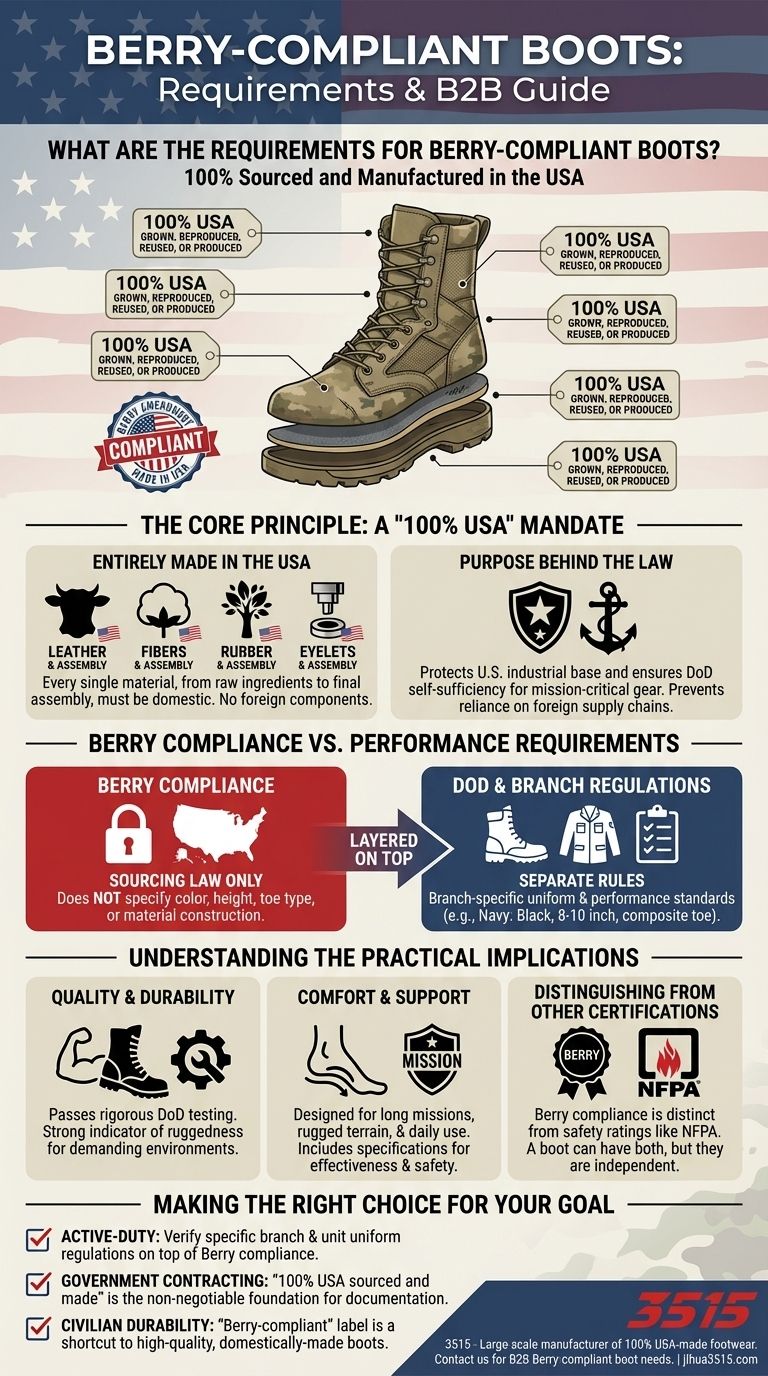
To be considered Berry-compliant, a pair of boots must be entirely sourced and manufactured in the United States. This includes every component, from the leather and textiles to the laces and soles. This domestic sourcing requirement is combined with strict durability and quality standards set by the U.S. Department of Defense (DoD) for items issued to military personnel.
The Berry Amendment is fundamentally a domestic sourcing law, not a performance specification. It exists to ensure the U.S. military is not dependent on foreign supply chains for critical gear by mandating that products like boots are 100% made in the USA.

The Core Principle: A "100% USA" Mandate
What "Entirely Made in the USA" Means
The defining feature of Berry compliance is its strict rule on origin. Every single material used in the construction of the boot must be grown, reprocessed, reused, or produced domestically.
This means the cattle for the leather, the fibers for the fabric, the rubber for the sole, and the materials for the eyelets must all originate from and be assembled within the United States.
The Purpose Behind the Law
This requirement is not arbitrary. The Berry Amendment was enacted to protect the U.S. industrial base and ensure the DoD remains self-sufficient for essential goods.
By guaranteeing a market for domestic producers, the law prevents the nation's military from becoming reliant on potentially hostile or unstable foreign suppliers for mission-critical equipment.
Berry Compliance vs. Performance Requirements
A Common Misconception
A key point of confusion is thinking "Berry-compliant" is a standalone feature set. The Berry Amendment itself does not specify a boot's color, height, toe type, or material construction.
It is strictly a sourcing requirement. The performance and design specifications are separate rules layered on top of it.
The Role of DoD and Branch Regulations
While a boot must be Berry-compliant to be procured by the DoD, it must also meet the specific uniform and performance regulations for the military branch that will use it.
For example, a Navy boot must be Berry-compliant and meet the Navy’s separate requirements for being black, 8-10 inches high, and featuring a composite toe cap.
Similarly, other combat boots may be required to be a specific color of suede and mesh to match a uniform, a rule set by the branch, not the Berry Amendment.
Understanding the Practical Implications
Quality and Durability
Because Berry-compliant boots are intended for military use, they must pass rigorous DoD testing for durability and quality.
This means that while the "Berry" label refers to sourcing, it is a strong indicator that the boot is built to a high standard of ruggedness suitable for demanding environments.
Comfort and Support
For military personnel, boots are a critical tool. They are worn for long missions over rugged terrain and during daily administrative work.
Therefore, DoD requirements often include specifications for comfort and function, such as solid arch support, to ensure the footwear is effective and safe for the wearer over extended periods.
Distinguishing from Other Certifications
It's important not to confuse Berry compliance with safety ratings like those from the National Fire Protection Association (NFPA).
NFPA standards focus on specific safety features, such as requiring flame-resistant thread and all-leather uppers for firefighting boots. A boot can be both Berry-compliant and NFPA-certified, but these are independent qualifications.
Making the Right Choice for Your Goal
To select the correct footwear, you must first identify which regulations apply to your situation.
- If your primary focus is active-duty military use: Always start by verifying your specific branch and unit uniform regulations, as these dictate the required color, style, and features on top of Berry compliance.
- If your primary focus is government contracting or supply: The "100% USA sourced and made" rule is the non-negotiable foundation of Berry compliance that you must document and prove.
- If your primary focus is civilian use seeking durability: Looking for the "Berry-compliant" label is an excellent shortcut to finding exceptionally high-quality, domestically-made boots that are proven to withstand military-grade conditions.
Ultimately, understanding the distinction between the sourcing law and the separate performance specifications is the key to selecting the correct and compliant footwear for any mission.
Summary Table:
| Requirement | Description |
|---|---|
| Sourcing | All materials (leather, soles, laces) must be 100% sourced and manufactured in the USA. |
| Quality Standards | Must meet rigorous DoD durability and performance tests for military use. |
| Purpose | Ensures U.S. military supply chain security and supports domestic manufacturing. |
| Key Distinction | Berry compliance is a sourcing law, not a performance specification. |
Need reliable, high-quality Berry-compliant boots?
As a large-scale manufacturer, 3515 produces a comprehensive range of 100% USA-made footwear that meets strict Berry Amendment requirements. Our boots are built to withstand military-grade conditions, offering superior durability, comfort, and compliance for distributors, brand owners, and bulk clients.
Let us help you secure a dependable domestic supply chain. Contact us today to discuss your Berry-compliant boot needs!
Visual Guide
Related Products
- Premium Grain Leather Safety Boots for Bulk Supply
- High Performance Fire-Retardant Waterproof Safety Boots
- High-Traction Suede Tactical Boots Wholesale & Custom Manufacturing
- Wholesale Durable Mid-Cut Tactical Boots for Custom & Private Label Brands
People Also Ask
- Which organizations develop safety standards for work boots? Ensure Compliance & Worker Safety
- What makes durable safety boots? The Ultimate Guide to Long-Lasting Work Footwear
- What are the consequences of not wearing safety boots? Protect Your Finances and Career
- What primary protective functions do professional safety boots provide in urban solid waste recovery and waste picking processes? Discover Dual-Layer Protection.
- What materials are commonly used for outsoles in safety boots? A Guide to Durability, Grip, and Comfort



