
At their core, jump boots are engineered as a specialized piece of safety equipment designed to protect a paratrooper from the severe impact of landing. Their construction prioritizes ankle stability and foot protection above all else, featuring tall, rigid leather shafts, reinforced toe caps and heels, and durable high-traction soles.
The design of a jump boot is not merely about creating durable footwear; it is a direct solution to a critical problem: mitigating the risk of lower-leg injury during the violent and unpredictable forces of a parachute landing.
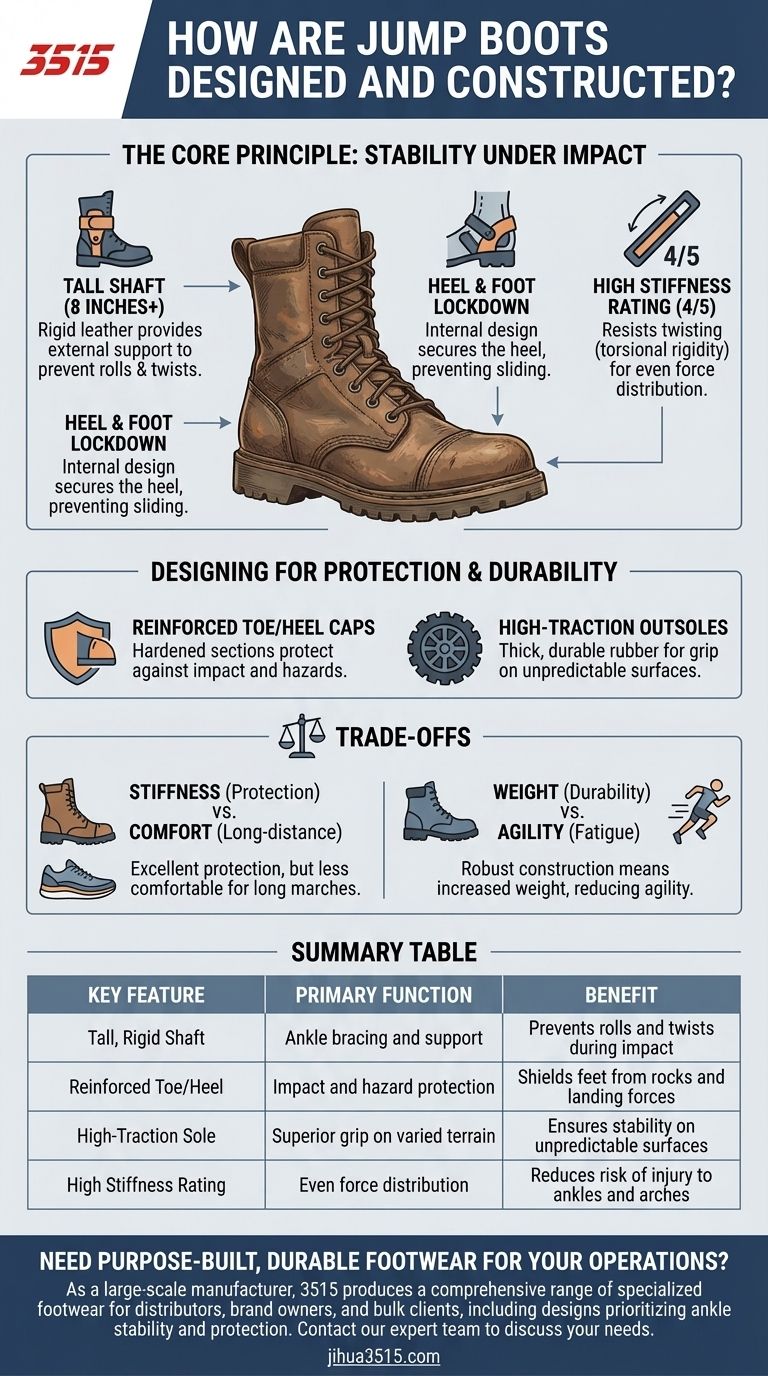
The Core Principle: Stability Under Impact
The primary function of a jump boot is to act as a brace for the ankle and foot, preventing the sprains, twists, and fractures common to airborne operations. Every feature is built around this central requirement.
The Tall Shaft for Ankle Bracing
A defining feature of jump boots is their taller shaft, often 8 inches or more. This height is critical for providing external support that extends well above the ankle joint.
The use of rigid, high-quality leather enhances this bracing effect. Unlike more flexible materials, the stiff leather resists the ankle's tendency to roll or buckle upon landing.
Heel and Foot Lockdown
The boot’s internal design, combining leather and synthetic materials, is engineered to lock the user's heel firmly into the back of the boot.
This prevents the foot from sliding internally during impact or while navigating difficult terrain with a heavy pack. A secure fit translates directly to greater stability and control.
A High Stiffness Rating
Jump boots are characterized by a high stiffness rating, often rated 4 out of 5. This means the boot strongly resists twisting (torsional rigidity) and bending along its length.
This rigidity ensures that the force of landing is distributed more evenly across the entire foot structure, rather than being concentrated on a single weak point like the arch or ankle.
Designing for Protection and Durability
Beyond stability, a jump boot must function as effective combat footwear once the paratrooper is on the ground. This requires robust protection and long-term durability.
Reinforced Toe and Heel Caps
Hardened or reinforced toe and heel sections are standard. These protect the foot from direct impact against the ground during a parachute landing fall (PLF) and shield it from rocks, roots, and other hazards in a combat environment.
High-Traction Outsoles
The outsoles are made from thick, durable rubber or synthetic compounds. The tread patterns are designed to provide reliable traction on a wide variety of unpredictable surfaces, from soft earth to wet pavement.
Understanding the Trade-offs
The specialized, safety-oriented design of jump boots comes with inherent compromises that are important to understand.
Stiffness vs. Comfort
The very rigidity that provides excellent protection makes the boots less comfortable for long-distance marching compared to more flexible, modern infantry boots. They often require a significant break-in period.
Weight and Agility
The robust construction, using thick leather and reinforced components, makes traditional jump boots heavier than many contemporary alternatives. This can reduce agility and increase fatigue over extended periods.
Making the Right Choice for Your Goal
Selecting footwear requires matching its intended design to your specific needs.
- If your primary focus is maximum ankle protection and stability: The rigid, purpose-built design of a jump boot is engineered specifically for this and remains highly effective.
- If your primary focus is long-distance hiking or general-purpose use: A more modern tactical or hiking boot will likely offer a better balance of support, flexibility, and reduced weight for superior comfort.
Ultimately, understanding that jump boots are a tool for mitigating the specific risk of a parachute landing allows you to appreciate their design and choose the right footwear for your mission.
Summary Table:
| Key Feature | Primary Function | Benefit |
|---|---|---|
| Tall, Rigid Shaft | Ankle bracing and support | Prevents rolls and twists during impact |
| Reinforced Toe/Heel | Impact and hazard protection | Shields feet from rocks and landing forces |
| High-Traction Sole | Superior grip on varied terrain | Ensures stability on unpredictable surfaces |
| High Stiffness Rating | Even force distribution | Reduces risk of injury to ankles and arches |
Need purpose-built, durable footwear for your operations?
As a large-scale manufacturer, 3515 produces a comprehensive range of specialized footwear for distributors, brand owners, and bulk clients. Our production capabilities encompass all types of safety and tactical boots, including designs that prioritize the critical ankle stability and protection detailed in this article.
We can help you develop or source the perfect footwear solution for your specific mission requirements. Contact our expert team today to discuss your needs and discover the value we can bring to your supply chain.
Visual Guide
Related Products
- Premium Wholesale Tactical Style Safety Shoes Boots with Quick Lacing
- Wholesale Tactical Boots High-Traction & Reflective for Bulk & Brand Orders
- Durable High-Ankle Tactical Boots Wholesale Manufacturer for Custom & Bulk Orders
- Durable Leather High-Ankle Tactical Boots for Wholesale & Custom Manufacturing
- Durable High-Ankle Tactical Boots for Wholesale & Custom Manufacturing
People Also Ask
- How are gait analysis research findings applied to the functional design of safety shoes and tactical boots?
- How do quality certification standards for safety shoes reduce perceived risk? Buy Online with Technical Certainty
- Why is the synchronization of craftsmanship and UX development emphasized for bulk customization of safety shoes?
- How does anthropomorphic design influence material selection? Enhance Footwear Performance through Biological Alignment
- How can specialized footwear mitigate safety risks? High-Volume OEM/ODM Solutions since 1951



















