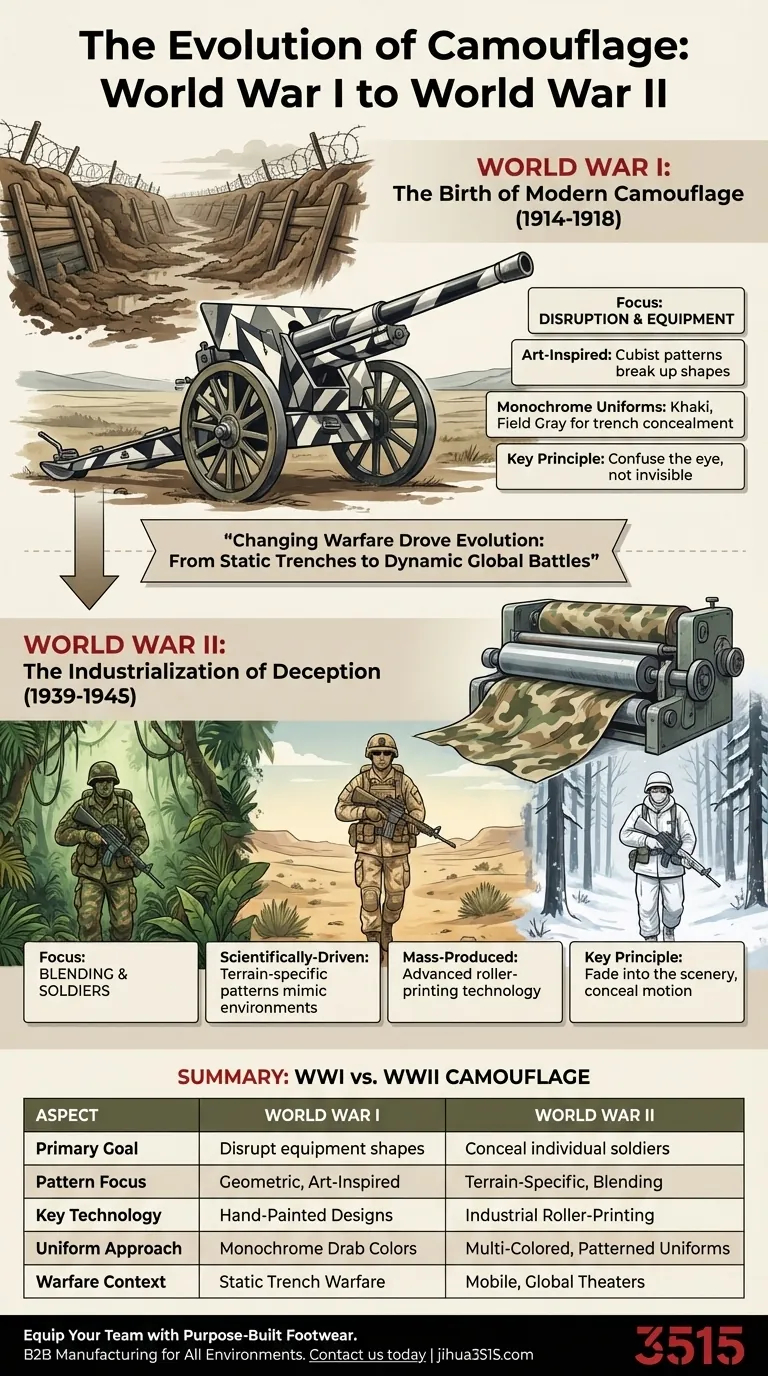
In the World Wars, camouflage evolved dramatically, transforming from an improvised, art-inspired tactic in World War I into a scientifically-driven, mass-produced military standard by the end of World War II. The first war saw efforts focused on disrupting the shape of large equipment like artillery, often using principles from Cubist art. By the second war, the focus shifted to concealing individual soldiers with terrain-specific patterns, enabled by advances in fabric printing technology.
The core driver of camouflage's evolution was the changing nature of warfare itself. The shift from the static, fixed positions of trench warfare to the dynamic, mobile battlefields of World War II across diverse global terrains demanded a more sophisticated and personal form of concealment.
The Birth of Modern Camouflage: World War I
Modern, industrialized warfare made traditional, brightly-colored uniforms a fatal liability. The first World War served as a brutal laboratory for the new science of military deception.
From High Visibility to Low Profile
The static nature of trench warfare, combined with the lethal accuracy of machine guns and long-range artillery, forced armies to abandon 19th-century traditions. The primary goal became simple concealment—blending into the mud and earth of the battlefield with drab, monochrome colors like khaki and field gray.
The Influence of Art on War
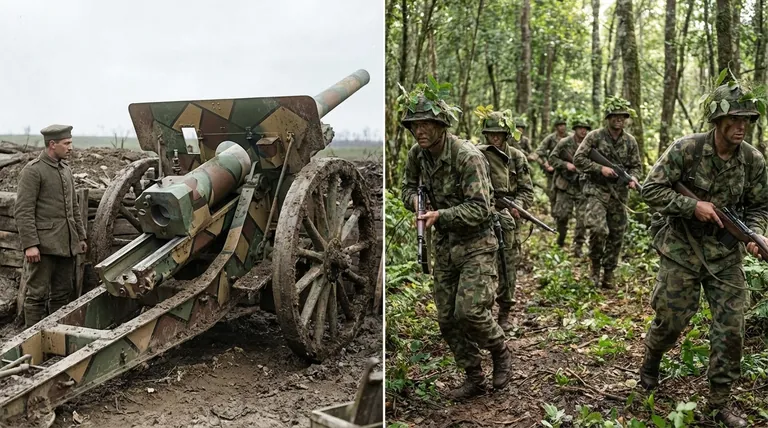
Early camouflage efforts were less about perfect blending and more about visual disruption. Military leaders recruited artists, particularly those familiar with movements like Cubism, to break up the familiar shapes of large, static objects.
These artists, known as camoufleurs, applied bold, geometric patterns to artillery pieces, observation posts, and ships. The goal was not to make the object invisible, but to confuse the eye and make it difficult for an enemy to judge its range, shape, and orientation.
A Focus on Equipment, Not Soldiers
In World War I, sophisticated camouflage was almost exclusively applied to equipment. The individual soldier's uniform was typically a single drab color, while complex patterns were reserved for high-value assets that couldn't be easily hidden.
The Industrialization of Deception: World War II
The fast-paced, mobile conflicts of World War II, fought across deserts, jungles, and snow-covered forests, created a new set of challenges that demanded a more advanced and widespread approach to camouflage.
The Shift to Patterned Uniforms
With armies fighting in more dynamic and varied environments, the need to conceal the individual soldier became paramount. Specialized units, such as paratroopers and snipers, were among the first to be issued multi-toned, patterned uniforms designed to blend in with specific landscapes.
Technology Enables Scale
A critical enabler for this shift was the advancement in industrial printing technology. New roller-printing techniques allowed for the mass production of complex, multi-colored patterns on fabric for the first time. This made it economically feasible to outfit large numbers of troops in specialized camouflage.
Specialization for Global Theaters
Unlike the general-purpose concealment of WWI, WWII saw the development of terrain-specific patterns. Militaries designed and issued distinct camouflage for different operational theaters, such as mottled green-and-brown for European forests, tan and sand colors for North African deserts, and stark white for winter warfare.
Understanding the Key Principles
The evolution from WWI to WWII reflects a maturing understanding of how visual deception works. Two core principles were at play, each suited to a different type of warfare.
Disruption vs. Blending
WWI camouflage primarily used disruption. The jarring, Cubist-inspired patterns were designed to break up an object's outline, making it hard to recognize. WWII patterns perfected the art of blending, using colors and shapes that mimicked the background environment to make the soldier or object fade into the scenery.
The Challenge of Static vs. Dynamic Use
A pattern that works for a stationary artillery piece (a WWI problem) is much simpler than one that must conceal a moving soldier (a WWII problem). The patterns of the second war had to be effective both when the soldier was still and when they were in motion, a significantly harder design challenge.
Core Lessons from Camouflage's Evolution
To understand this rapid development is to understand the pressures of modern conflict. The key takeaways depend on your analytical focus.
- If your primary focus is on technology: The ability to mass-produce complex patterns through roller-printing was the single biggest factor that allowed camouflage to scale from a niche art to a standard-issue military technology.
- If your primary focus is on military strategy: The development of camouflage directly mirrors the shift from static defensive warfare to dynamic, multi-environment offensive operations.
- If your primary focus is on design principles: This history marks a clear transition from using artistic theory for visual disruption to applying environmental science for effective blending and concealment.
Ultimately, the evolution of camouflage is a clear lesson in how military necessity forces rapid and pragmatic innovation.
Summary Table:
| Aspect | World War I | World War II |
|---|---|---|
| Primary Goal | Disrupt shapes of large equipment | Conceal individual soldiers |
| Pattern Focus | Geometric, art-inspired disruption | Terrain-specific blending |
| Key Technology | Hand-painted designs | Industrial roller-printing |
| Uniform Approach | Monochrome, drab colors | Multi-colored, patterned uniforms |
| Warfare Context | Static trench warfare | Mobile, global theaters |
Ready to equip your team with purpose-built footwear for any environment?
As a large-scale manufacturer, 3515 produces a comprehensive range of durable, high-performance footwear for distributors, brand owners, and bulk clients. Whether you need tactical boots inspired by military innovation or specialized shoes for demanding conditions, our production capabilities encompass all types of shoes and boots.
Contact us today to discuss your custom footwear needs and leverage our manufacturing expertise.
Visual Guide