The lace-to-toe boot is popular among wildland firefighters for one primary reason: unparalleled fit and support. This design extends the lacing much closer to the toe box, providing granular control over the boot's tightness across the entire length of the foot. In the dangerous and unstable terrain firefighters navigate, this precise, glove-like fit is a critical factor for stability, endurance, and injury prevention.
In the unpredictable environment of a wildland fire, a boot's ability to lock the foot in place prevents debilitating injuries and reduces fatigue. The lace-to-toe design provides the most secure and customizable fit possible, making it the superior choice for this demanding work.
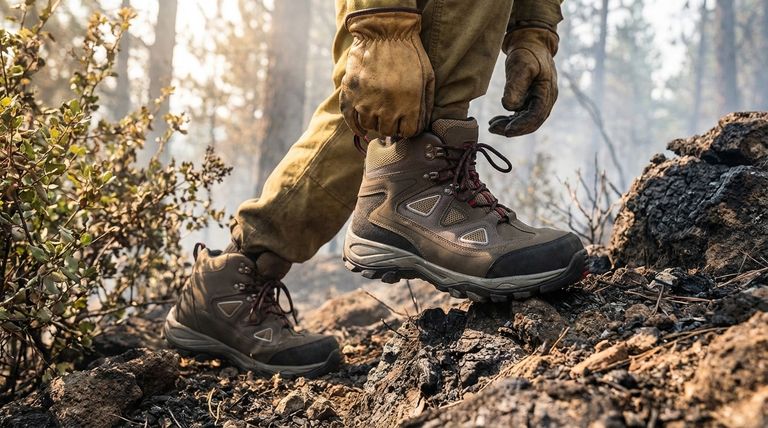
Why a Precise Fit is Mission-Critical
A wildland firefighter's boot is not just footwear; it is a critical piece of personal protective equipment. The environment demands performance that goes far beyond what standard work boots can offer.
The Challenge of Unstable Terrain
Firefighters spend hours traversing steep inclines, side-hilling across loose soil, and navigating treacherous ground littered with rocks and roots.
In these conditions, any internal foot movement inside the boot is a liability. A foot that slides forward on a descent or shifts laterally can easily lead to a rolled ankle, a loss of balance, or a serious sprain.
Preventing Fatigue and Injury
A boot that fits poorly creates friction, leading to blisters and hot spots that can become debilitating over a long shift.
More importantly, a secure fit provides essential arch and ankle support. By locking the foot in place, the boot acts as an extension of the leg, reducing the muscular strain required to maintain stability and fight fatigue.
Accommodating Long Workdays
During a 12- to 16-hour shift of intense physical labor, feet inevitably swell. Firefighters also wear different thicknesses of wool socks to manage moisture and provide cushioning.
A boot must be able to adapt to these changing conditions. The ability to loosen the toe box while keeping the ankle tight, or vice-versa, is crucial for maintaining both comfort and performance.
Deconstructing the Lace-to-Toe Advantage
The specific design of a lace-to-toe boot directly addresses the core needs of a wildland firefighter better than a traditional boot lacing system.
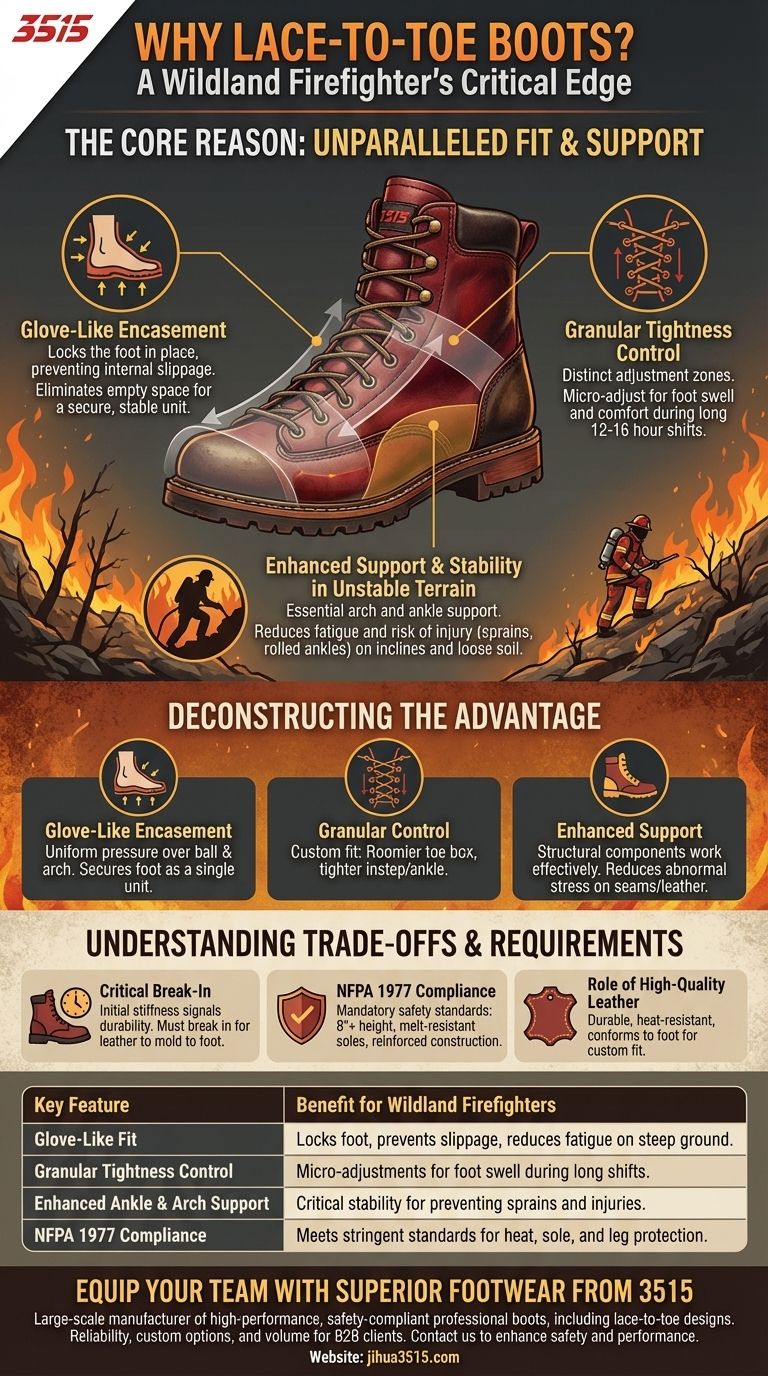
The "Glove-Like" Encasement
By extending the eyelets closer to the front, the lace-to-toe design allows the wearer to tighten the leather directly over the ball and arch of the foot.
This creates a snug, uniform pressure that eliminates empty space within the boot, securing the foot as a single, stable unit.
Granular Control Over Tightness
Unlike a standard boot where tension is concentrated around the ankle and instep, the lace-to-toe system provides distinct zones of adjustment.
This allows a firefighter to create a custom fit, such as leaving the toe box slightly roomier for comfort while cinching the instep and ankle tightly for maximum support.
Enhanced Support and Durability
The ability to achieve a perfect fit ensures the structural components of the boot can do their job effectively. The boot and foot move as one, which reduces abnormal stress on the seams and leather.
This construction is typically found on high-quality, durable leather boots designed to conform to the wearer's foot over time, providing even greater support.
Understanding the Trade-offs and Requirements
Choosing the right boot involves more than just the lacing style. The materials and construction must meet stringent safety standards.
The Critical Break-In Period
A new pair of high-quality firefighter boots should not feel perfectly comfortable out of the box. Their initial stiffness is a sign of durable, heavy-duty leather construction.
Firefighters must allow adequate time to break in new boots before taking them on the fireline. This process allows the thick leather to soften and mold to the specific shape of their feet.
Not Just Any Boot Will Do
Wildland fire boots must meet specific safety standards, such as NFPA 1977.
Key requirements include a minimum height of 8 inches to protect the lower leg, melt-resistant soles made from materials like Vibram, and reinforced construction to guard against sharp objects and falling debris.
The Role of High-Quality Leather
Leather is the preferred material because of its durability, resistance to heat, and ability to mold to the foot.
Over time, a well-maintained leather boot provides a custom-fit level of support that synthetic materials cannot replicate, which is essential for those who are on their feet for extended periods.
Making the Right Choice for the Job
The choice of boot ultimately comes down to the specific demands of the environment and the need for uncompromising performance.
- If your primary focus is maximum stability on steep ground: The lace-to-toe design offers the most secure fit to prevent internal foot slippage.
- If your primary focus is adaptability during long shifts: The ability to micro-adjust fit from the toe to the ankle is essential for managing foot swell and comfort.
- If your primary focus is safety compliance: Ensure any boot, regardless of lacing style, meets or exceeds NFPA 1977 standards for heat resistance and construction.
Ultimately, choosing a lace-to-toe boot is about gaining control over your most critical piece of equipment in an environment where control is paramount.
Summary Table:
| Key Feature | Benefit for Wildland Firefighters |
|---|---|
| Glove-Like Fit | Locks the foot in place, preventing slippage and reducing fatigue on steep, uneven ground. |
| Granular Tightness Control | Allows micro-adjustments from toe to ankle to accommodate foot swell during long shifts. |
| Enhanced Ankle & Arch Support | Provides critical stability to help prevent sprains and other injuries. |
| NFPA 1977 Compliance | Meets stringent safety standards for heat resistance, sole construction, and leg protection. |
Equip Your Team with Superior Footwear from 3515
As a large-scale manufacturer, 3515 produces a comprehensive range of high-performance, safety-compliant footwear for distributors, brand owners, and bulk clients. Our production capabilities encompass all types of professional boots, including durable lace-to-toe designs built for the most demanding environments.
We provide the reliability, custom options, and volume to meet your specific needs. Contact our team today to discuss how our boots can enhance safety and performance for your operations.
Visual Guide
Related Products
- Durable Goodyear Welt Leather Work Boots for Wholesale & Private Label
- Premium Wholesale Wheat Nubuck Safety Boot with Rapid Lacing System
- Wholesale Classic Leather Lace-Up Ankle Boots for Brand Manufacturing
- Premium Wholesale Tactical Style Safety Shoes Boots with Quick Lacing
- Advanced KPU Athletic Safety Shoe with Steel Toe Cap Anti-Slip Rotary Lacing System
People Also Ask
- What is the difference between full-grain and top-grain leather? Premium Material Guide for Boot Manufacturers
- What are the advantages of leather as an upper material for work boots? Unmatched Durability & Custom Comfort
- Why is it important to waterproof leather work boots? Protect Your Investment and Performance
- How should new leather work boots be broken in? A Guide to Comfort and Durability
- What are the advantages of leather uppers in work boots? Unmatched Durability & Protection