
The primary advantages of leather uppers in work boots are their exceptional durability, superior protection against job site hazards, and their unique ability to conform to the shape of your foot over time for a custom fit. This combination of toughness and personalized comfort is why leather remains the benchmark material for demanding work environments.
While modern materials offer benefits in weight and cost, leather's core strengths of durability and protection are the reasons it has been the trusted standard for generations. Understanding its specific trade-offs is the key to choosing the right boot for your needs.
The Core Benefits of a Leather Upper
For decades, leather has been the default material for high-quality work boots. This is not simply due to tradition, but because its natural properties are uniquely suited for creating protective and long-lasting footwear.
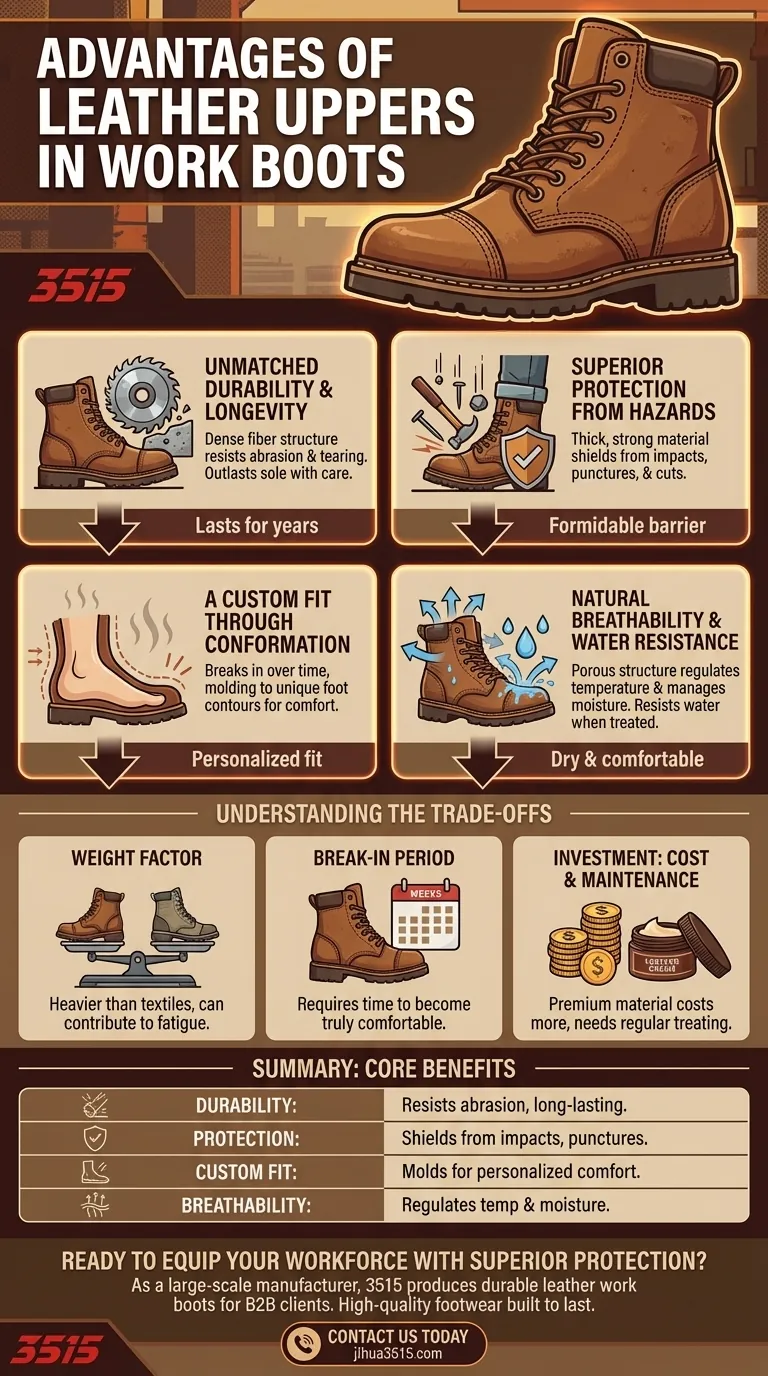
Unmatched Durability and Longevity
The dense fiber structure of leather, especially full-grain leather, makes it highly resistant to abrasion and tearing. It provides a formidable barrier against the debris and rough surfaces common on any job site.
With proper care, a leather upper can last for years, often outliving the sole of the boot itself.
Superior Protection from Hazards
Compared to textile or synthetic uppers, leather offers a significantly higher degree of protection. Its thickness and strength shield the foot from impacts, punctures, and cuts far more effectively.
For environments where physical hazards are a daily reality, the protective qualities of a leather boot are non-negotiable.
A Custom Fit Through Conformation
One of leather's most valued characteristics is its ability to break in. Over time, the material warms and stretches, gradually molding to the unique contours of your foot.
This creates a customized fit that can’t be replicated by static synthetic materials, leading to superior long-term comfort and support.
Natural Breathability and Water Resistance
Despite its toughness, leather is a porous material that allows for natural air circulation. This breathability helps regulate temperature and manage moisture inside the boot.
Leather also absorbs moisture, which helps prevent the buildup of odor-causing bacteria. When properly treated and maintained, it offers excellent water resistance, keeping your feet dry in damp conditions.
Understanding the Trade-offs
No material is perfect. To make an informed decision, you must weigh leather's significant advantages against its inherent trade-offs.
The Weight Factor
Durability comes with mass. Leather boots are almost always heavier than their textile counterparts. For fast-paced jobs that require constant movement, this added weight can contribute to fatigue over a long shift.
The Break-in Period
The same property that allows leather to create a custom fit also necessitates a break-in period. New leather boots can feel stiff and may require several days or weeks of wear to become truly comfortable.
The Investment: Cost and Maintenance
High-quality genuine leather is a premium material, and its cost reflects that. Furthermore, leather requires periodic maintenance.
Using a leather protecting cream is essential to hydrate the material, prevent it from drying out and cracking, and maintain its water resistance. This care ensures the boot's longevity.
Making the Right Choice for Your Work Environment
Your choice of upper material should be a direct reflection of your daily tasks and environment.
- If your primary focus is maximum protection and long-term durability: A full-grain leather boot is the undisputed standard for hazardous job sites and heavy-duty work.
- If your primary focus is lightweight comfort in hot weather: A boot with textile or synthetic uppers will offer better breathability and reduce fatigue in fast-paced roles.
- If your primary focus is a balance of performance and comfort: Consider the specific job hazards and know that investing in quality leather pays dividends in safety and a personalized fit.
Ultimately, choosing the right boot means matching the material's strengths to the demands of your job.
Summary Table:
| Advantage | Key Benefit |
|---|---|
| Durability & Longevity | Resists abrasion and tearing, often outlasting the boot's sole. |
| Superior Protection | Shields feet from impacts, punctures, and cuts better than synthetics. |
| Custom Fit | Molds to the shape of your foot over time for personalized comfort. |
| Breathability | Natural air circulation helps regulate temperature and manage moisture. |
Ready to equip your workforce with superior protection?
As a large-scale manufacturer, 3515 produces a comprehensive range of durable leather work boots for distributors, brand owners, and bulk clients. Our production capabilities ensure you get high-quality footwear built to last, providing the safety and comfort your customers demand.
Contact us today to discuss your work boot needs and discover how we can add value to your supply chain.
Visual Guide
Related Products
- Durable Leather Work Boots for Wholesale & Custom Manufacturing
- Wholesale Leather Work Boots with Customizable Wedge Sole for Brands
- Durable Leather Work Boots for Wholesale & Custom OEM Manufacturing
- Durable Goodyear Welt Leather Work Boots for Wholesale & Private Label
- Durable Leather Work Boots Wholesale Manufacturer & Custom Factory
People Also Ask
- What is the difference between full-grain and top-grain leather? Premium Material Guide for Boot Manufacturers
- What are the common workplace hazards that can be mitigated with the right work boots? Protect Your Workforce
- What are the common foot issues workers face due to uncomfortable work boots? Prevent Pain & Deformities
- What are the advantages of leather versus synthetic work boots? A Guide to Choosing the Right Material
- What are the key components of modern work boots? Engineered for Ultimate Durability and Comfort














