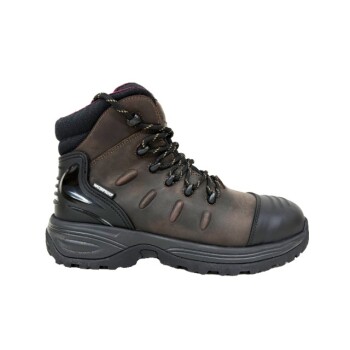
The choice between full-grain and top-grain leather defines the durability, aesthetic trajectory, and market positioning of cruiser and work-style boots. Full-grain leather is the unadulterated top layer of the hide, offering maximum tensile strength and a natural patina that develops over time. Top-grain leather is sanded to remove surface imperfections and refinished for a uniform appearance, providing a more pliable and stain-resistant material that is easier to standardize across large production volumes.
While both materials represent the premium tier of leather manufacturing, full-grain is the definitive choice for maximum longevity and heritage appeal, whereas top-grain offers a balanced solution of flexibility and visual consistency for broad commercial distribution.
The Structural Integrity of Full-Grain Leather
Maximum Fiber Density and Durability
Full-grain leather is sourced from the outermost layer of the animal hide, where the fiber structure is most dense and resilient. Because it retains the natural grain, it offers the highest resistance to abrasion and tearing, making it the "gold standard" for heavy-duty work boots.
The Value of Natural Patina
One of the most significant selling points of full-grain leather is its ability to develop a patina. Over time, the material absorbs oils and environmental elements, creating a unique, rich finish that brand owners leverage to market "lifetime" products.
Breathability and Moisture Management
Because the pores of the hide remain open and untreated by heavy sanding or synthetic coatings, full-grain leather is naturally breathable. This is a critical technical advantage for cruiser boots, where temperature regulation during long rides is essential for user comfort.
The Refinement and Utility of Top-Grain Leather
Surface Standardization and Consistency
Top-grain leather undergoes a light sanding process to remove natural scars, insect bites, or imperfections. For large-scale distributors and wholesalers, this results in a highly uniform product that reduces material waste during the cutting and assembly phases of manufacturing.
Enhanced Pliability and Comfort
Removing the outermost surface layer makes top-grain leather significantly more pliable than full-grain. This reduces the "break-in" period for the end consumer, making it an attractive option for work-style boots intended for immediate, everyday use.
Resistance to Stains and Moisture
During the finishing process, top-grain leather is often embossed with an artificial grain and sealed with a protective topcoat. This coating provides superior stain resistance and water repellency compared to the more porous full-grain alternative.
Engineering Excellence at an Enterprise Scale
State-of-the-Art Processing Capabilities
Leveraging a rich heritage since 1951, modern manufacturing facilities utilize advanced machinery to ensure precision in both full-grain and top-grain processing. This technical expertise allows for the consistent delivery of high-tier materials that meet rigorous international quality certifications.
Robust Supply Chain for High-Volume Delivery
Maintaining a stable supply of premium hides is essential for B2B partners who require consistent large-volume delivery. Enterprise-level manufacturers integrate their deep industry history with modern logistics to ensure that material quality remains identical from the first unit to the ten-thousandth.
Custom OEM/ODM Leather Solutions
The ability to transition between full-grain and top-grain production allows for versatile OEM/ODM capabilities. Manufacturers can tailor the leather's thickness, finish, and flexibility to meet the specific branding and performance requirements of global distributors.
Understanding the Trade-offs
The Limitations of Full-Grain
While full-grain is the most durable, its natural variations mean that no two boots are identical, which may be a challenge for brands requiring absolute visual uniformity. Additionally, its high density results in a longer break-in period and a higher cost per square foot.
The Drawbacks of Top-Grain
The sanding process that makes top-grain uniform also removes the strongest fibers of the hide, making it less durable than full-grain under extreme stress. Furthermore, the synthetic finishes applied to the surface reduce breathability and prevent the leather from developing a natural patina.
Strategic Selection for Your Product Line
When deciding between these two premium materials for your footwear project, consider your primary market objective and the expectations of your target demographic.
- If your primary focus is Heritage and Longevity: Utilize full-grain leather to capture the premium market segment that values durability, breathability, and the unique aging process of the material.
- If your primary focus is Consistency and Out-of-the-Box Comfort: Select top-grain leather to provide a uniform, stain-resistant product that is easier to scale and requires less maintenance for the end user.
By aligning material choice with manufacturing scale and technical precision, brand owners can deliver high-performance footwear that meets the specific demands of the modern cruiser and work-boot markets.
Summary Table:
| Feature | Full-Grain Leather | Top-Grain Leather |
|---|---|---|
| Source | Outermost layer; unadulterated | Sanded layer; refinished surface |
| Durability | Maximum tensile strength | High, but slightly reduced by sanding |
| Appearance | Natural grain; develops patina | Uniform; stain-resistant coating |
| Breathability | High (natural pores) | Lower (due to synthetic finishes) |
| Consistency | Natural variations (unique) | Standardized (minimal waste) |
| Break-in | Longer period | Softer; immediate comfort |
Scale Your Footwear Brand with a Heritage Manufacturing Partner
Choosing the right leather is critical for market success. As a large-scale manufacturer serving global distributors and brand owners since 1951, 3515 provides the technical expertise to bring your vision to life. We offer comprehensive OEM/ODM production capabilities for all footwear types, anchored by our flagship Safety Shoes series.
Whether you require the rugged durability of full-grain leather or the sleek consistency of top-grain, our state-of-the-art equipment and international certifications ensure consistent, large-volume delivery. Our portfolio includes:
- Work & Tactical Boots for extreme environments.
- Outdoor & Training Shoes for performance and comfort.
- Sneakers & Dress Shoes for diverse bulk requirements.
Enhance your supply chain stability and profit margins today. Contact our expert team at 3515 to request a quote and technical consultation.
Related Products
- Wholesale Leather Work Boots with Customizable Wedge Sole for Brands
- Durable Leather Work Boots for Wholesale & Custom Manufacturing
- Durable Leather Work Boots for Wholesale & Custom OEM Manufacturing
- Durable Goodyear Welt Leather Work Boots for Wholesale & Private Label
- Durable Leather Work Boots Wholesale Manufacturer & Custom Factory
People Also Ask
- What are the advantages of leather as an upper material for work boots? Unmatched Durability & Custom Comfort
- How can leather work boots be protected from environmental elements? A 3-Step Guide to Lasting Durability
- What is the complete process for deep cleaning leather work boots? A Step-by-Step Guide to Preserve Your Investment
- What are the key qualities of leather for work boots? Superior Durability, Breathability & Custom Fit
- Why is it important to waterproof leather work boots? Protect Your Investment and Performance