
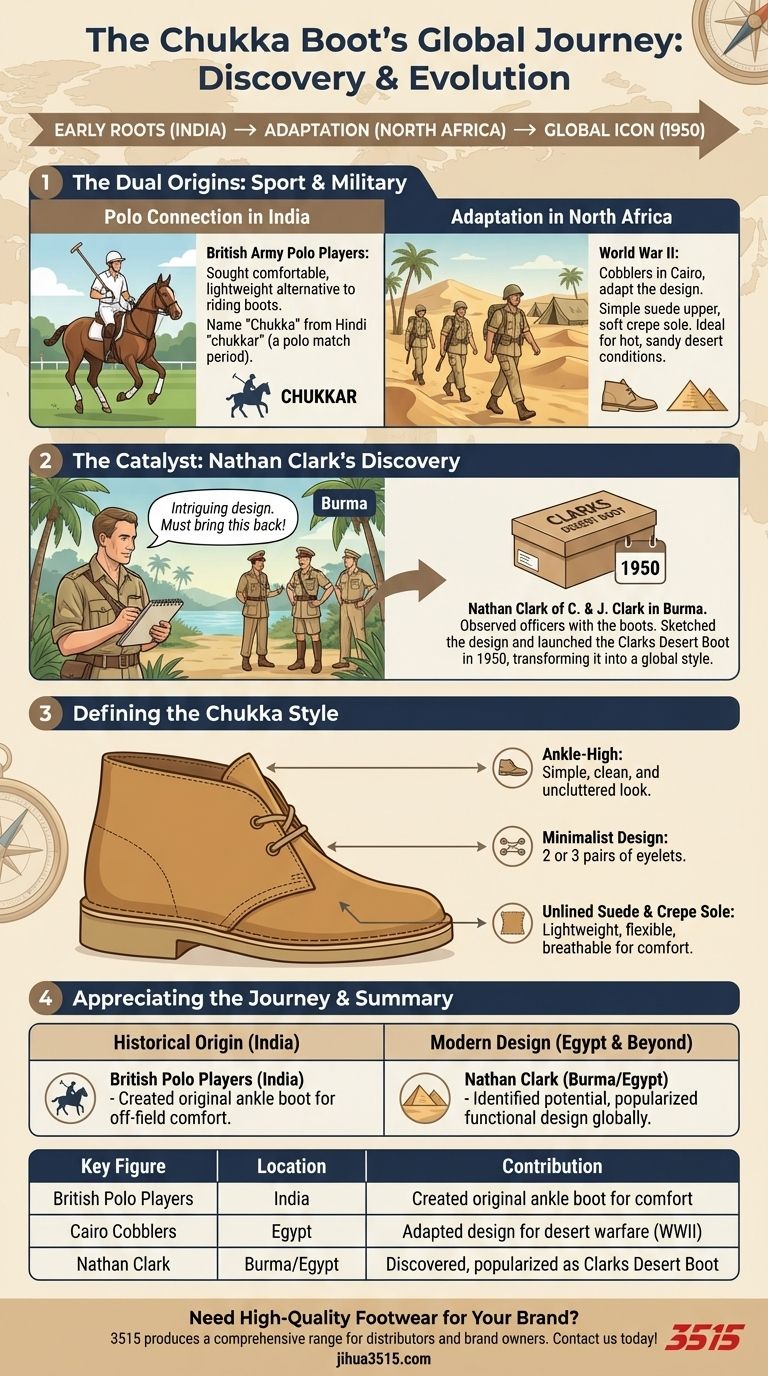
While Nathan Clark is widely credited with discovering and popularizing the Chukka Boot for a Western audience, he did not invent it. During his military service in World War II, he observed officers in Burma wearing a unique, comfortable ankle boot and traced its immediate origins back to cobblers in Cairo's Khan el-Khalili bazaar. However, the boot's true lineage begins much earlier in India.
The Chukka Boot was not a singular invention but an evolution. Its functional design originated with British polo players in India, was adapted by soldiers in North Africa, and was ultimately introduced to the global market by Nathan Clark.
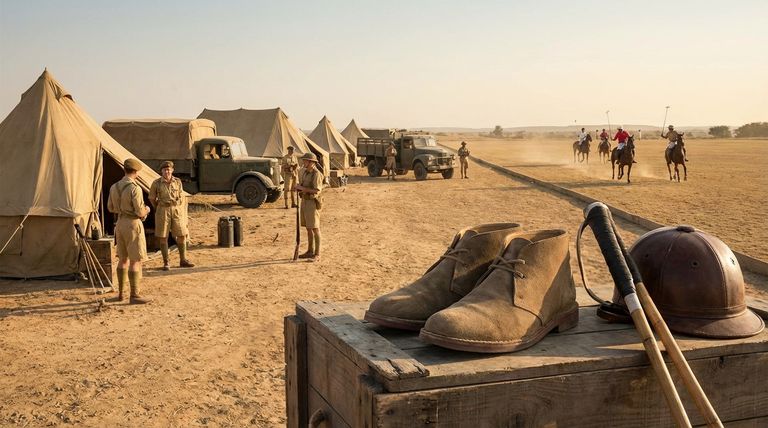
The Dual Origins: Sport and Military
The story of the Chukka is a journey across continents, starting on the polo fields of India and finding a new purpose in the deserts of North Africa.
The Polo Connection in India
The earliest roots of the boot are tied to the British Army in India. Polo players sought a comfortable, lightweight alternative to their rigid riding boots for wearing during downtime.
This new style was a variation of the traditional Jodhpur boot but was shorter and more flexible.
The name "Chukka" itself comes from the world of polo. It is derived from the Hindi word "chukkar" (meaning "circle" or "turn"), which is also the basis for the term "chukker," a seven-and-a-half-minute period of play in a polo match.
Adaptation in North Africa
As British soldiers moved across the empire, they brought their preferences and styles with them. By World War II, a version of this comfortable boot was being produced by cobblers in Cairo.
This particular style, often made with a simple suede upper and a soft crepe sole, was perfectly suited for the hot, sandy conditions of the desert campaigns. It became the unofficial off-duty footwear for many officers.
The Catalyst: Nathan Clark's Discovery
This practical, comfortable boot might have remained a regional curiosity if not for the observant eye of a soldier with a background in footwear.
An Observation in Burma
Nathan Clark, of the C. & J. Clark shoe company, was stationed in Burma during WWII. He noticed that fellow officers who had served in North Africa were wearing these distinct suede ankle boots.
Intrigued by their simple construction and apparent comfort, he began sketching the design and gathering information about their source.
The Birth of an Icon
Upon returning to England, Clark presented the idea for this "Desert Boot" to his family's company. He used the simple, effective design he had seen on soldiers as the direct blueprint for the Clarks Desert Boot, which he launched in 1950.
This act of discovery and marketing transformed the boot from a piece of military kit into a global style staple.
What Defines the Chukka Style
The very characteristics that made the boot practical for soldiers are what define its enduring appeal.
Simplicity in Design
A true Chukka is defined by its minimalism. It is an ankle-high boot with very few pieces of leather.
It traditionally features only two or three pairs of eyelets for the laces, contributing to its clean and uncluttered look.
Unlined for Comfort
The original boots were often unlined and made from suede, which made them lightweight, flexible, and breathable—ideal for comfort in warm climates. This construction is a hallmark of the classic Desert Boot style.
Appreciating the Chukka's Journey
To understand the Chukka, you must appreciate its distinct points of origin and popularization.
- If your primary focus is historical origin: Acknowledge the boot's beginnings with British polo players in India, where its name and core purpose were born.
- If your primary focus is modern design: Recognize Nathan Clark's critical role in identifying the boot's potential in Egypt and introducing its functional design to a global audience.
The Chukka Boot stands as a perfect example of how a practical design, born from necessity, can travel the world to become a timeless piece of style.
Summary Table:
| Key Figure | Location | Contribution |
|---|---|---|
| British Polo Players | India | Created the original ankle boot for comfort off the field |
| Cairo Cobblers | Egypt | Adapted the design for desert warfare in WWII |
| Nathan Clark | Burma/Egypt | Discovered the boot, popularized it globally as the Clarks Desert Boot |
Need High-Quality Footwear for Your Brand or Business?
As a large-scale manufacturer, 3515 produces a comprehensive range of footwear for distributors, brand owners, and bulk clients. Our production capabilities encompass all types of shoes and boots, including timeless styles like the Chukka. We ensure quality, durability, and style to meet your market demands.
Contact us today to discuss your manufacturing needs and let us bring value to your supply chain.
Visual Guide
Related Products
- Durable Leather Tactical Boots Wholesale & Custom Manufacturing for Brands
- Premium Wholesale Tactical Style Safety Shoes Boots with Quick Lacing
- Wholesale High-Traction Camo Boots - Custom Manufacturer for Brands
- Durable Leather High-Ankle Tactical Boots for Wholesale & Custom Manufacturing
- Durable Leather Work Boots Wholesale Manufacturer & Custom Factory
People Also Ask
- What specialized protections do tactical boots offer? Maximize Endurance with High-Performance Footwear
- What features should law enforcement officers look for in tactical boots? Essential Guide for Safety & Performance
- Importance of Professional Tactical Boots in Loess Gully Regions: Ensure Safety and Precision for Field Monitoring
- What is rucking, and why are tactical boots suitable for it? Discover the Ultimate Footwear for Heavy Loads
- What makes the traction of tactical boots superior? Unlock the Science of Unbeatable Grip



















