Clarks' definitive contribution was not invention, but masterful refinement and popularization. They transformed a functional, military-inspired boot into a global style icon by simplifying its design for civilian comfort, launching it internationally, and allowing it to be adopted by influential cultural movements and figures.
Clarks succeeded by identifying a boot designed for pure function—the desert chukka—and marketing its core attributes of comfort and simplicity to a world ready for a more casual and versatile alternative to traditional footwear.
From Military Utility to Civilian Style
The story of the desert boot is one of observation and adaptation. Clarks saw a solution to a specific problem and recognized its potential for a much broader audience.
The World War II Origin
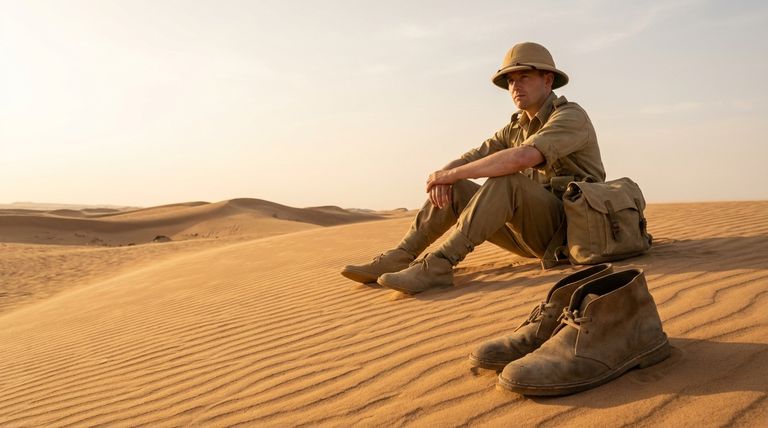
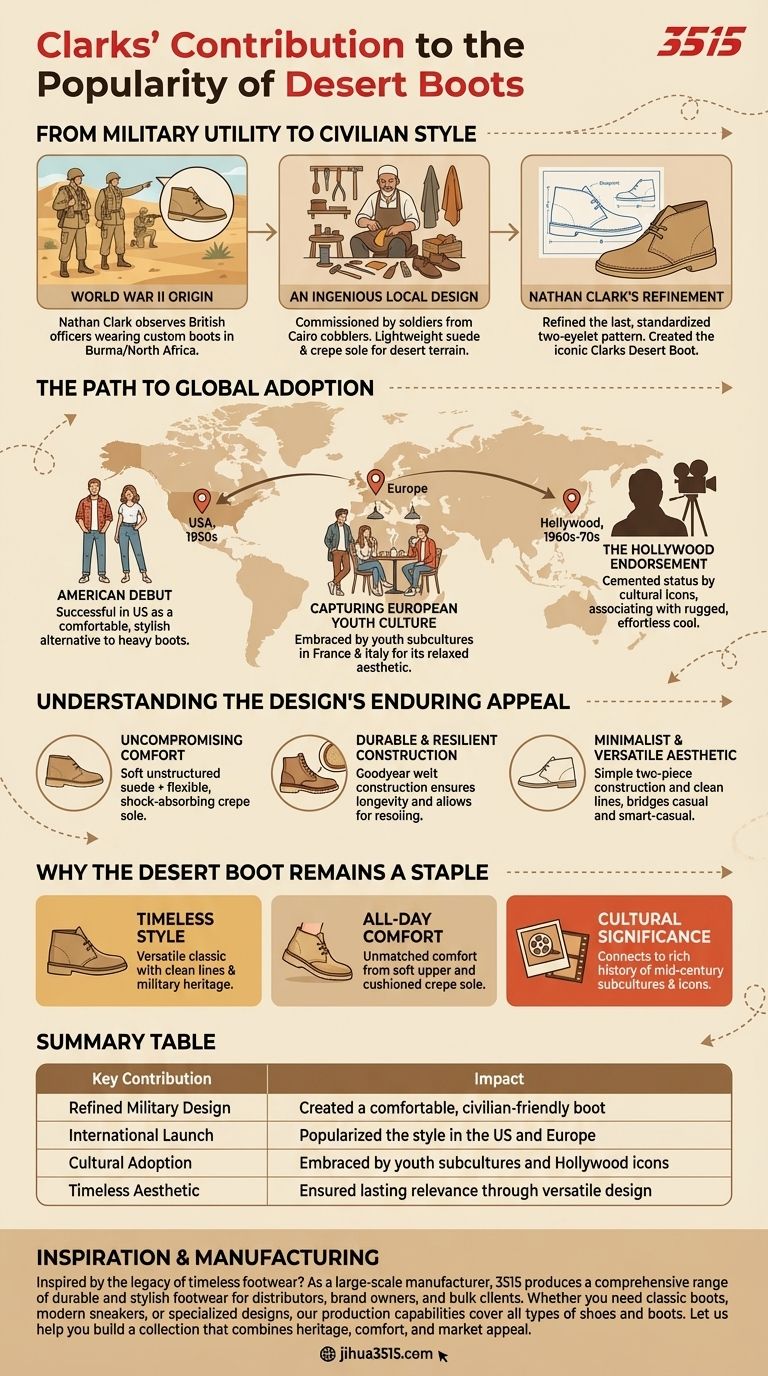
During World War II, Nathan Clark, whose family founded the Clarks company, was stationed with the British Eighth Army. He observed officers wearing simple, sand-colored suede boots with crepe soles in Burma and North Africa.
An Ingenious Local Design
These boots were not standard military issue. They were privately commissioned by South African soldiers from cobblers in Cairo. The design was purpose-built for desert terrain: lightweight suede uppers for breathability and soft crepe rubber soles for traction on sand.
Nathan Clark's Refinement
Inspired by this practical design, Nathan Clark developed his own version upon returning to England. He refined the last, standardized the two-eyelet pattern, and created the iconic shoe we now know as the Clarks Desert Boot.
The Path to Global Adoption
Interestingly, the boot's success did not begin in its home country. Its rise was a gradual, international phenomenon that gained momentum through cultural adoption.
An American Debut
The Clarks Desert Boot first found success in the United States in the 1950s. It was seen as a comfortable, stylish, and slightly unconventional alternative to the heavier leather boots and shoes of the era.
Capturing European Youth Culture
From the U.S., its popularity spread to continental Europe, where it was embraced by youth subcultures in France and Italy. They were drawn to its relaxed aesthetic, which stood in stark contrast to more formal footwear.
The Hollywood Endorsement
The boot's status was cemented in the 1960s and 70s when it was worn by cultural icons like actor Steve McQueen. His on-screen persona associated the desert boot with a rugged, adventurous, and effortlessly cool masculinity, massively boosting its appeal.
Understanding the Design's Enduring Appeal
The desert boot's lasting popularity isn't an accident. It is rooted in a few key design principles that prioritize the wearer's experience.
Uncompromising Comfort
The core appeal has always been comfort. The combination of a soft, unstructured suede upper and a flexible, shock-absorbing crepe sole created a feel that was radically different from stiff, traditional leather footwear.
Durable and Resilient Construction
Clarks utilized a Goodyear welt construction, a time-tested method where a strip of leather is stitched around the boot's perimeter to attach the upper to the sole. This technique ensures durability and longevity.
A Minimalist and Versatile Aesthetic
With its simple two-piece construction and clean lines, the desert boot is exceptionally versatile. It effortlessly bridges the gap between casual and smart-casual, making it a reliable choice for a wide range of settings.
Why the Desert Boot Remains a Staple
The Clarks Desert Boot has transcended trends to become a permanent fixture in men's style. Its relevance comes from its ability to meet several distinct needs.
- If your primary focus is timeless style: The desert boot's clean lines and military heritage make it a versatile classic that complements almost any casual wardrobe.
- If your primary focus is all-day comfort: Its combination of a soft upper and a cushioned crepe sole offers a level of comfort that few other leather boots can match.
- If your primary focus is cultural significance: Wearing a Clarks Desert Boot connects you to a rich history of mid-century subcultures, from military officers to Hollywood icons.
Ultimately, Clarks secured the desert boot's legacy by creating a shoe that perfectly balanced authentic heritage with modern comfort and style.
Summary Table:
| Key Contribution | Impact |
|---|---|
| Refined Military Design | Created a comfortable, civilian-friendly boot |
| International Launch | Popularized the style in the US and Europe |
| Cultural Adoption | Embraced by youth subcultures and Hollywood icons |
| Timeless Aesthetic | Ensured lasting relevance through versatile design |
Inspired by the legacy of timeless footwear? As a large-scale manufacturer, 3515 produces a comprehensive range of durable and stylish footwear for distributors, brand owners, and bulk clients. Whether you need classic boots, modern sneakers, or specialized designs, our production capabilities cover all types of shoes and boots. Let us help you build a collection that combines heritage, comfort, and market appeal. Contact us today to discuss your manufacturing needs!
Visual Guide
Related Products
- Wholesale Lightweight Tactical Boots Custom Manufacturer for Desert & Combat Use
- Durable Military Combat Boots with Water Drainage for Wholesale & OEM
- Durable Spiked Camouflage Boots Wholesale & Factory Production
- Wholesale High-Traction Camo Boots - Custom Manufacturer for Brands
- Durable Leather Tactical Boots Wholesale & Custom Manufacturing for Brands
People Also Ask
- What are the common types of combat boots? Find the Right Boot for Your Mission
- What specialized protections do tactical boots offer? Maximize Endurance with High-Performance Footwear
- How does additive manufacturing equipment reduce environmental risks? Sustainable Tactics for Modern Footwear Production
- What are the different types of tactical boots available? Find the Right Boot for Your Mission
- How is the compatibility of polymer materials demonstrated in smart footwear? Enhancing Tactical & Training Performance