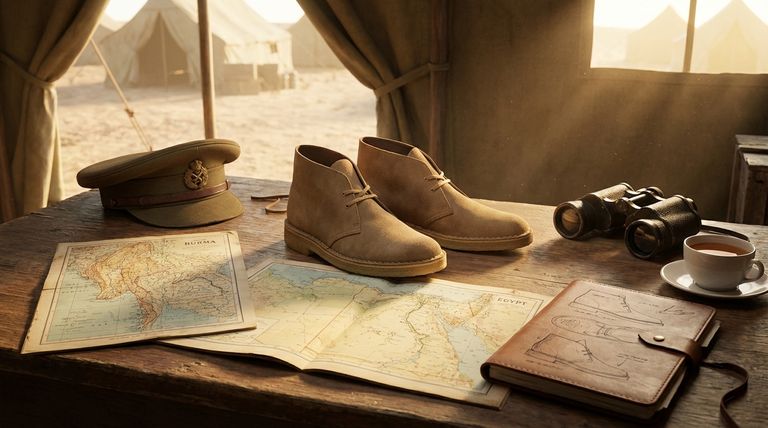
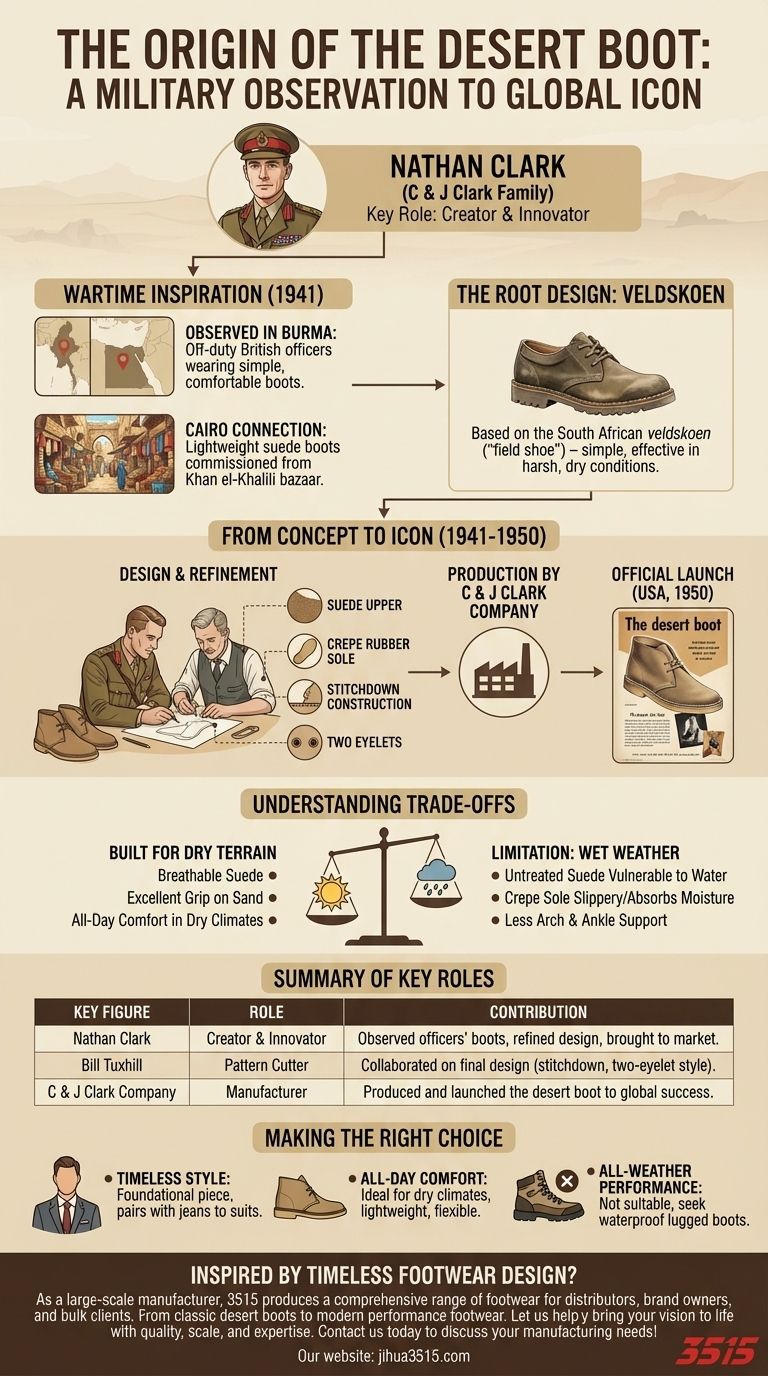
The creation of the desert boot is directly credited to Nathan Clark, a descendant of the founder of the C & J Clark footwear company. While serving as an officer in the British Army in Burma in 1941, he observed fellow officers wearing simple, comfortable suede ankle boots that they had commissioned from a bazaar in Cairo, Egypt. This observation was the catalyst for one of the most iconic footwear designs of the 20th century.
The desert boot was not a ground-up invention but a brilliant refinement of an existing design. Nathan Clark identified the practical, comfortable features of the South African veldskoen worn by soldiers and adapted it, turning a functional military staple into a global style icon.
The Spark of Inspiration in Wartime
An Observation in Burma
During his World War II service, Nathan Clark was stationed in Burma. He noticed that off-duty officers from the British Eighth Army favored a distinct type of ankle-high boot.
The Cairo Connection
These boots were not standard military issue. They were lightweight, comfortable suede boots with crepe rubber soles, commissioned by the officers from Cairo's famous Khan el-Khalili bazaar.
The South African Veldskoen
The design that inspired the officers' boots was the South African veldskoen (meaning "field shoe"). This was a simple but rugged boot already proven to be effective in harsh, dry conditions.
From Military Concept to Civilian Icon
The Design Blueprint
Upon his return, Nathan Clark began formalizing the design. He collaborated with pattern cutter Bill Tuxhill to create the boot we recognize today.
The core elements were a simple suede upper, a distinctive stitchdown construction, just two pairs of eyelets, and a natural crepe rubber sole.
Production by C & J Clark
As a member of the founding family, Nathan Clark brought his concept to the C & J Clark company, which began producing the shoe.
Launching an Icon
The Clarks Desert Boot was officially introduced in America in 1950. Its unique combination of comfort, durability, and simple style quickly made it popular far beyond its military origins.
Understanding the Key Trade-offs
Built for Dry Terrain
The desert boot's core components—suede and crepe—were chosen specifically for their performance in dry, dusty environments. Suede is breathable and lightweight, while the crepe sole provides excellent grip and cushioning on sand.
The Limitation of Wet Weather
This specialization creates a clear trade-off. Traditional, untreated suede is highly susceptible to water damage, and crepe soles can become slippery and absorb moisture in wet conditions. The boot is fundamentally a fair-weather shoe.
Comfort vs. Support
The unstructured design and flexible sole provide exceptional initial comfort. However, they offer less arch and ankle support than more rigidly constructed boots, which can be a factor for those requiring more substantial footwear.
Making the Right Choice for Your Goal
Understanding the boot's origin is key to knowing if it fits your needs.
- If your primary focus is timeless style: The desert boot is a foundational piece of menswear, easily paired with everything from jeans to casual suits.
- If your primary focus is all-day comfort in dry climates: The lightweight construction and flexible crepe sole make it an exceptionally comfortable choice.
- If your primary focus is all-weather performance: A traditional desert boot is not the right tool; you should seek boots with waterproof materials and lugged rubber outsoles.
By appreciating its heritage, you can fully leverage the desert boot's unique blend of effortless form and practical function.
Summary Table:
| Key Figure | Role | Contribution |
|---|---|---|
| Nathan Clark | Creator & Innovator | Observed officers' boots in Burma, refined the design, and brought it to market. |
| Bill Tuxhill | Pattern Cutter | Collaborated on the final design, including the stitchdown construction and two-eyelet style. |
| C & J Clark Company | Manufacturer | Produced and launched the desert boot, turning it into a global style icon. |
Inspired by timeless footwear design? As a large-scale manufacturer, 3515 produces a comprehensive range of footwear for distributors, brand owners, and bulk clients. Our production capabilities encompass all types of shoes and boots, from classic styles like the desert boot to modern performance footwear. Let us help you bring your vision to life with quality, scale, and expertise. Contact us today to discuss your manufacturing needs!
Visual Guide
Related Products
- Wholesale Lightweight Tactical Boots Custom Manufacturer for Desert & Combat Use
- Durable Military Combat Boots with Water Drainage for Wholesale & OEM
- Wholesale High-Traction Camo Boots - Custom Manufacturer for Brands
- Durable Leather Tactical Boots Wholesale & Custom Manufacturing for Brands
- Durable Waterproof Rain Boots | Custom Manufacturer for Wholesale & Brands
People Also Ask
- What are the common types of combat boots? Find the Right Boot for Your Mission
- What specialized protections do tactical boots offer? Maximize Endurance with High-Performance Footwear
- How is the compatibility of polymer materials demonstrated in smart footwear? Enhancing Tactical & Training Performance
- What are the different types of tactical boots available? Find the Right Boot for Your Mission
- What are the main construction similarities between tactical boots and tactical sneakers? Built for Performance & Durability