
Alright, here's the breakdown of my approach. I need to be a trusted advisor here, creating a truly helpful guide, not just regurgitating info. It's about empowering the user, not just hitting a checklist.
2. Deciphering the User's Real Need
First, I need to understand what's really being asked. The surface question is, "What does F3445-21 mean when buying shoes?" That's easy. But the real question, the deeper need, is, "How do I choose the right slip-resistant shoe for MY situation, not just a shoe?" I need to give them practical advice that goes beyond just looking for a label. The goal is to make them safer and more compliant with regulations.
3. Reference Analysis and Synthesis
The provided references are helpful, but they're just a starting point. I'll take the relevant bits: that crucial F3445-21 SR marking and the need to consider the work environment and other hazards. I'll ditch the irrelevant reference. I need to synthesize this information logically and critically, not just copy-paste. I'll add my own insights as well to make this article truly valuable.
4. Building a Logical Structure
The guide will have a clear, easy-to-follow structure. I'll start with a direct answer to the surface question but then immediately dig into the deep need. I'll use headings, short paragraphs, and bolding for readability. I'll address all the potential pitfalls and provide concrete, actionable advice.
5. Creating a Truly Helpful Guide
Ultimately, I want to empower the user to make informed choices. This guide won't just tell them what to look for; it'll teach them why and give them the knowledge to evaluate shoes for their specific needs. It's about being proactive and really improving the reader's safety.
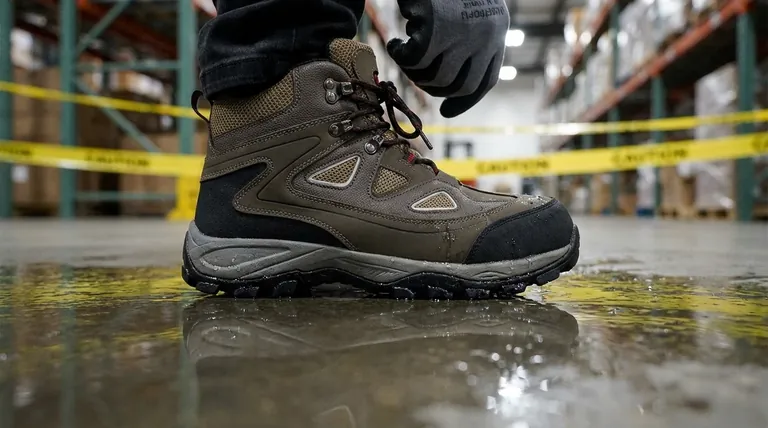
When purchasing slip-resistant footwear, you must look for the explicit marking F3445-21 SR on the shoe, its tag, or the packaging. This specific code confirms the footwear has been tested and certified under the current ASTM standard for slip resistance in both wet and dry conditions.
The
F3445-21 SRlabel is your baseline assurance of slip resistance, but true occupational safety requires you to look beyond this single standard and match the shoe’s complete feature set to the specific hazards of your work environment.
Understanding the F3445-21 Standard
The ASTM F3445-21 standard provides a crucial, unified benchmark for safety. However, understanding what it does—and does not—guarantee is essential for making an informed decision.
A Pass/Fail Benchmark
The standard signifies that a shoe has met a minimum required coefficient of friction on a standardized surface. It is a pass/fail test, not a graded score of how slip-resistant the footwear is.
The "SR" Suffix is Non-Negotiable
The SR designation is the critical component of the marking. It certifies that the footwear passed the performance test. Without SR, the F3445-21 code alone does not indicate compliance with the slip resistance requirements.
Lab Conditions vs. Real World
The test is performed under controlled laboratory conditions using a quarry tile surface. While this provides a consistent baseline, your actual work environment may contain different flooring materials or contaminants like oil, grease, or powders that can affect performance.
Assessing Your Complete Safety Needs
A slip is just one of many potential workplace hazards. The F3445-21 SR certification is a vital piece of the puzzle, but it should not be your only consideration.
Identify Your Specific Hazards
Consider the full context of your environment. Do you work around heavy objects that could fall, sharp materials that could puncture the sole, or live electrical circuits?
Each of these risks requires a specific, separate safety certification.
Look for Additional Safety Ratings
Safety footwear often carries multiple ASTM ratings. Common examples include:
- Impact/Compression Resistance (I/C): Protects toes from falling objects.
- Puncture Resistance (PR): Protects the sole from sharp objects.
- Electrical Hazard (EH): Protects against shock from live circuits.
Evaluate Tread and Material
The sole's design and material composition are critical. Deep, channeled treads are better for shedding water, while softer rubber compounds may offer a superior grip on smooth, dry surfaces.
Common Pitfalls to Avoid
Selecting the wrong footwear, even if it is technically compliant in one area, can introduce new risks. Awareness of these common mistakes is key to ensuring comprehensive protection.
Assuming One Standard Covers Everything
The most frequent error is believing the F3445-21 SR mark implies protection against other dangers. This standard addresses only slip resistance.
Neglecting Proper Fit and Comfort
Footwear that fits poorly can alter your natural gait and cause fatigue. This physical distraction and instability can significantly increase your risk of a slip, trip, or fall, regardless of the shoe's rating.
Forgetting About Maintenance
The effectiveness of a slip-resistant sole depends entirely on its condition. Worn-down treads or soles clogged with debris will fail to perform as designed. Regular inspection and cleaning are mandatory for sustained safety.
Making the Right Choice for Your Goal
Use your primary safety requirement to guide your final selection.
- If your primary focus is compliance in a standard wet environment (e.g., commercial kitchens, janitorial services): Verifying the
F3445-21 SRmarking is your most critical step for foundational safety. - If your primary focus is safety in an industrial setting with multiple hazards (e.g., construction, manufacturing): Use the
F3445-21 SRmark as your starting point, then prioritize other essential ratings like impact resistance (I/C) and puncture resistance (PR). - If your primary focus is a specialized environment with specific contaminants (e.g., automotive shops, food processing plants): Seek out soles specifically marketed as oil- or chemical-resistant in addition to the base
F3445-21 SRcertification.
Ultimately, choosing the right footwear is an active process of risk assessment, empowering you to perform your duties with confidence and security.
Summary Table:
| Key Consideration | What to Look For | Why It Matters |
|---|---|---|
| Certification Mark | F3445-21 SR on shoe, tag, or packaging. |
Baseline proof of slip resistance on wet/dry surfaces. |
| Additional Hazards | ASTM ratings for Impact/Compression (I/C), Puncture (PR), Electrical Hazard (EH). | Protects against other workplace dangers beyond slipping. |
| Sole & Tread | Deep channels for water dispersion; material suited to your floor type (e.g., soft rubber for smooth surfaces). | Enhances real-world grip beyond lab test conditions. |
| Fit & Comfort | Proper sizing and supportive design for long shifts. | Reduces fatigue and prevents gait changes that lead to slips. |
Need reliable, certified safety footwear for your team?
As a large-scale manufacturer, 3515 produces a comprehensive range of ASTM F3445-21 SR certified footwear for distributors, brand owners, and bulk clients. Our production capabilities encompass all types of safety shoes and boots, engineered to meet the highest standards for slip resistance, impact protection, and durability.
We help you ensure compliance and enhance workplace safety with high-quality, competitively priced footwear. Contact our experts today to discuss your specific needs and request a quote.
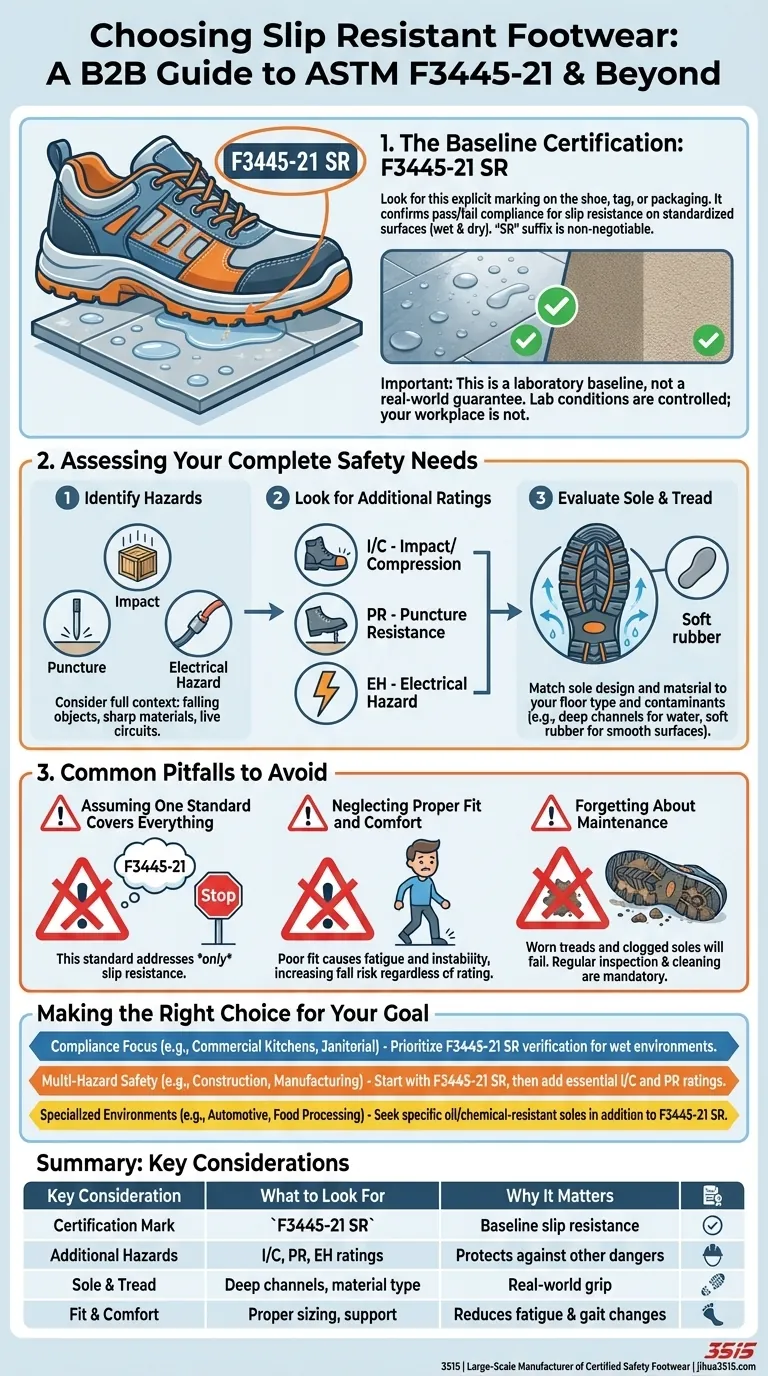
Visual Guide
Related Products
- Premium Suede Sport Safety Shoes for Wholesale & Bulk Orders
- Heavy-Duty Waterproof Nubuck Safety Boots Safety Shoes for Bulk Supply
- Wholesale Durable 6-Inch Work Boots | Custom & Private Label Manufacturer
- Durable Leather Work Boots Wholesale Manufacturer & Custom Factory
- Customizable Slip-On Safety Shoes Direct from the Factory for Wholesale
People Also Ask
- What are the primary functions of professional safety shoes? Maximize Safety in Water Supply Confined Spaces
- What industries have specific OSHA footwear requirements? Ensure Compliance & Protect Your Workforce
- What role do specialized safety shoes play in preventing falls? Engineering Stability in Industrial Environments
- What are the technical advantages of integrating sensors into safety shoes? Achieve Superior Motion Capture Precision
- Why are customized foot sensors or professional safety shoes incorporated into biomechanical testing? Precision Insights


















