To ensure a proper work boot fit, you must check for several key indicators at once. There should be about a centimeter of space between your longest toe and the end of the boot, your heel should be secure without rubbing or slipping, and your toes should have room to wiggle. Most importantly, there should be no immediate pain, pinching, or "hot spots," as these are unlikely to improve over time.
A perfect fit goes beyond simple sizing. The true goal is to match the boot's physical fit—snug yet comfortable—with its functional fit, ensuring its safety features and construction are precisely suited to your specific work environment.
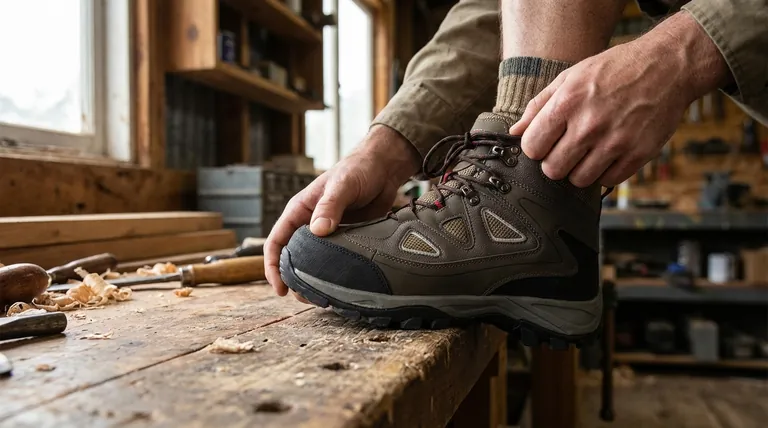
The Non-Negotiable Fit Checklist
A systematic check is the only way to verify a boot's fit. Move through these steps when you try on any pair.
Assess Toe Room and Length
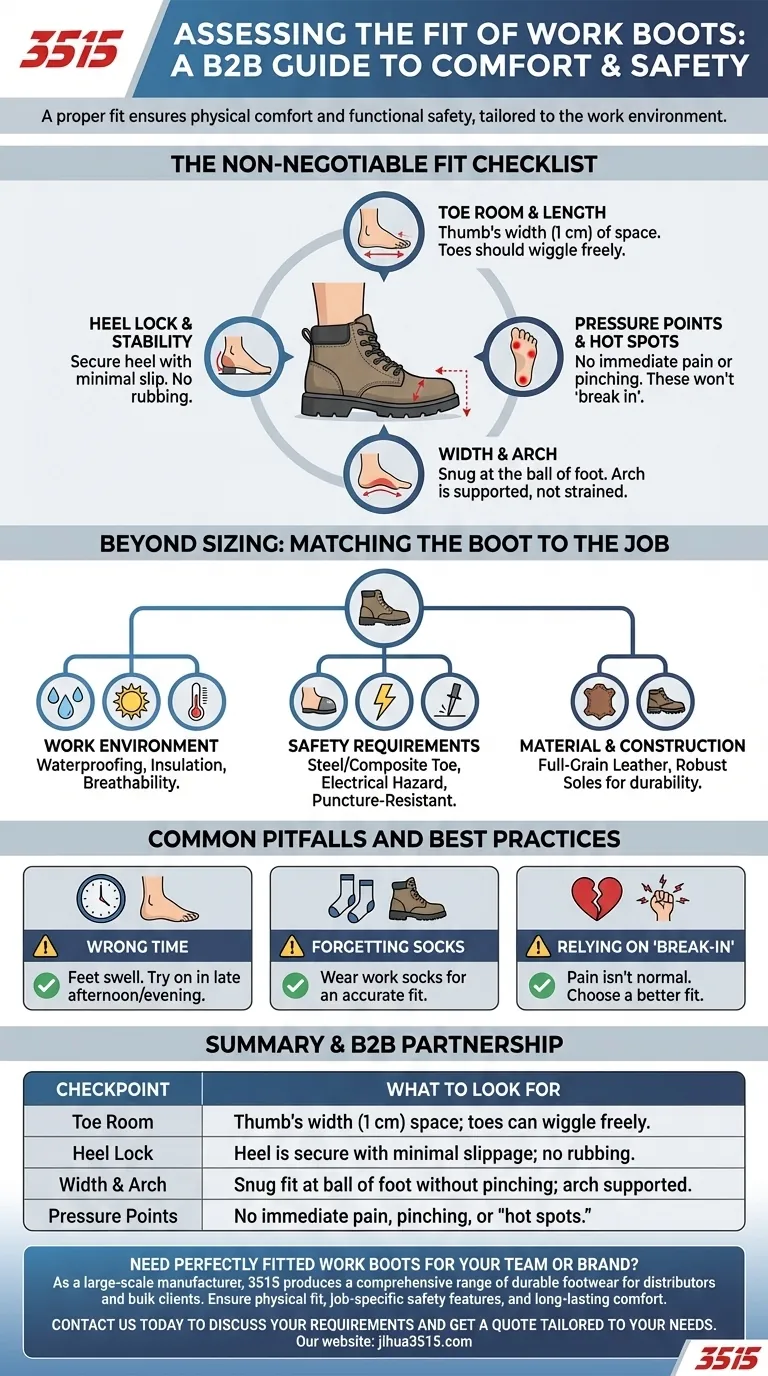
Your toes should never touch the end of the boot, even when walking downhill. A gap of about a thumb's width (roughly one centimeter) provides the necessary space for your foot to flex and swell slightly throughout the day. You should be able to wiggle your toes freely.
Evaluate Heel Lock and Stability
As you walk, your heel should remain securely in place. A minor amount of lift is normal in some new boots, but excessive slipping can cause painful blisters and instability. The boot should grip your heel without rubbing it.
Check the Width and Arch
The boot should feel snug around the ball of your foot without pinching or crushing it. Your arch should feel supported, not strained or flat. If the boot feels too tight on the sides, you likely need a wider size.
Identify Pressure Points and Hot Spots
Pay close attention to any specific points of high pressure or discomfort. These "hot spots" are red flags. While quality leather may stretch slightly, a significant pressure point indicates a poor match for your foot shape and will not "break in" to become comfortable.
Beyond Sizing: Matching the Boot to the Job
A boot that fits perfectly in the store can still be the wrong boot for your job. The functional fit is just as critical as the physical fit.
Your Work Environment Dictates Design
Consider the conditions you face daily. Do you work outdoors in the wet, requiring waterproofing? Do you need insulation for cold environments or breathable materials for heat? The boot's features must align with your primary work environment.
Understand the Safety Requirements
Your job site likely has specific safety standards. You must ensure the boot's features—such as a steel toe, composite toe, puncture-resistant sole, or electrical hazard protection—meet or exceed those requirements. Never compromise on safety for comfort.
Consider Material and Construction Quality
The materials directly impact long-term fit and durability. Full-grain leather, for example, will mold to your foot over time. Robust inner and outer soles provide critical support and absorb impact, contributing to all-day comfort.
Common Pitfalls and Best Practices
Avoiding simple mistakes during the selection process can save you significant discomfort and money.
Trying Boots On at the Wrong Time
Your feet naturally expand throughout the day. Always try on work boots in the late afternoon or evening to get the most accurate measurement of your foot at its largest.
Forgetting Your Work Socks
The thickness of your socks can dramatically alter a boot's fit. Always wear the same type of cushioned or moisture-wicking socks you use for work when trying on new boots.
Relying Too Heavily on the "Break-In" Period
A "break-in" period is for softening stiff materials like leather; it is not for fixing a fundamentally bad fit. Sharp pain or major pressure points are signs to choose a different boot, not to endure discomfort.
Making the Right Choice for Your Goal
Use your primary need to guide your final assessment.
- If your primary focus is all-day comfort on hard surfaces: Prioritize excellent arch support and cushioning, and confirm there is enough room for a custom insole if needed.
- If your primary focus is safety in a hazardous environment: Verify that the boot's specific safety certifications match your job's requirements before you even begin assessing the physical fit.
- If your primary focus is durability and longevity: Look closely at material quality and construction, ensuring a snug fit that accounts for the slight stretching of materials like leather over time.
A well-fitted boot is a fundamental tool that protects you from the ground up.
Summary Table:
| Checkpoint | What to Look For |
|---|---|
| Toe Room | A thumb's width (about 1 cm) of space; toes can wiggle freely. |
| Heel Lock | Heel is secure with minimal slippage; no rubbing. |
| Width & Arch | Snug fit at the ball of the foot without pinching; arch feels supported. |
| Pressure Points | No immediate pain, pinching, or "hot spots." |
Need perfectly fitted work boots for your team or brand?
As a large-scale manufacturer, 3515 produces a comprehensive range of durable footwear for distributors, brand owners, and bulk clients. Our production capabilities encompass all types of safety and work boots, ensuring a perfect blend of physical fit, job-specific safety features, and long-lasting comfort.
Contact us today to discuss your work boot requirements and get a quote tailored to your needs.
Visual Guide
Related Products
- Durable Leather Work Boots for Wholesale & Custom Manufacturing
- Durable Leather Work Boots for Wholesale & Custom OEM Manufacturing
- Durable Leather Work Boots Wholesale Manufacturer & Custom Factory
- Durable Leather Moc Toe Work Boots for Wholesale & Custom Manufacturing
- Wholesale Leather Work Boots with Customizable Wedge Sole for Brands
People Also Ask
- What is the difference between full-grain and top-grain leather? Premium Material Guide for Boot Manufacturers
- What are the common workplace hazards that can be mitigated with the right work boots? Protect Your Workforce
- What are the common foot issues workers face due to uncomfortable work boots? Prevent Pain & Deformities
- What are the advantages of leather versus synthetic work boots? A Guide to Choosing the Right Material
- What are the key components of modern work boots? Engineered for Ultimate Durability and Comfort