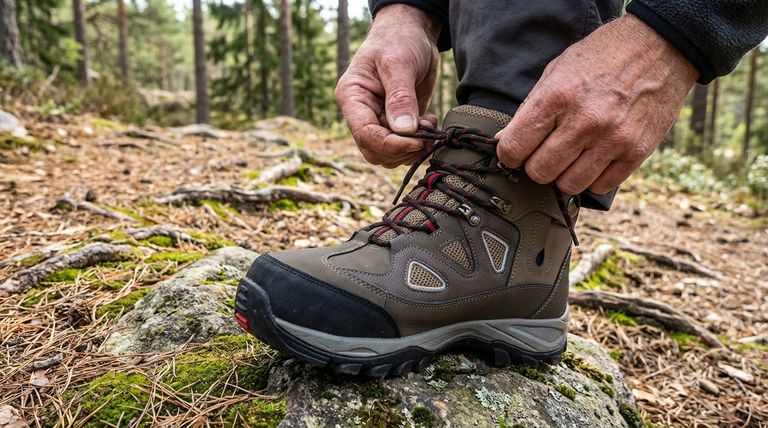
For a truly secure fit, the most effective technique mentioned is lock lacing, also known as a Heel Lock. This method specifically targets and eliminates heel slippage by creating a secure loop near the top of the boot, which acts like a pulley system to cinch the ankle and lock your heel into the back of the boot.
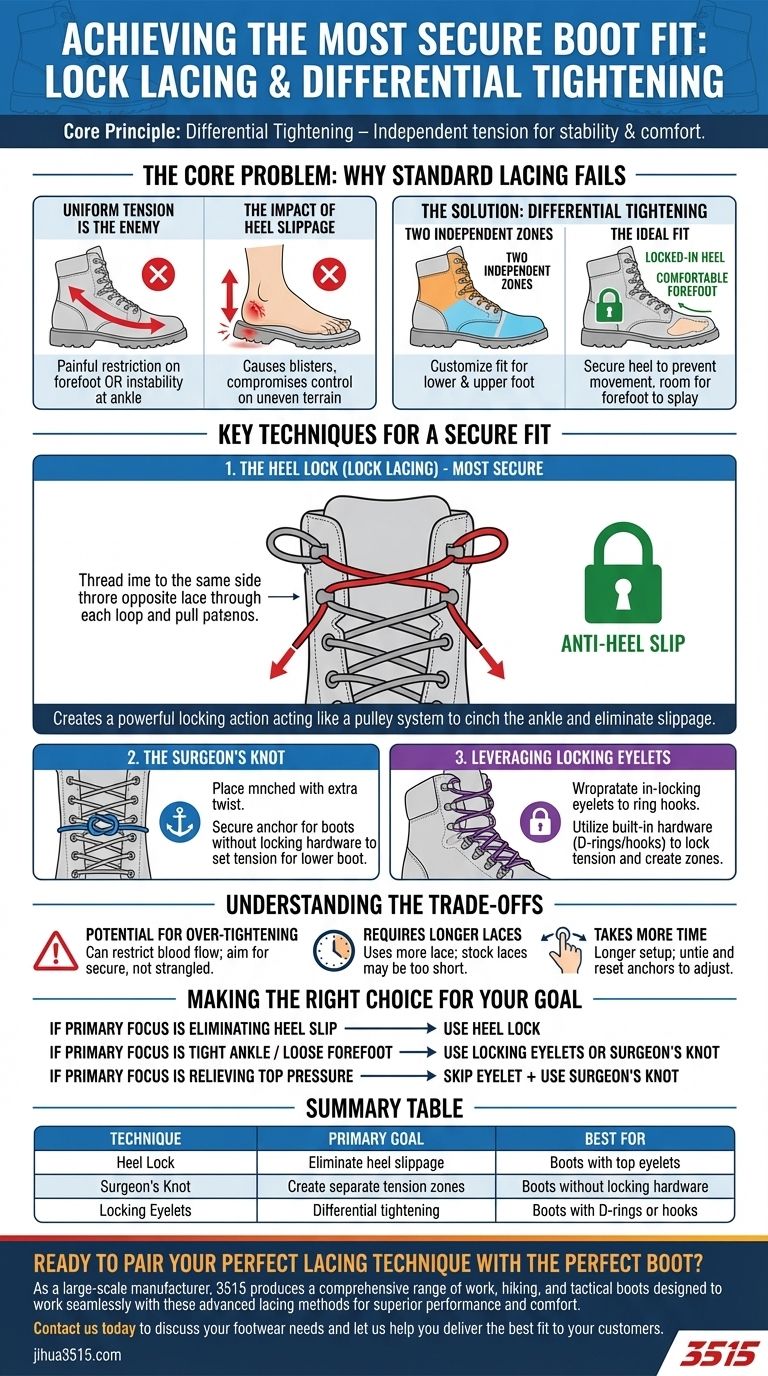
The core principle of secure boot lacing is not about a single pattern, but about achieving differential tightening. This means applying independent levels of tension to your forefoot and your ankle, ensuring both stability and comfort.
The Core Problem: Why Standard Lacing Often Fails
Most people lace their boots with a single, uniform level of tension from the toe all the way to the ankle. This simple approach is often the source of significant discomfort and poor performance.
Uniform Tension is the Enemy
A boot that is tight enough at the ankle to prevent slippage is often painfully restrictive on the forefoot. Conversely, a boot that is comfortable on the forefoot is often too loose at the ankle, leading to instability.
The Impact of Heel Slippage
When your heel moves up and down inside the boot, it creates friction that leads to blisters. More importantly, it compromises your control and stability, particularly on uneven terrain.
The Solution: Differential Tightening
The goal is to create two independent lacing zones: one for the lower part of your foot and one for the upper part around your ankle. This allows you to customize the fit for your specific needs.
What is a Tension Zone?
A tension zone is a section of your laces that can be tightened or loosened without affecting the other sections. Advanced lacing techniques create anchor points to separate these zones.
The Goal: A Locked-in Heel with a Comfortable Forefoot
The ideal fit for most activities involves a snug, "locked-in" heel and ankle to prevent movement, combined with a forefoot that has enough room to splay naturally without being compressed.
Key Techniques for a Secure Fit
There are several methods to achieve differential tightening, depending on the hardware on your boots.
The Heel Lock (Lock Lacing)
This is the most direct way to eliminate heel slip. Instead of crossing the laces over at the top eyelets, you pass each lace through the eyelet on the same side, creating two loops. You then thread the opposite lace through each loop before pulling tight and tying your knot. This creates a powerful locking action aimed squarely at the ankle.
The Surgeon's Knot
For boots without locking eyelets, the Surgeon's Knot is your best tool. It is a simple knot (a basic overhand knot with an extra twist) placed midway through your lacing pattern. This knot acts as a secure anchor, allowing you to set the tightness for the lower boot, lock it in, and then tighten the ankle section to a different level.
Leveraging Locking Eyelets
Many modern hiking and work boots come with locking eyelets (often called D-rings or lace locks) located near the ankle flex point. These are specifically designed for differential tightening. You can pull the lower laces to your desired tension and then wrap them around these hooks to lock that tension in place before lacing the upper section.
Understanding the Trade-offs
While effective, these advanced techniques have practical considerations you should be aware of.
Potential for Over-tightening
The mechanical advantage gained from a Heel Lock or a tightly cinched Surgeon's Knot can make it easy to over-tighten the laces. This can restrict blood flow and cause discomfort or numbness. The goal is to be secure, not strangled.
Requires Longer Laces
Techniques like the Surgeon's Knot and Heel Lock use more lace than a standard criss-cross pattern. You may find that your stock laces are too short and need to be replaced.
Takes More Time to Adjust
Setting up these lacing patterns takes a few extra moments compared to a simple lacing job. Adjusting them on the fly requires you to untie and reset the anchor points.
Making the Right Choice for Your Goal
Select your lacing strategy based on the specific problem you are trying to solve.
- If your primary focus is eliminating heel slip: The Heel Lock is your most direct and effective solution.
- If your primary focus is a tight ankle with a looser forefoot: Use your boot's locking eyelets or tie a Surgeon's Knot to create two separate tension zones.
- If your primary focus is relieving pressure on the top of your foot: Skip an eyelet over the pressure point (known as "window lacing") and use a Surgeon's Knot below it to maintain tension elsewhere.
By mastering these principles, you transform your boot's fit from a compromise into a custom-tuned asset for your feet.
Summary Table:
| Technique | Primary Goal | Best For |
|---|---|---|
| Heel Lock (Lock Lacing) | Eliminate heel slippage | Boots with top eyelets |
| Surgeon's Knot | Create separate tension zones | Boots without locking hardware |
| Locking Eyelets | Differential tightening | Boots with D-rings or hooks |
Ready to pair your perfect lacing technique with the perfect boot?
As a large-scale manufacturer, 3515 produces a comprehensive range of footwear for distributors, brand owners, and bulk clients. Our production capabilities encompass all types of work, hiking, and tactical boots designed to work seamlessly with these advanced lacing methods for superior performance and comfort.
Contact us today to discuss your footwear needs and let us help you deliver the best fit to your customers.
Visual Guide
Related Products
- Premium Wholesale Tactical Style Safety Shoes Boots with Quick Lacing
- Premium Wholesale Wheat Nubuck Safety Boot with Rapid Lacing System
- Wholesale Lightweight Tactical Boots with Dial Closure OEM & Bulk Orders
- Wholesale Training Shoes with Dial Lacing System Custom OEM Manufacturing
- Wholesale Classic Leather Lace-Up Ankle Boots for Brand Manufacturing
People Also Ask
- How are gait analysis research findings applied to the functional design of safety shoes and tactical boots?
- Why is the synchronization of craftsmanship and UX development emphasized for bulk customization of safety shoes?
- How does anthropomorphic design influence material selection? Enhance Footwear Performance through Biological Alignment
- How can specialized footwear mitigate safety risks? High-Volume OEM/ODM Solutions since 1951
- How do quality certification standards for safety shoes reduce perceived risk? Buy Online with Technical Certainty