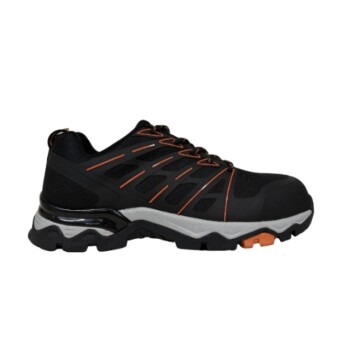
Professional safety shoes function as a primary physical barrier against the two most immediate hazards in aviation maintenance: impact injuries and loss of stability. They mitigate risks by utilizing reinforced steel toes to deflect falling tools and specialized anti-slip outsoles to secure footing on slippery scaffolding during critical tasks like aircraft shell sealing.
While often categorized simply as apparel, professional safety shoes are a vital control measure within the Job Safety Analysis (JSA) framework. They provide the essential mechanical grip required to prevent falls from heights while simultaneously acting as armor against crushing injuries from dropped equipment.
The Mechanics of Protection on Scaffolding
Impact Resistance at Height
Gravity amplifies the danger of even small maintenance tools. When working on vertical structures, the risk of dropping wrenches or heavy components is significant.
Steel-toe reinforcement in professional safety shoes acts as a hard shield. This prevents crushing injuries to the feet, ensuring that a dropped tool remains a minor incident rather than a disabling injury.
Stability on Metallic Surfaces
Aviation scaffolding is frequently constructed from smooth metal, which becomes perilous when introduced to maintenance fluids.
Anti-slip outsoles are engineered to bite into these surfaces. This friction is essential for maintaining balance during tasks like vent maintenance, where the worker's center of gravity may shift constantly.
Integrating Footwear into Risk Management
The Role in Job Safety Analysis (JSA)
In the context of JSA, safety shoes are not merely a recommendation; they are a required barrier.
They serve to physically interrupt the accident chain. If a worker steps on a slick spot during shell sealing, the shoe's grip prevents the slip from becoming a fall.
Navigating Environmental Hazards
Maintenance platforms often involve exposure to sealants, lubricants, or environmental moisture.
Just as workers on high-altitude water tanks require high-grip soles to navigate wet ladders, aviation technicians rely on this same technology to traverse potentially slick aircraft exteriors and platforms safely.
Understanding the Limitations
PPE is the Last Line of Defense
It is critical to remember that safety shoes mitigate consequences; they do not remove the hazard.
While outsoles provide grip, they cannot compensate for reckless movement or lack of situational awareness. They must be viewed as part of a system, not a standalone solution.
The Necessity of Redundancy
Excellent footwear does not negate the need for fall arrest systems.
Shoes provide stability, but if balance is completely lost, they cannot stop a fall. They function best when paired with industrial safety rope systems or harnesses, creating a layered defense strategy.
Making the Right Choice for Your Team
To maximize safety during aviation maintenance, align your equipment choice with the specific hazards of the task.
- If your primary focus is heavy component replacement: Prioritize shoes with maximum steel-toe impact ratings to protect against dropped heavy machinery.
- If your primary focus is shell sealing or fluid application: Prioritize footwear with aggressive, high-traction tread patterns designed specifically for wet, metallic surfaces.
The right safety shoe transforms a chaotic, high-risk environment into a controlled, stable workspace.
Summary Table:
| Feature | Benefit/Protection | Hazard Mitigated |
|---|---|---|
| Steel-toe Reinforcement | Prevents crushing injuries | Dropped tools, heavy components |
| Anti-slip Outsoles | Enhances stability and grip | Slipping on wet/metallic surfaces, falls from height |
| Primary Physical Barrier | First line of defense | Direct contact with hazards |
Elevate the safety standards for your aviation maintenance teams with 3515's expertly engineered professional safety footwear. As a large-scale manufacturer serving distributors and brand owners, 3515 offers comprehensive production capabilities for all footwear types, anchored by our flagship Safety Shoes series. Our extensive portfolio covers work and tactical boots, outdoor shoes, training shoes, and sneakers, as well as Dress & Formal shoes to meet diverse bulk requirements.
Protect your workforce from impact, slips, and falls on scaffolding with our durable, high-performance solutions. Contact us today to discuss your bulk order needs and secure unparalleled protection for your customers.
References
- Daeho Kim. A Study on the Risk Assessment Technique of Aviation Sector in the Serious Accidents Punishment Act. DOI: 10.46246/kjasem.230003
This article is also based on technical information from 3515 Knowledge Base .
Related Products
- Premium Safety Shoes with Rotating Buckle Safety Sneakers
- Premium Suede Sport Safety Shoes for Wholesale & Bulk Orders
- Premium KPU Injection Athletic Style Safety Shoes
- Wholesale Anti-Smash & Puncture-Proof Safety Shoes Custom Manufacturing for Brands
- Premium Wheat Nubuck Safety Shoes for Bulk Distribution
People Also Ask
- What are the primary functions of professional safety shoes? Maximize Safety in Water Supply Confined Spaces
- What happens during the cutting stage of safety shoes manufacturing? Precision, Process & Quality
- How do specialized safety shoes protect against battery maintenance injuries? Prevent Impact and Chemical Burns
- What industries have specific OSHA footwear requirements? Ensure Compliance & Protect Your Workforce
- What role do specialized safety shoes play in preventing falls? Engineering Stability in Industrial Environments